Rising as a 'New Bio Cluster' Following Songdo, Osong, and Pangyo
Integrating Research Facilities for R&D Synergy... Affiliates Also in One Location
Expecting Strengthened Collaboration from Mid-sized Pharma to Bio Ventures
Excellent Location Conditions... Advantageous for Recruiting Top Research Talent
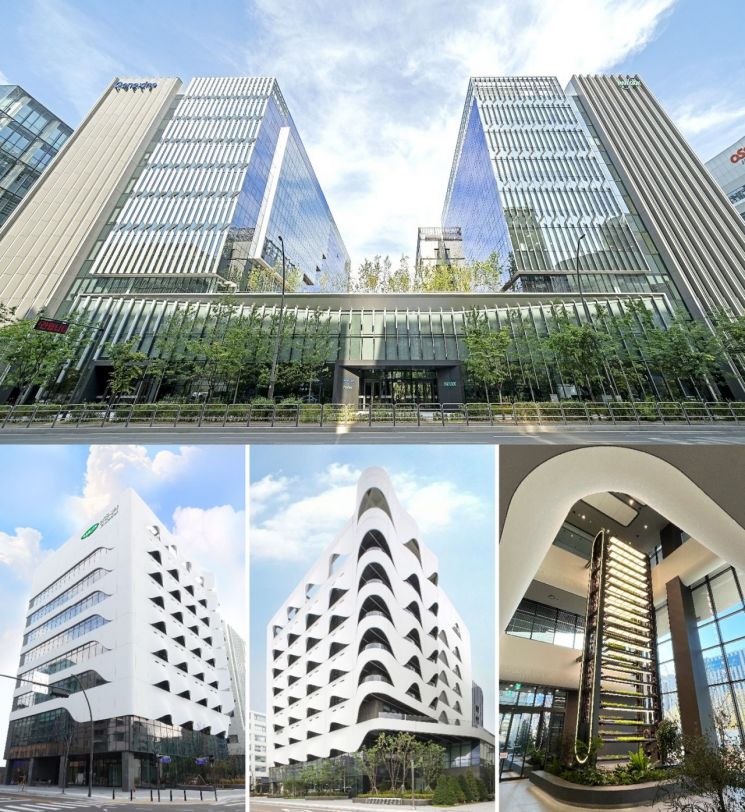 A view of the newly constructed Handok Future Complex and Genexine Progen Bio Innovation Park in Magok as of May this year (above), and the Samjin Pharmaceutical Magok Research Center built at the end of last year (below).
[Asia Economy Reporter Lee Gwan-joo] The major pharmaceutical and bio clusters in South Korea include Songdo in Incheon, Osong in Cheongju, and Pangyo in Seongnam. Songdo is home to global-scale bio companies such as Samsung Biologics and Celltrion, while Osong hosts key institutions including the Ministry of Food and Drug Safety, the Korea Disease Control and Prevention Agency, and the Korea Health Industry Development Institute, along with a concentration of bio-venture factories. Pangyo is fostering growth with numerous bio and healthcare startups led by industry organizations like the Korea Bio Association. Challenging these 'three major clusters' are Magok in Gangseo-gu, Seoul, and Gwacheon in Gyeonggi Province. Both mid-sized pharmaceutical companies and bio ventures are preparing to emerge as new pharmaceutical and bio clusters by relocating not only their research centers but also their headquarters.
Pharmaceutical and Bio Moving Toward Magok and Gwacheon
Magok began to grow with the Seoul Housing and Communities Corporation (SH)'s Magok Urban Development Project in 2007. From the development stage, the goal was to create a high-tech industrial cluster to attract next-generation growth industries, successfully drawing in numerous bio companies.
Within the industry, the move of LG Chem’s Life Sciences Division to Magok LG Science Park at the end of 2017 is considered the starting point. Subsequently, Kolon Life Science built a new headquarters in Magok, moving its headquarters and research center in April 2018. In 2019, SD Bioscience and Helixmith established their bases in Magok. In 2020, Shinshin Pharmaceutical relocated its headquarters and research center, and Ostem Implant also moved its headquarters, integrating about ten research centers into the 'Magok Central Research Center.'
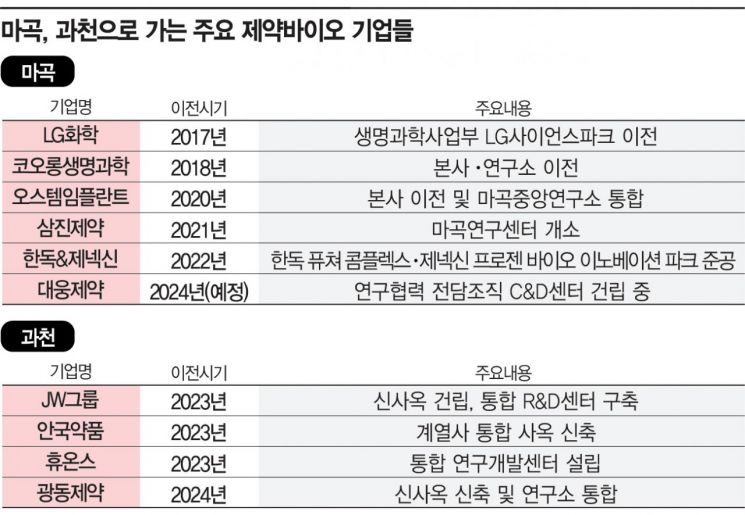
The influx of pharmaceutical and bio companies into Magok has continued. At the end of last year, Samjin Pharmaceutical opened the Magok Research Center, actively conducting research and development of innovative treatments for medical unmet needs such as cancer, fibrotic diseases, ophthalmic diseases, and degenerative brain diseases. Handok and Genexine held a completion ceremony for the 'Handok Future Complex and Genexine Progen Bio Innovation Park' in May this year and have completed moving in. Daewoong Pharmaceutical is currently constructing the Magok C&D Center, aimed for completion in 2024, to serve as a research and development base.
While Magok is rising in Seoul, Gwacheon Knowledge Information Town in Gyeonggi Province, which began full-scale development at the end of 2020, is emerging as a new pharmaceutical and bio cluster. Although development started later than Magok, many mid-sized pharmaceutical companies are already preparing to relocate to Gwacheon. JW Group plans to build a new headquarters and establish an integrated R&D center with a move-in target next year, aiming to merge research centers that were separately operated by each affiliate to create synergy. Anguk Pharmaceutical will also consolidate its affiliates and research facilities through the completion of a new headquarters in July next year. Huons Group plans to relocate its integrated research and development center to Gwacheon next year, and Kwangdong Pharmaceutical is constructing a new building with a completion target of 2024.
Research, Open Innovation, and Location: The Three Key Factors
The industry sees three major factors behind the growth of Magok and Gwacheon as new pharmaceutical and bio clusters. First is the strengthening of research and development (R&D), which is the core of pharmaceutical and bio industry growth. Currently, many pharmaceutical companies have their research centers scattered by region and affiliate due to site issues. Integrating these centers not only increases research personnel but also allows companies to leverage each other's strengths. This is evident as most companies currently located or planning to locate in Magok and Gwacheon are pursuing the establishment of integrated research centers.
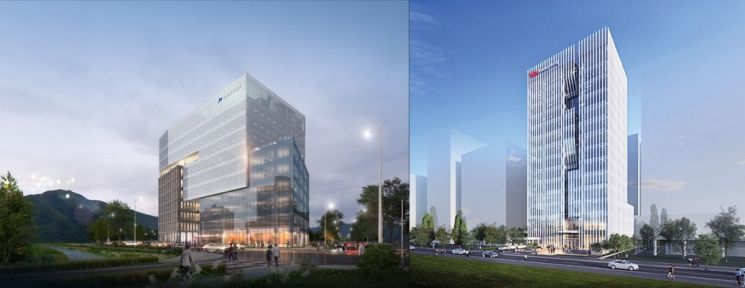 JW Group's new headquarters (left) and Gwangdong Pharmaceutical's new headquarters rendering to be built in Gwacheon Knowledge Information Town.
Along with strengthening R&D, there is the advantage of expanding 'open innovation'?a strategy of open collaboration?that has recently gained attention in the industry. With pharmaceutical companies of a certain scale and bio ventures densely concentrated in one place, collaboration can be more efficient, and connections with startups possessing technological capabilities become easier. The active expansion into new areas such as drug delivery systems, exosomes, microbiomes, digital therapeutics, and digital healthcare beyond new drug development further underscores the need for open innovation.
Lastly, location factors cannot be overlooked. To secure excellent talent, proximity to Seoul is advantageous. Both Magok, located in Seoul, and Gwacheon, situated near Seoul, offer convenient transportation. As these areas are currently under development, their living infrastructure is expected to continue expanding. An industry insider said, "Recently, even Dongtan, Gwanggyo, and Pangyo are considered far from Seoul, making it difficult to secure research personnel despite good conditions. The proximity to Seoul is attractive, and since these areas are being developed as industrial zones, the costs for building new headquarters are relatively lower than in downtown Seoul, which is another reason for choosing Magok and Gwacheon."
© The Asia Business Daily(www.asiae.co.kr). All rights reserved.



















