On the 28th, the Federation of Korean Industries to Hold Expert Meeting on 'Semiconductor, IRA, and US Supply Chain Restructuring Strategies and Korea's Response'
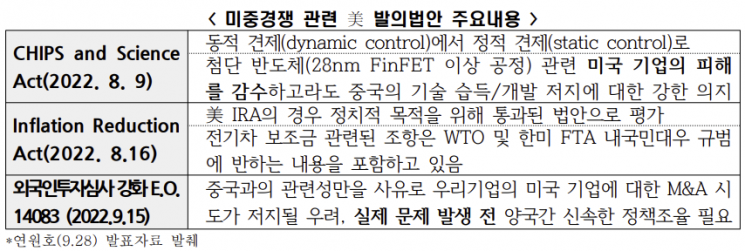
[Asia Economy Reporter Kim Pyeonghwa] There is a claim that the essence of the U.S. supply chain restructuring strategies, such as the Chips and Science Act (CSA) and the Inflation Reduction Act (IRA), lies in securing future advanced industry supremacy. It is advised that for Korea to survive in the science and technology supremacy competition, active negotiations with the U.S., expanding domestic shares within the supply chain, and securing critical minerals are necessary.
The Federation of Korean Industries (FKI) held an expert roundtable on the 28th at the FKI building in Yeouido, Seoul, titled "U.S. Supply Chain Restructuring Strategies such as Semiconductors and IRA and Korea's Response." The event was organized to assess Korea's response direction amid the recent U.S.-led advanced industry competitiveness efforts and global supply chain restructuring.
In his opening remarks, Kwon Tae-shin, Vice Chairman of FKI, said, “Supply chain strategy has now established itself as an important industrial strategy not only for individual companies but also at the national level.” He added, “With U.S. President Biden emphasizing cooperation with allied countries and implementing a new supply chain strategy, our companies are now at a difficult crossroads where they must consider geopolitical factors and international affairs in supply chain management.”
"Securing Advanced Technology Is the Winning Weapon in Diplomatic Warfare"
Yang Hyang-ja, Chairperson of the National Assembly's Special Committee on Semiconductor Industry Competitiveness Enhancement, delivered the keynote speech, stating that we have entered an era where science and technology are diplomacy, security, and defense. She also explained, "In a situation where countries defeated in advanced technology competition could become neo-colonies, Korea faces the mission of becoming a science and technology supremacy nation. To win this war, companies play a crucial role in pioneering technological territories and leading economic and security warfare.” She emphasized that the best negotiation card in diplomatic warfare is securing advanced industrial technology and stressed the urgent need for the passage of the Semiconductor Industry Competitiveness Enhancement Act (K-Chips Act) in the National Assembly for the semiconductor sector.
Regarding the IRA, she proposed three response strategies. One was to cooperate with other countries such as the European Union (EU) and Japan concerning parts of the IRA that violate the National Treatment (NT) clause, which prohibits discrimination between Korean and U.S. companies/products, and the Most Favored Nation (MFN) clause for Korea. She also urged strengthening cooperation with the U.S. Department of State and the U.S. Trade Representative (USTR) to reflect provisions favorable to Korea during the IRA enforcement decree drafting process and to intensify persuasion efforts targeting the U.S. Congress.
In an expert discussion chaired by Choi Seok-young, Advisor at Law Firm Kwangjang and former Ambassador to Geneva, prospects and response directions related to the U.S.-passed laws such as the Chips and Science Act and IRA were discussed. Yeon Won-ho, Head of the Economic Security Team at the Korea Institute for International Economic Policy (KIEP), noted regarding the deepening U.S.-China tensions, “The U.S. is simultaneously pursuing strengthening its own capabilities and international cooperation for economic security. The domestic U.S. prioritization trend is expected to continue through the midterm elections in November this year and until the second half of next year ahead of the 2024 presidential election.” He advised, “Rather than waiting passively, Korea should actively engage in dialogue and negotiations for policy coordination with the U.S.”
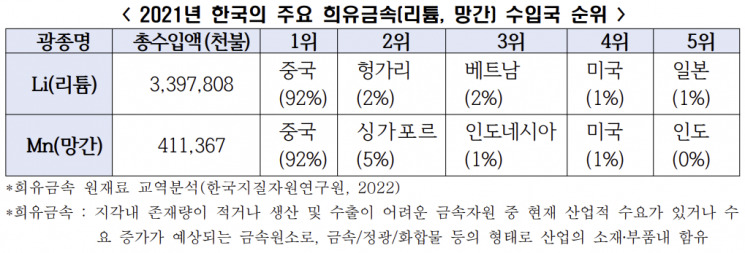
Jo Cheol, Senior Research Fellow at the Korea Institute for Industrial Economics and Trade, predicted that the IRA will inevitably cause short-term difficulties for domestic automakers exporting electric vehicles to the U.S. and will also impact the electric vehicle transition in the long term. Researcher Jo stated, “Efforts such as negotiating exceptions for our exported cars with the U.S. are necessary, but at the same time, measures like accelerating local plant operations are also needed.” He added, “This should be used as an opportunity to expand the role of our companies in the supply chain for batteries, related parts and materials, and minerals.”
There was also an opinion that a national-level strategy is needed to secure the supply chain of critical minerals. Kim Dong-hwan, Director of the International Strategic Resources Institute, said, “New resource nationalism is accelerating even in resource-rich countries like Mexico and Chile, which have FTAs with the U.S., through mining laws and tax laws that restrict foreign investment and impose high tax rates.” He emphasized, “In this environment, building a new supply chain to meet the 80% condition set by the IRA by 2027 is beyond the capabilities of private companies alone. Therefore, the government must quickly restore the resource development ecosystem in the public sector, develop critical minerals, and support private companies' mineral investments.”
© The Asia Business Daily(www.asiae.co.kr). All rights reserved.


















