On the 27th, nominee Jo Gyu-hong apologizes at the confirmation hearing, "Sorry for public doubts"
"As a former Ministry of Economy and Finance official, I can design macro and long-term policies," he also emphasized
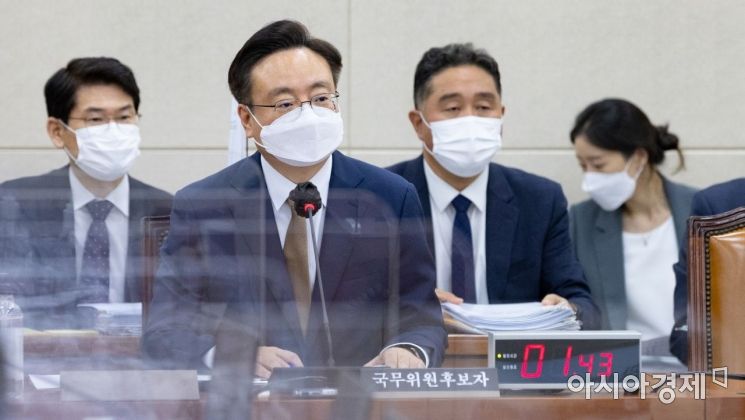 Cho Kyu-hong, nominee for Minister of Health and Welfare, is attending the confirmation hearing held at the National Assembly on the 27th, responding to questions from lawmakers. Photo by Yoon Dong-joo doso7@
[Asia Economy Reporter Jo In-kyung] At the confirmation hearing for Cho Kyu-hong, the nominee for Minister of Health and Welfare held on the 27th, the opposition party continued its attacks regarding the nominee's morality and expertise in the health and welfare sector. Questions focused on whether Cho was suitable for the head of the Ministry of Health and Welfare, citing his past history of receiving a billion-won salary while working at the European Bank for Reconstruction and Development (EBRD), simultaneously receiving a government pension, and being registered as a dependent under his spouse without paying any health insurance premiums.
The National Assembly's Health and Welfare Committee held the confirmation hearing for Cho on the 27th. This came 125 days after the Ministry of Health and Welfare minister position became vacant following the consecutive withdrawals of two nominees, Jeong Ho-young and Kim Seung-hee, under the Yoon Seok-yeol administration.
Kim Won-i, a member of the Democratic Party of Korea, stated at the hearing, "While serving as a director at EBRD, the nominee received a salary of 1.1 billion KRW and simultaneously collected a government pension and was registered as a dependent under his spouse for health insurance, thus not paying any health insurance premiums but still receiving benefits." He added, "If the nominee becomes the Minister of Health and Welfare, there are tasks such as strengthening the financial soundness of health insurance and reforming the national pension, so there is doubt whether he is qualified in the eyes of the public."
After retiring as Deputy Director-General of Fiscal Management at the Ministry of Economy and Finance, Cho worked as a director at EBRD, earning about 300 million KRW annually. Over approximately two years at EBRD, Cho received a total salary of about 1.1 billion KRW, and separately received 114 million KRW in government pension payments.
Shin Hyun-young, also from the Democratic Party, listed these issues and criticized, "The public is in a situation where they have to bear more health insurance premiums, yet the nominee received a billion-won salary, collected government pension without reduction, and did not pay health insurance premiums. How can he gain the trust of the people if he says he will reform the pension system?" Kang Eun-mi of the Justice Party also pointed out, "Many workers who do not even earn minimum wage feel deprived knowing that the nominee received about 40 million KRW annually from the pension despite earning 300 million KRW in salary."
On the other hand, ruling party lawmakers defended Cho, stating that income from the international organization EBRD is tax-exempt and thus exempt from income tax, and that the government pension was paid because the payment period had arrived, so there are no legal or procedural issues. Lee Jong-sung of the People Power Party said, "According to the bank establishment agreement, EBRD income is not subject to taxation, and the nominee has repeatedly confirmed whether he is subject to pension reduction," adding, "Claims that he deliberately evaded income reporting or omitted declarations to receive excessive pension are groundless."
Cho responded, "Although the public may have doubts, I did not break the law," and said, "I will sincerely prepare institutional reform measures." He also apologized, saying, "I express my apologies for causing public suspicion."
Cho's enrollment in Seoul National University’s evening graduate school while serving as a short-term enlisted soldier also came under scrutiny. Jeon Hye-sook of the Democratic Party questioned, "At that time, Article 63 of the Military Service Act stipulated that all conscripts were prohibited from attending schools above high school level, including universities, during their military service period," and asked, "On what grounds did the nominee claim that attending graduate school while serving as a short-term enlisted soldier was legally permissible?"
Previously, the nominee's side rebutted the criticism that the military service period overlapped with graduate school attendance by stating, "According to the Military Service Act and related regulations, there was no clause prohibiting study after working hours for short-term enlisted soldiers." Cho replied, "The Constitutional Court's rulings and my case have different aspects, and since laws have been continuously amended since my service, it is difficult to say whether it was illegal or not."
Choi Jae-hyung of the People Power Party pointed out, "Even if the nominee did not violate specific legal provisions, it must be acknowledged that the form of service was inconsistent with the law's intent," adding, "Military service is a very sensitive issue, and to perform duties as a minister, administration must align with the law's purpose."
The opposition also argued that Cho, coming from an economic ministry prioritizing economic logic, is not suitable for the Minister of Health and Welfare. Kim Min-seok of the Democratic Party expressed concern, saying, "There are too many Ministry of Economy and Finance officials in President Yoon Seok-yeol's first cabinet," and warned, "Losing sight of public interest and the socially vulnerable is the biggest disqualification."
In response to Kang Eun-mi of the Justice Party's question about concerns that "If a Ministry of Economy and Finance official becomes Minister of Health and Welfare, a dark age for welfare might come," Cho said, "I understand such concerns exist, but I believe they are misunderstandings," adding, "Because I am from the Ministry of Economy and Finance, I can design policies from a more macro and long-term perspective." He emphasized, "Even when implementing the same projects, I can save budget and operate more efficiently, and also better secure necessary budgets by utilizing personal networks."
Meanwhile, the hearing was temporarily adjourned 40 minutes after it began due to heated disputes between the ruling and opposition parties over inappropriate remarks made during President Yoon Seok-yeol's visit to the United States. Chairperson Jeong Chun-sook of the Democratic Party declared a recess, and the meeting resumed in the afternoon.
© The Asia Business Daily(www.asiae.co.kr). All rights reserved.

















