Concerns Over Illegal Farmland Use and Landslides at Solar Power Plants
Compliance with Permit Conditions and Safety Management of Solar Facilities Under Construction
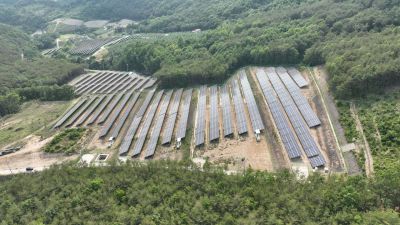
[Asia Economy Reporter Ra Young-cheol] Gangwon Province announced on the 28th that "due to ongoing issues such as the illicit operation of solar power facilities on farmland within the province and concerns over landslides caused by solar power facilities installed on mountainous terrain, we have decided to inspect illegal solar power projects."
Accordingly, they will focus on inspecting cases where agricultural land is used improperly by constructing livestock barns, mushroom cultivation houses, insect breeding facilities, etc., but not actually raising livestock, mushrooms, or insects, thereby abusing current laws to unjustly utilize agricultural land facilities as solar power facilities.
The province plans to order restoration to original conditions if the facilities are left unused or improperly used as warehouses without being used for the permitted purpose, and will also request the renewable energy certificate (REC) issuing agencies to suspend or revoke certificate issuance, which is the profit from solar power generation.
For the 80 solar power generation facilities currently under construction in the province, they plan to inspect the overall construction and safety management appropriateness, especially for solar power facilities utilizing forest land prone to disasters and large-scale construction sites over 10,000 ㎡.
Currently, there are a total of 9,055 permitted solar power plants in Gangwon Province with a capacity of 2,521 MW, and 6,330 plants are in operation with a capacity of 1,459 MW. The non-capacity is equivalent to the size of the Shin-Kori Unit 3 nuclear power plant, and the estimated installation area is about 7.6 million ㎡, which is more than 1,000 soccer fields.
Meanwhile, during the Moon Jae-in administration, there were criticisms that the so-called 'Green New Deal' policy, which installed solar power on large-scale reclaimed land by exploiting the climate crisis, was a 'wrong policy that incites national disasters' such as food shortages and natural landscape destruction.
Due to the amendment of the Farmland Act allowing solar power installation on reclaimed land, many farmers who used to farm on reclaimed land lost their homes and were driven onto the streets.
In 2016, during the Park Geun-hye administration, the area of farmland converted for solar power installation was only 505 hectares. This rapidly increased to 1,437 hectares in 2017 and 3,675 hectares in 2018 during the Moon Jae-in administration.
Furthermore, with the abolition of the building completion date restriction, many illicit buildings for solar power installation sprang up like mushrooms, and in agricultural promotion zones where the permitted purposes were cattle, mushrooms, and insects, barns filled only with solar panels on the roofs appeared in many places.
© The Asia Business Daily(www.asiae.co.kr). All rights reserved.

















