Diesel Vehicle Blind Spots: Delivery Vans, Village Buses, and Garbage Trucks to Switch to Eco-Friendly Vehicles
From 2025, Grade 4 Vehicles Restricted in Green Transport Zones → Expanded Citywide in Seoul by 2030
Thorough Management of Major Fine Dust Sources... Strengthened 'Ozone' Reduction Measures
[Asia Economy Reporter Lim Cheol-young] The Seoul Metropolitan Government is accelerating the phase-out of diesel vehicles with the goal of reducing air pollutants by half by 2030, and is closely managing air pollutants emitted from heating facilities, construction sites, and other sources. Starting with restrictions on Grade 4 vehicles in green transportation zones from 2025, the plan is to expand the restricted areas to cover the entire city of Seoul by 2030. Additionally, emission reduction policies targeting harmful volatile organic compounds (VOCs) for ozone management will also be promoted.
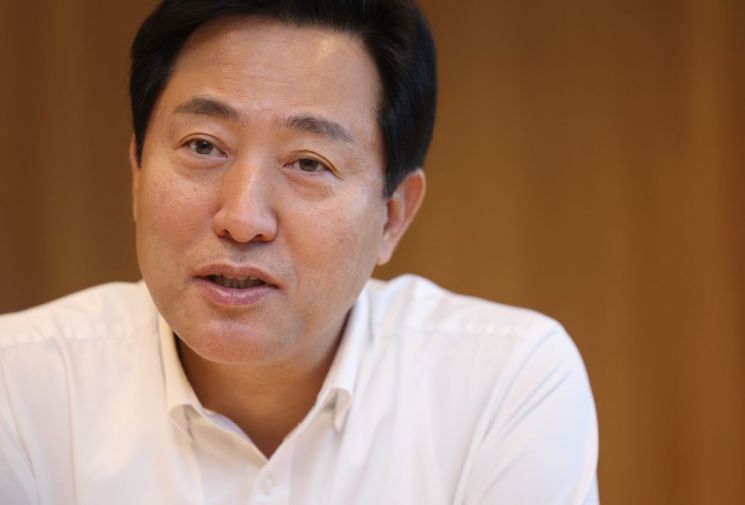
On the 28th, Mayor Oh Se-hoon announced the comprehensive plan "Clearer Seoul 2030," which includes these measures, stating that 3.8 trillion won will be invested by 2030 to reduce air pollutants by half and enter the top 10 globally in air quality. Mayor Oh said, "Through this comprehensive plan 'Clearer Seoul 2030,' we will dramatically improve Seoul's air quality," adding, "The plan is also expected to create 28,000 jobs and generate 8.4 trillion won in production inducement effects."
Seoul has implemented various measures to improve air quality. As a result, the annual average concentration of particulate matter (PM10) in Seoul decreased by 22% from 60㎍/㎥ in 2006 to 47㎍/㎥ in 2011, and the concentration of fine particulate matter (PM2.5) hit record lows consecutively in 2020 and 2021. However, Seoul's annual average PM2.5 concentration was 20㎍/㎥ in 2021, falling short of the national air quality standard of 15㎍/㎥, and remains higher compared to major overseas cities such as Paris, London, and Los Angeles.
Accordingly, Seoul is implementing this comprehensive plan centered on three main directions and 11 key tasks. The three main directions include ▲ rapid transition of diesel vehicles in blind spots to low-emission vehicles ▲ expansion of restricted operation of polluting vehicles throughout Seoul ▲ and ensuring clean air is felt in everyday life.
Transition to eco-friendly vehicles including delivery trucks, village buses, and cleaning vehicles following city buses
Following the 100% transition of city buses to eco-friendly compressed natural gas (CNG) buses, Seoul is accelerating the transition of approximately 45,000 vehicles, including delivery trucks, delivery motorcycles, village buses, and cleaning vehicles, which still remain as blind spots. The plan is to convert 6,100 delivery trucks and 33,400 delivery motorcycles to electric vehicles by 2026, and convert 457 diesel village buses (28% of the total) to electric vehicles. The city plans to support replacement costs of 100 million won per vehicle aligned with the scrapping schedule of village buses, as demand for electric buses from transportation companies is increasing due to recent fuel price hikes.
Diesel cleaning vehicles and diesel buses entering Seoul from other cities and provinces will also be replaced with low-emission vehicles. For 225 road cleaning vehicles, considering that the technology is still in early development, they will be gradually converted to compressed natural gas (CNG) or electric vehicles according to scrapping schedules and development status by vehicle type. From 2030, entry of 2,118 diesel cleaning vehicles into waste treatment facilities will be restricted to promote the transition to low-emission vehicles.
In particular, among 6,321 buses entering Seoul from Gyeonggi and Incheon, 39% (2,438 vehicles) are diesel vehicles, and the goal is to replace all of them with compressed natural gas (CNG) or electric vehicles by 2026 through active cooperation with Gyeonggi and Incheon. Mayor Oh said, "We will continue discussions on prioritizing the introduction of low-emission buses through a tripartite consultative body among Seoul, Gyeonggi, and Incheon, and induce the transition to eco-friendly buses by making eco-friendly bus operation a condition when negotiating new routes entering Seoul," adding, "We will also pursue amendments to the Special Act on Air Quality Improvement in Air Management Zones to establish grounds for restricting the use of diesel buses."
Expansion of operation restrictions and early scrapping support to Grade 4 vehicles... Operation restrictions across Seoul by 2030
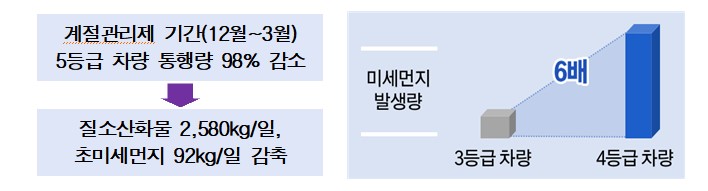
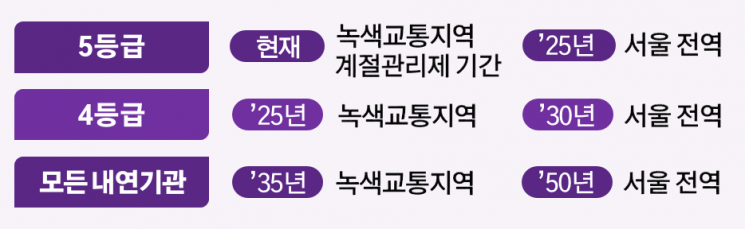
The scope of polluting vehicle operation restrictions and early scrapping support will be expanded from the current Grade 5 vehicles to include Grade 4 vehicles. Seoul plans to phase in the expansion of targets to phase out old polluting vehicles early, aiming to restrict the operation of all internal combustion engine vehicles throughout Seoul by 2050.
Accordingly, Seoul will restrict the operation of Grade 4 vehicles in green transportation zones starting in 2025 and expand this to the entire city by 2030. Currently, operation restrictions apply only to Grade 5 vehicles, with year-round restrictions in green transportation zones and seasonal restrictions (December to March) across Seoul. The city plans to pilot operation restrictions during emergency reduction measures starting in the second half of next year and then prepare detailed implementation plans including target vehicles and specific methods.
Along with the expansion of the operation restriction system, the early scrapping support target will also be expanded from Grade 5 to Grade 4 vehicles. Approximately 510,000 Grade 5 diesel vehicles have completed low-emission measures since 2007, and the remaining 8,000 vehicles will complete these measures by next year. Starting next year, early scrapping support will be provided annually for 10,000 Grade 4 diesel vehicles, totaling 81,139 vehicles, to complete the process by 2030.
Mayor Oh said, "The European Union (EU) announced a ban on sales of internal combustion engine vehicles starting in 2035, and companies like GM and Volkswagen have also announced plans to stop production and sales of internal combustion engine vehicles," adding, "To lead the phase-out of internal combustion engine vehicles, we will restrict the operation of all internal combustion engine vehicles in green transportation zones by 2035 and ban new registrations, and will consult with the Ministry of Land, Infrastructure and Transport to amend the Automobile Management Act to expand this restriction to the entire city by 2050."
Detailed management of fine particulate matter emission sources... Strengthening ozone reduction
Seoul will also closely manage emission sources that release air pollutants in various parts of daily life beyond the transportation sector. The city will thoroughly manage major sources of fine particulate matter in Seoul such as heating, workplaces, fugitive dust, and construction machinery, and strengthen measures to reduce ozone, which has been steadily increasing over the past 20 years, unlike particulate matter.
First, Seoul will expand eco-friendly construction sites. To strengthen management of construction sites that generate fugitive dust, the city will enhance a continuous monitoring system using advanced equipment and expand restrictions on the use of old construction machinery to all construction sites. For large construction sites with a total area of 10,000㎥ or more, an Internet of Things (IoT) monitoring system capable of monitoring fine dust and noise will be installed, and a pilot project will be conducted to introduce a remote sensing system to detect high-concentration fugitive dust areas within a 4-5 km radius and monitor them in real time.
The restriction on the use of old construction machinery will be expanded from large-scale construction sites subject to environmental impact assessments with a total area of 100,000㎡ or more to construction sites of 10,000㎡ or more by 2025, and to construction sites generating fugitive dust of 1,000㎡ or more from 2030. Mayor Oh said, "We will pursue amendments to the Air Environment Conservation Act and promote the realization of early scrapping support funds, currently about 10% of the vehicle price, to reflect used vehicle prices to encourage low-emission conversion."

Seoul will expand air pollution prevention facilities and also take measures to manage ozone. The city plans to replace all 3,932 remaining burners at workplaces with low-NOx burners by 2025. All 3.01 million household boilers will be replaced with eco-friendly boilers by 2030. For small-scale workplaces, which are currently managed only through irregular on-site inspections, IoT monitoring systems will be installed at all 852 workplaces by 2025.
Emission reduction policies targeting harmful volatile organic compounds (VOCs), the main cause of ozone formation, will also be implemented. Support for installing reduction facilities will begin for laundries, printing shops, and other businesses excluded from regulations, and the use of eco-friendly paints will be mandated starting with the public sector. Standards for VOC content in consumer products such as air fresheners will be established. Accordingly, Seoul plans to start a pilot project for installing reduction facilities targeting small printing and laundry businesses within the year and pursue amendments to the Air Environment Conservation Act to expand the scope of legally managed targets.
Expansion of eco-friendly product use... Efforts to improve indoor air quality in subways, daycare centers, and more
Seoul will expand the use of eco-friendly products and take measures to provide comfortable and safe indoor air quality. To lead reductions starting with the public sector, the city will require the use of paints certified with the 'Environmental Label' at public construction sites commissioned by the city and its affiliated organizations, and mandate the use of inks with low VOC content for public publications. To establish reduction measures in homes and commercial sectors, the city will propose to the government the establishment of product-specific VOC content standards for consumer products such as hair sprays and air fresheners.
Furthermore, Seoul will work to improve indoor fine dust concentrations in heavily used and densely populated multi-use facilities such as subways and daycare centers. To reduce fine dust generated during cooking activities like grilling or frying, the installation of reduction devices in large-scale cooking facilities will also be promoted. Mayor Oh said, "We aim to achieve fine particulate matter levels below 30㎍/㎥ in subways by 2030," adding, "For densely populated daycare centers, air quality automatic measuring devices will be installed in 895 legally managed facilities by next year, and installation will be expanded to all 4,762 daycare centers by 2026 for ongoing inspections."
© The Asia Business Daily(www.asiae.co.kr). All rights reserved.
![Clutching a Stolen Dior Bag, Saying "I Hate Being Poor but Real"... The Grotesque Con of a "Human Knockoff" [Slate]](https://cwcontent.asiae.co.kr/asiaresize/183/2026021902243444107_1771435474.jpg)


















