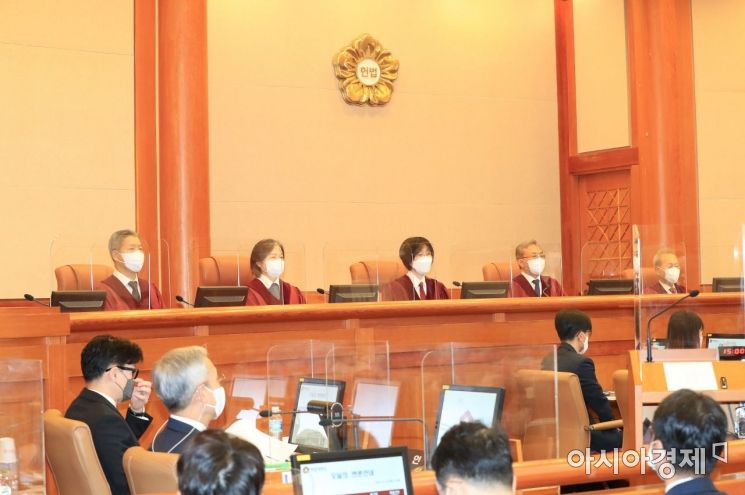
 On the 27th, a public hearing on the constitutional dispute regarding the so-called 'Prosecution Complete Abolition' laws, including the amended Prosecutors' Office Act and Criminal Procedure Act, is being held at the Constitutional Court in Jongno-gu, Seoul. Photo by Kim Hyun-min kimhyun81@
[Asia Economy Reporter Choi Seok-jin, Legal Affairs Specialist] On the 27th, a fierce debate took place between the Ministry of Justice, the petitioner in the constitutional dispute adjudication, and the National Assembly, the respondent, over whether the passage of the so-called 'Geomsu Wanbak' (complete removal of prosecutorial investigative authority) laws?which significantly curtailed prosecutors' investigative powers through amendments to the Prosecutors' Office Act and the Criminal Procedure Act?violated the procedures prescribed by the Constitution and laws, thereby infringing on prosecutors' investigative authority, or whether it was a legitimate exercise of legislative power.
At 2 p.m. that day, during the public hearing of the constitutional dispute adjudication case between the Minister of Justice and the National Assembly held at the Constitutional Court's grand bench in Jaedong, Jongno-gu, Seoul, Minister of Justice Han Dong-hoon appeared as the representative of the petitioner to deliver an opening statement.
Minister Han emphasized, "This legislation is unconstitutional as it was enacted with wrongful intent, through improper procedures, and contains content that harms the people."
He pointed out, "First, this law was created with the 'wrongful intent' of some politicians trying to evade criminal investigations ahead of a regime change. Second, it was enacted through 'improper procedures' such as 'disguised party switching,' 'splitting the session,' and 'inserting amendments unrelated to the original plenary session bill,' making it unconstitutional."
He added, "This law is unconstitutional because it contains 'wrongful content' that damages the constitutional function of the prosecution to protect the people from crime, thereby harming the public."
The key issues in this case include whether prosecutors' investigative and prosecutorial powers are constitutional authorities, whether there were significant procedural defects in the amendment process of the Prosecutors' Office Act and the Criminal Procedure Act, whether the laws passed are invalid if the legislative process was illegal, and whether the Geomsu Wanbak laws infringed on prosecutors' investigative and prosecutorial powers.
The Ministry of Justice argued that based on the constitutional provisions regarding the right to request warrants, prosecutors' investigative and prosecutorial powers are constitutionally recognized authorities, and thus the National Assembly cannot infringe upon their essential aspects through legislation.
Regarding procedural defects in the legislative process, the Ministry of Justice emphasized that the National Assembly violated constitutional principles of majority rule and due process, as well as undermined the purpose of the multiparty system, by neutralizing the agenda adjustment committee through Representative Min Hyeong-bae's 'disguised party switching,' rendering the plenary session's unlimited debate (filibuster) ineffective through 'splitting the session,' and submitting and voting on amendments unrelated to the plenary session's original bill.
They also argued that the amended Prosecutors' Office Act, which drastically reduced the scope of crimes subject to prosecution and prohibited prosecution of crimes once investigation had begun, essentially infringed on the constitutionally granted investigative and prosecutorial powers of prosecutors, rendering it invalid.
Furthermore, they stressed that the amended Criminal Procedure Act's limitation on prosecutors' supplementary investigative authority over police-transferred cases and the removal of the complainant's right to object to police non-prosecution decisions are also unconstitutional measures.
On the other hand, the National Assembly first challenged the standing and capacity of the parties in the constitutional dispute adjudication.
The Constitution mentions 'prosecutors' only in two places: Article 12, Paragraph 3, which states that "when making an arrest, detention, seizure, or search, a warrant issued by a judge upon the prosecutor's request must be presented," and the latter part of Article 16, which states that "when conducting seizure or search of a residence, a warrant issued by a judge upon the prosecutor's request must be presented." In other words, the Constitution does not explicitly stipulate prosecutors' investigative or prosecutorial powers.
Therefore, the National Assembly argued that prosecutors' investigative and prosecutorial powers are not constitutional authorities, and furthermore, prosecutors are not constitutional state organs, so they lack standing in constitutional dispute adjudication.
This argument implies that since there is no explicit constitutional provision regarding prosecutors' investigative or prosecutorial powers, prosecutors cannot be regarded as constitutionally independent bodies nor can their investigative or prosecutorial powers be recognized as constitutionally granted authorities.
In particular, the National Assembly also argued that even if prosecutors' investigative powers are limited, it is difficult to say that the authority of the Minister of Justice, who supervises prosecutors, is directly infringed.
Moreover, the National Assembly emphasized that the amended laws only limit investigative powers, and since the National Assembly has legislative discretion over the subjects and scope of investigations, there is no problem.
The Constitutional Court also stated in an unconstitutionality review case on the Corruption Investigation Office for High-ranking Officials Act earlier last year that "the Constitution does not directly regulate the subjects, methods, or procedures of investigation or prosecution," and that "whether to establish and operate an independent agency not affiliated with existing administrative organizations to carry out investigative and prosecutorial duties, and the scope of investigations and prosecutions by such an agency, should be decided considering all circumstances, including the necessity of establishing an independent agency and the public's interest in enhancing trust in public service. Therefore, the legislature's decision should be respected unless it is clearly arbitrary or grossly unreasonable."
Furthermore, the National Assembly argued that the reduction and adjustment of prosecutors' investigative and prosecutorial powers through this law amendment do not restrict the constitutionally stipulated right to request warrants, so no constitutional issue arises.
In response to these arguments by the National Assembly, Prosecutor Kim Seok-woo of the Ministry of Justice rebutted that since the Minister of Justice oversees and manages prosecutorial affairs and holds the position to exercise investigative and prosecutorial powers over general and specific cases, the minister's investigative and prosecutorial powers are also infringed.
Former Constitutional Court Justice Kang Il-won, representing the National Assembly, said, "The respondent side argues this because historically the Minister of Justice did not exercise the given powers, but this is a claim contrary to the law. The previous administration exercised investigative directive powers several times, causing controversy, but legally, all were considered lawful exercises of legal authority."
He added, "The minister has investigative directive authority over prosecutors, and if prosecutors' investigative powers are infringed, naturally the minister's investigative powers are also directly or indirectly infringed."
After the arguments from both sides, the justices took turns asking questions on various issues.
Attorney Noh Hee-beom, representing the National Assembly, responded to a justice's question about the extent of procedural violations or authority infringements required to file a constitutional dispute adjudication by saying, "In the past, the Constitutional Court added the requirement of 'serious legal violation' based on the principle and spirit of proportionality even in impeachment cases. If asked about the standard, I think proportionality review should also be conducted in constitutional dispute adjudication cases."
The Ministry of Justice countered, "The purpose of the amended law itself is improper and unconstitutional," arguing that "in terms of purpose, means, and public interest proportionality, it does not comply with the principle of proportionality."
During the Q&A, there was also a debate about the status of prosecutors under the Constitution.
The Ministry of Justice argued that although the Constitution does not explicitly stipulate prosecutors' investigative powers, it clearly regulates the right to request warrants based on investigative authority, and the Constitutional Court has previously described prosecutors as "representatives of public interest and human rights defenders" or "legal experts," so transferring prosecutorial investigative powers to the police contradicts the Constitution's intent.
Regarding the amendment separating investigative prosecutors and prosecuting prosecutors, they said, "It is unacceptable to distinguish between the reporter and the journalist writing the article, or between the judge conducting the trial and the judge delivering the verdict. Of course, the prosecutor requesting a warrant and the investigating prosecutor do not have to be the same person, but granting warrant request authority to a prosecutor who did not conduct the investigation is nonsensical."
In response to a justice's question, "Must the person in charge of investigation always be a prosecutor?" the Ministry of Justice replied, "Investigation without consideration of prosecution, and not premised on trial, is no different from civilian surveillance."
Conversely, the National Assembly rebutted the Ministry of Justice's use of the term "person in charge of investigation," stating, "The term 'person in charge of investigation' does not exist in the Constitution or the Criminal Procedure Act. It is a term used by the petitioners and is a concept we do not agree with."
During the Q&A, one justice humorously asked the Ministry of Justice, "I will ask an easy question after many difficult ones. You wrote 'jeongeon songchi juui' (전건송치주의). Is the 'jeon' character 前 (former) or 全 (whole)?"
The Ministry of Justice answered, "It is the character for 'whole' (全)." The justice then remarked, "Then why did you write the former character (前)?" which drew laughter from the audience.
The Ministry of Justice admitted, "There was a fatal error," and the justice concluded, "Okay, we will consider it corrected."
Another justice asked about Article 61, Paragraph 2 of the Constitutional Court Act, which stipulates that "a petition under Paragraph 1 may only be filed if the respondent's disposition or omission infringes or poses a clear risk of infringing the petitioner's authority granted by the Constitution or law," questioning whether this conflicts with the respondent's claim that prosecutors lack standing in constitutional dispute adjudication.
Attorney Noh from the National Assembly responded, "This is a somewhat peculiar part, but the infringement of legal authority is not interpreted as infringement by law. It is hard to assume that authority created by law is infringed by law."
He added, "Even if prosecutors' investigative and prosecutorial powers are legally established, when these are reduced or adjusted through law amendments, it is unlikely to fall under Article 61, Paragraph 2 of the Constitutional Court Act, so they lack standing."
Attorney Noh acknowledged that the Constitutional Court Act allows challenges to infringement of legal authority but stated, "However, legislative authority cannot be infringed by legislative amendments, though it can be infringed by other state organs."
He continued, "For example, when the authority of local governments or regulated parties is infringed by the president's or minister's disposition or order, it is naturally subject to constitutional dispute adjudication. If interpreted otherwise, it would deny legislative authority itself and result in the Constitutional Court judging the propriety of legislation."
The National Assembly's position is that procedural defects in the legislative process can only infringe the authority of internal National Assembly bodies, while external bodies outside the National Assembly can have their substantive authority infringed by the content of enacted laws themselves.
One justice attracted attention by distributing a prepared list of questions to both parties and continuing to ask questions as if conducting an interrogation.
In the latter part of the public hearing, Professor Lee In-ho of Chung-Ang University Law School and Professor Lee Hwang-hee of Sungkyunkwan University Law School appeared as expert witnesses for the Ministry of Justice and the National Assembly, respectively, and gave their opinions.
Professor Lee In-ho stated, "This case is an incident where a crucial part of representative democracy malfunctioned," emphasizing, "It is a failure of politics and the political process, and an important failure that cannot be entrusted to the self-purification ability of the legislature."
He said, "Democracy is not the tyranny of the majority. There are two things the majority cannot dispose of: one is the inviolable human rights guaranteed by Article 10 of the Constitution, and the other is the rules of fair play. In this case, the rules of fair play were violated."
Professor Lee Hwang-hee cited past constitutional dispute adjudication cases where procedural defects in the National Assembly's legislative process were at issue, arguing, "Procedural defects cannot affect the validity of enacted laws."
Currently, following the expert testimonies, the final statements from both the Ministry of Justice and the National Assembly are ongoing.
Meanwhile, prior to the Ministry of Justice, the People Power Party's constitutional dispute adjudication and injunction application cases are also under review by the Constitutional Court. The Court views the infringement of prosecutors' investigative powers as the core issue of this case and decided to hold a public hearing on the Ministry of Justice's petition, but it is highly likely that the final rulings on both cases will be delivered simultaneously.
© The Asia Business Daily(www.asiae.co.kr). All rights reserved.
![Clutching a Stolen Dior Bag, Saying "I Hate Being Poor but Real"... The Grotesque Con of a "Human Knockoff" [Slate]](https://cwcontent.asiae.co.kr/asiaresize/183/2026021902243444107_1771435474.jpg)
















