Astronomy Institute Confirms Dust After Asteroid Collision
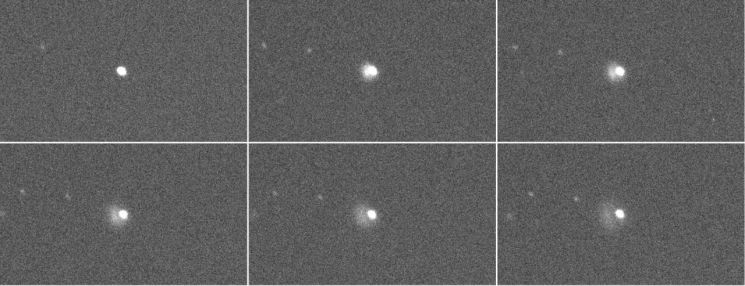 Video captured by the Korea Astronomy and Space Science Institute using a celestial telescope belonging to the Space Object Electronic Optical Surveillance Network before and after the DART spacecraft collision. Number 1 shows the asteroid Dimorphos just before the collision, and numbers 2 to 6 show the dust being ejected immediately after the collision.
[Asia Economy Reporter Kim Bong-su] South Korea's astronomical telescope vividly captured the scenes of NASA's (National Aeronautics and Space Administration) Double Asteroid Redirection Test (DART) conducted on the afternoon of the 26th (Eastern Time, USA).
The Korea Astronomy and Space Science Institute announced that on the same day, its 0.5m aperture astronomical telescope, OWL-Net No. 3, installed at the Wise Observatory in Mitzpe Ramon, Israel, captured the moment when the DART spacecraft collided with the Dimorphos asteroid, located 11 million km away from Earth. The video released by the institute clearly shows a dust plume erupting from the surface of the Dimorphos asteroid immediately after the collision.
DART is humanity's first planetary defense experiment, where NASA physically impacts an asteroid to test whether and how much its orbit can be altered. The collision with Dimorphos, a satellite of Didymos near Jupiter, was successful around 7:14 PM (Korean time, 8:14 AM on the 27th).
The institute explained, "DART aims to secure technology to artificially collide a kinetic impactor with an asteroid, while also investigating detailed data such as the target body's mass, composition, and internal structure, thereby establishing foundational technology to prepare for emergency situations where an asteroid might collide with Earth."
Additionally, the institute plans to investigate the orbital changes of Dimorphos using its own astronomical telescopes. Since the DART spacecraft itself directly collides with the asteroid, it is impossible to observe changes after the collision directly. The Italian Space Agency's (ASI) cubesat LICIACube, which was carried onboard and released just before impact, will observe the collision scene. However, since LICIACube will pass by Dimorphos shortly after filming the collision from slightly behind the DART spacecraft, it will be difficult to observe Dimorphos after the collision.
Therefore, NASA is monitoring Didymos using ground-based telescopes worldwide, the Hubble Space Telescope, and the James Webb Space Telescope to observe various phenomena caused by the collision and confirm changes in Dimorphos's orbit.
The institute is investigating Dimorphos's orbital changes using the 1.8m telescope at Bohyunsan Optical Astronomy Observatory, the 1.0m telescope at Lemon Mountain Observatory, the 0.6m telescope at Sobaeksan Astronomy Observatory, and the 0.5m telescopes of the Optical Wide-field patroL Network (OWL-Net).
The institute stated, "For about two weeks after the collision, it will be difficult to calculate orbital changes using ground-based telescopes due to dust emissions, so intensive observations will be conducted afterward."
© The Asia Business Daily(www.asiae.co.kr). All rights reserved.
![From Hostess to Organ Seller to High Society... The Grotesque Scam of a "Human Counterfeit" Shaking the Korean Psyche [Slate]](https://cwcontent.asiae.co.kr/asiaresize/183/2026021902243444107_1771435474.jpg)
















