Three Major Anomalies Including Non-Disclosure of Private Contracts Reach 3494 Complex
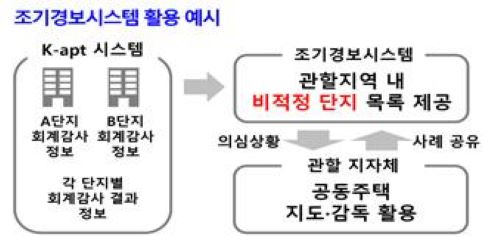
[Asia Economy Reporter Cha Wanyong] The Busan A complex did not charge maintenance-related costs such as repair and maintenance fees and litigation costs such as attorney fees as management fees, but handled them through a temporary account. The early warning system detected accounting audit anomalies in this complex, selected it for a special audit, and implemented guidance and supervision.
On the 27th, the Ministry of Land, Infrastructure and Transport announced that it detected apartment complexes suspected of management corruption through this early warning system for apartment management corruption and referred them to local governments.
The early warning system is a system that allows proactive and preventive guidance and supervision based on signs of abnormalities in apartment complexes. It is operated by the Korea Real Estate Board under delegation from the Ministry of Land, Infrastructure and Transport, and can query and manage detailed information such as management fees, bidding details, and accounting audit results of apartment complexes within the jurisdiction of local governments.
A total of 31 abnormality data items are provided on an ongoing basis, and a function to share guidance and supervision cases with other local governments is also established by registering local government-specific surveys (audits), major detected cases, and action status.
The main abnormalities confirmed through the operation of the early warning system are ▲ frequent changes of the management office director ▲ non-disclosure of private contract results ▲ non-disclosure of competitive bidding results.
As of September 2022, complexes that have changed their management office director three or more times within the last two years account for 269 complexes, which is 1.5% of the 17,918 complexes nationwide registered in K-apt. Complexes with frequent changes of management office directors may have internal problems such as excessive complaints or conflicts with the residents' representative meetings.
2,990 complexes, accounting for 16.7% of complexes nationwide, have no history of disclosing results of selecting contractors through private contracts in the past year. This can be interpreted as a sign of neglect in managing small management fee expenditures or avoidance of disclosing contract counterparts due to anticipated disputes with residents.
223 complexes, accounting for 1.2% of complexes nationwide, have no history of disclosing results of selecting contractors through competitive bidding in the past year. This raises suspicion of selecting contractors without using K-apt (Apartment Management Information System) or separating contracts for the purpose of private contracts.
These complexes can be immediately identified through the early warning system. Local governments can conduct audits on apartment complexes, issue orders if necessary for supervision, and impose fines if there are violations of apartment housing laws.
Kang Taeseok, Director of the Housing Construction Supply Division at the Ministry of Land, Infrastructure and Transport, said, "We will shift to an active and systematic guidance and supervision management system through the early warning system, secure consistency in guidance and supervision through case sharing among local governments," and added, "Together with the Korea Real Estate Board, the operating agency, we will continue to promote stable operation and advancement following the establishment of the early warning system to foster a sound management culture in apartment complexes."
© The Asia Business Daily(www.asiae.co.kr). All rights reserved.
![Clutching a Stolen Dior Bag, Saying "I Hate Being Poor but Real"... The Grotesque Con of a "Human Knockoff" [Slate]](https://cwcontent.asiae.co.kr/asiaresize/183/2026021902243444107_1771435474.jpg)
















