Democratic Party Discussion on Change and Innovation: National Assembly Operation Reform Plan
Despite National Assembly Act Provisions, Assembly Operates with Terms Like 'However' and 'Despite'
Negotiation Instead of Fixed Framework
Jo Eung-cheon: "We Must Create a Working National Assembly Through a Working National Assembly Act"
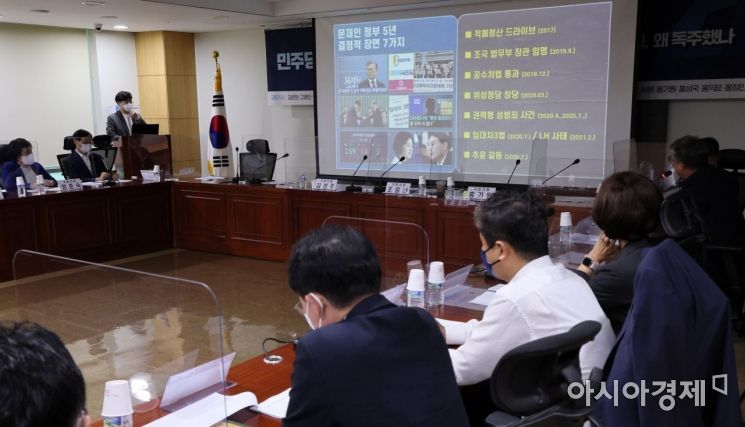 On the 26th, Cho Eung-cheon, a member of the Democratic Party of Korea, attended the "Democratic Party Reflection and Innovation Continuous Forum" held at the National Assembly and presented on the topic "Reflection and Lessons from Five and a Half Years of Democratic Party Governance." Photo by Yoon Dong-joo doso7@
[Asia Economy Reporter Naju-seok] "Our National Assembly operates with a structure where only three people?the Speaker of the National Assembly and the floor leaders of the two major parties?are enough."
On the 27th, Rep. Cho Eung-cheon of the Democratic Party of Korea pointed this out during a discussion titled ‘Change and Innovation’ held at the National Assembly, in a presentation on ‘Reforming National Assembly Operations for a Democratic Parliament.’ As a solution, he said the Democratic Party should once again push for the ‘Working National Assembly Act’ that was promoted in the first year of the 21st National Assembly.
Rep. Cho said, "The reason why the National Assembly is problematic today is because of the words ‘however’ and ‘notwithstanding’ in the National Assembly Act," explaining that "due to the provision stating ‘however, it can be otherwise by consultation among the representatives (floor leaders) of the negotiating groups,’ the National Assembly Act has become a law that is practically meaningless." He finds the reason why the National Assembly is turning into a ‘fighting assembly’ rather than a ‘working assembly’?with tedious disputes starting from scheduling between the ruling and opposition parties?in the National Assembly Act, which regulates consultations between floor leaders. He explained that everything from bill processing to holding meetings is regulated by ‘consultation’ between the ruling and opposition parties.
In fact, while the National Assembly Act sets regulations on various procedural matters, it recognizes the discretion of floor leaders or party whips through the proviso clauses following ‘however,’ which has turned the operation of the National Assembly into a battlefield rather than work. According to Rep. Cho, the word ‘however’ appears 117 times in the 169 articles of the National Assembly Act.
Because proviso clauses like ‘however’ that imply exceptions are applied extensively, it is common for these provisos to become the general rule rather than the regulations themselves. For example, the current ‘Act on the Inspection and Investigation of State Affairs’ stipulates that the audit should be conducted before the regular session, not after. However, since the law was introduced, the audit has been conducted without exception during the regular session since 2012. This has been possible due to the provision stating ‘however, the audit can be conducted during the regular session by resolution of the plenary session.’
Rep. Cho’s solution is the ‘Working National Assembly Act’ promoted by the Democratic Party in 2020. This law was emphasized by then floor leader Kim Tae-nyeon of the Democratic Party in 2020, who said, "The first bill to pass the National Assembly should be the ‘Working National Assembly Act.’" Kim, the former floor leader, also argued that "the abnormal past practice where the ruling and opposition parties tug-of-war over meeting dates and fail to secure proper deliberation time must be cut off and improved to fit the times."
In fact, this law included provisions to abolish the Legislative and Judiciary Committee’s systematic and comprehensive review authority, which had caused numerous controversies, and to operate the National Assembly on a standing basis. For example, the National Assembly would be in session during all periods of the year except for some summer and winter periods, and the 1st day of every month would be fixed as the convening date for extraordinary sessions, eliminating the need for conflicts between the ruling and opposition parties over convening extraordinary sessions. Additionally, plenary sessions, standing committees, and bill subcommittees would have fixed meeting days to prevent disputes over convening standing committees. The law also included provisions such as first-in-first-out bill review, establishing multiple bill subcommittees to allow lawmakers to devote more effort to bill review. Furthermore, to prevent standing committees from not being properly convened, attendance records would be disclosed, and there would be regulations allowing the replacement of committee chairs or members for unfaithful committees. The law also included provisions related to majority vote procedures and the election of the Speaker’s panel.
During the discussion, there was agreement on the necessity of the Working National Assembly Act, and suggestions were made for communication channels involving lawmakers, promoting meetings between ruling and opposition parties, and proposing general meetings of lawmakers.
© The Asia Business Daily(www.asiae.co.kr). All rights reserved.

















