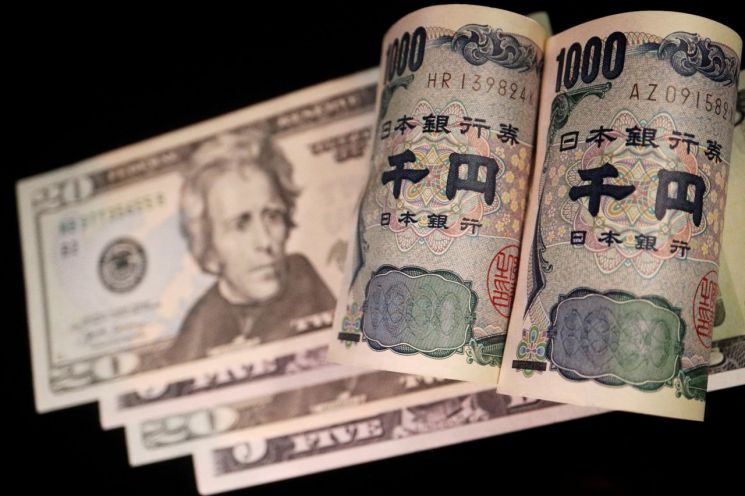
[Asia Economy Reporter Jeong Hyunjin] The Bank of Japan (BOJ) and the Japanese government reportedly sold dollars to buy yen amounting to approximately 3 trillion yen (about 29.7 trillion KRW) on the 22nd in response to the yen's depreciation, according to a report by Nihon Keizai Shimbun on the 27th.
Nihon Keizai estimated the amount through analysis by foreign exchange market participants. According to the BOJ's forecast of current account balances announced the previous day for the 27th, the decrease in current account balances due to "fiscal and other factors" reflecting foreign exchange intervention was 3.6 trillion yen. Based on estimates from short-term financial companies, if there had been no foreign exchange market intervention, the expected decrease would have been up to 700 billion yen. Considering this, the scale of foreign exchange intervention is estimated to be between 2.9 trillion and 3.6 trillion yen.
This appears to be the largest single-day amount of foreign exchange market intervention by the BOJ and the Japanese government through yen purchases. Previously, the largest single-day amount of market intervention by yen purchases was 2.6201 trillion yen on April 10, 1998.
The Ministry of Finance plans to officially announce the scale of yen purchases made on the 22nd later, but Nihon Keizai stated that it is highly likely to be the largest ever, surpassing 1998. Nihon Keizai added, "There is a limit to the funds available for market intervention through yen purchases, so the scale of intervention is an important factor to consider in future developments."
Among Japan's foreign currency reserves, the funds that authorities can immediately deploy for foreign exchange intervention are approximately 136.1 billion USD (as of the end of August), deposited with the Bank for International Settlements (BIS) and other central banks. Converted into yen, this amounts to about 19.7 trillion yen. Reflecting the 3 trillion yen intervention, the Japanese foreign exchange authorities have used about 15% of their cash "ammunition."
Despite such intervention by the foreign exchange authorities, the value of the Japanese yen continues to decline. On the 22nd, the exchange rate briefly surged to 145.90 yen per dollar but fell back to the 140 yen range on the same day due to the intervention. However, on the morning of that day, the dollar-yen exchange rate rose again to around 144 yen per dollar. Nihon Keizai pointed out, "There are many voices questioning the sustainability of the effect of the BOJ's market intervention through yen purchases while maintaining large-scale monetary easing policies."
At a press conference held by BOJ Governor Haruhiko Kuroda in Osaka City the previous day, many questions focused on whether foreign exchange market intervention by buying yen conflicts with monetary easing. Governor Kuroda responded that monetary easing is aimed at supporting economic recovery, so "the purpose and effect are different." He added, "When combined, it creates a more appropriate situation, which is a policy mix. They are complementary and I do not think they are contradictory or have different directions," according to Asahi Shimbun.
© The Asia Business Daily(www.asiae.co.kr). All rights reserved.
![Clutching a Stolen Dior Bag, Saying "I Hate Being Poor but Real"... The Grotesque Con of a "Human Knockoff" [Slate]](https://cwcontent.asiae.co.kr/asiaresize/183/2026021902243444107_1771435474.jpg)
















