[Asia Economy Reporters Lee Ji-eun and Geum Bo-ryeong] The People Power Party has proposed a TV debate to the Democratic Party of Korea regarding the amendment to the Rice Purchase Obligation Act. As the opposition party pushes for the passage of the Grain Management Act amendment containing the purchase obligation, the ruling party has counterattacked by proposing a public debate. This appears to be a strategy to pressure the Democratic Party through public opinion. The Democratic Party reaffirmed its determination to pass the bill, stating that if the Grain Management Act is not amended and legislated, the collapse of rice prices will recur.
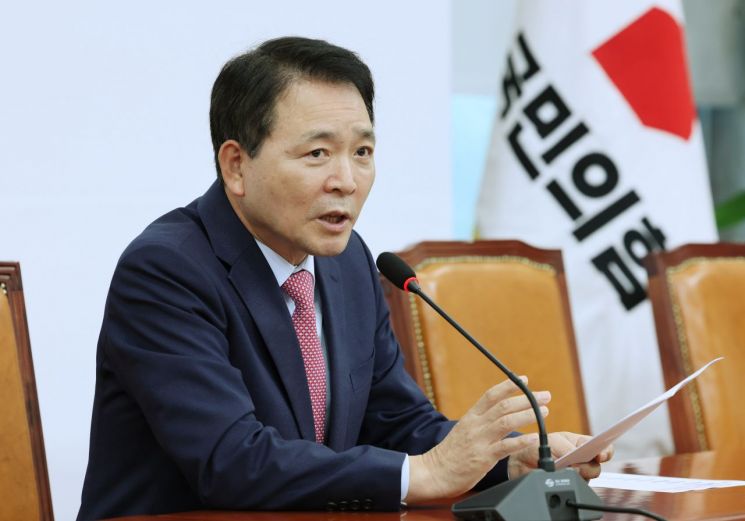
On the 27th, Seong Il-jong, chairman of the People Power Party's Policy Committee, requested a bipartisan TV debate on the Grain Management Act amendment during a pre-inspection meeting for the National Assembly audit held at the National Assembly main building. He said, "Let's debate which party seriously approaches the lives of farmers and the people," and criticized, "Despite taking the largest-ever rice purchase measure of 450,000 tons, the Democratic Party is trying to unilaterally submit and forcibly pass the amendment. If they truly care about farmers, why didn't they pass the Grain Management Act during the Moon Jae-in administration?"
The People Power Party's request for a TV debate is primarily based on the judgment that public opinion will favor the fiscal input required by the rice purchase obligation. The government and ruling party estimated that more than 1 trillion won was spent on purchasing 450,000 tons, but if purchases become mandatory, fiscal expenditures will snowball. There is also concern that farmers will become overly dependent on rice farming.
Chairman Seong emphasized, "Do people live by eating only rice? Can the state compulsorily isolate all surplus agricultural products such as radishes, cabbage, garlic, and ginger?" He added, "We must guarantee a proper livelihood for farmers by adjusting supply and demand through minimal market intervention."
Additionally, the limitations of the agenda coordination committee, which was initiated the day before, also played a role in blocking the amendment. The agenda coordination committee is a body established to deliberate on issues with disagreements between the ruling and opposition parties. It is formed upon the request of at least one-third of the committee members and can discuss for up to 90 days. While it can delay discussions on specific bills, if two-thirds of the six coordinators approve, the bill can pass. In the National Assembly's Agriculture, Food, Rural Affairs, Oceans and Fisheries Committee agenda coordination committee discussing the Grain Management Act, independent lawmaker Yoon Mi-hyang, assigned as a member from a minor non-negotiating party, along with three Democratic Party members, can easily meet the quorum for approval.
The Democratic Party urged the ruling party to make a decision promptly, emphasizing the need for swift passage. An opposition lawmaker from the National Assembly Agriculture, Food, Rural Affairs, Oceans and Fisheries Committee stated in a statement that day, "The government and ruling party have brought no alternatives for stabilizing rice prices through the amendment of the Grain Management Act," and countered, "The 450,000-ton isolation measure is only a temporary fix for the unprecedented collapse of rice prices." They further demanded, "Stop the delay tactics of bill processing through the agenda coordination committee immediately."
© The Asia Business Daily(www.asiae.co.kr). All rights reserved.

















