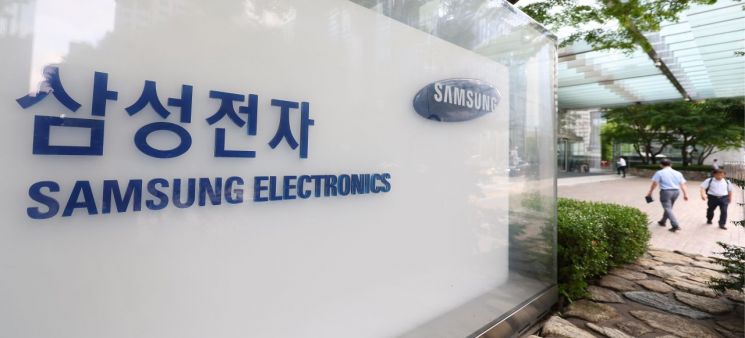
[Asia Economy Reporter Kwon Jae-hee] Even the 'national stock' Samsung Electronics could not escape the impact of the domestic stock market collapse. With the stock price falling to the 53,000 KRW range, concerns are rising that the '40,000 KRW Samsung Electronics' might be imminent. It is analyzed that global inflation concerns leading to weak semiconductor demand and the won-dollar exchange rate are affecting foreign investors' supply and demand, pulling down the stock price.
According to the Korea Exchange on the 27th, as of 9:27 AM, Samsung Electronics was trading at 53,600 KRW, down 0.56% from the previous trading day. This is the 52-week low recorded during the trading session the previous day. Samsung Electronics' 52-week low had continued for four consecutive days until yesterday, and if it falls below 53,600 KRW today, it will set another 52-week low.
Samsung Electronics' stock price has dropped about 8% since the beginning of this month. At the start of the month, Samsung Electronics was in the 58,000 KRW range, but except for one day (September 1), foreign investors have been net sellers for 15 consecutive trading days. During this period, foreign investors net sold Samsung Electronics shares worth 1.6327 trillion KRW, while individuals net bought shares worth 2.1243 trillion KRW.
With the won-dollar exchange rate surpassing 1,400 KRW, foreign investors' selling pressure has continued, and the rapid decline in semiconductor demand due to inflation is analyzed to be pulling down the stock price.
Accordingly, the securities industry is lowering its expectations for Samsung Electronics. IBK Investment & Securities lowered its target price from 88,000 KRW to 70,000 KRW, and DB Financial Investment lowered it from 87,000 KRW to 83,000 KRW. In addition, Eugene Investment & Securities (83,000 KRW → 75,000 KRW) and Hyundai Motor Securities (82,500 KRW → 78,000 KRW) also consecutively lowered their target prices for Samsung Electronics.
Kim Woon-ho, a researcher at IBK Investment & Securities, analyzed, "The decline in the average selling price (ASP) of semiconductors is larger than expected, and the growth rate of memory semiconductors is also expected to be negative. The fact that customers are not responding despite price drops due to weak demand, and that the demand slump is spreading from servers to mobile, are also concerning factors."
As Samsung Electronics, the largest market cap company, sets new lows day after day, there are also concerned voices about individual investors who see this as a buying opportunity.
Son Joo-seop, a researcher at Cape Investment & Securities, stated, "Due to concerns about economic recession, decreased IT demand, increased inventory, and continued downward revisions of earnings estimates, it is difficult for the stock price to turn to a sustained upward trend. Since the stock market is likely to continue high volatility and downward pressure for the time being, I recommend constructing a defensive portfolio."
© The Asia Business Daily(www.asiae.co.kr). All rights reserved.

















