Historic Low for British Pound Against Dollar
Weakness in Asian Currencies Including Won, Yuan, and Yen
Foreign Exchange Market 'Turbulence' as Expectations for Korea-US Currency Swap Fade
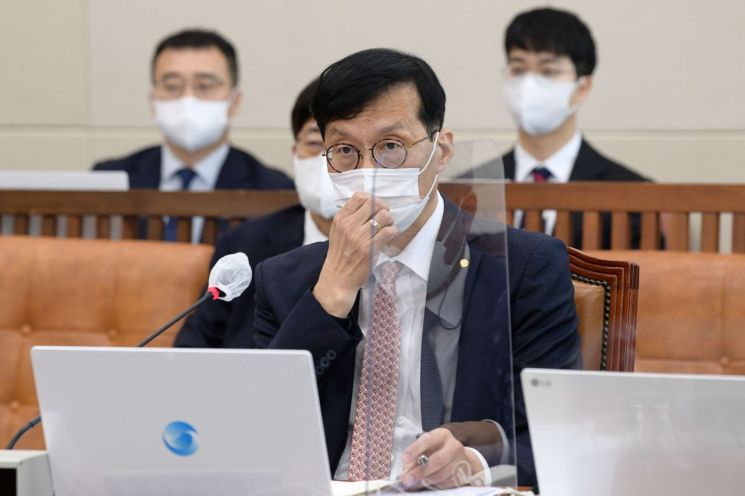
[Asia Economy Reporter Seo So-jeong] "Theoretically, there is no need for a currency swap at the moment. If the prerequisites are not met and we ask for a swap, it could actually have adverse effects." (Lee Chang-yong, Governor of the Bank of Korea)
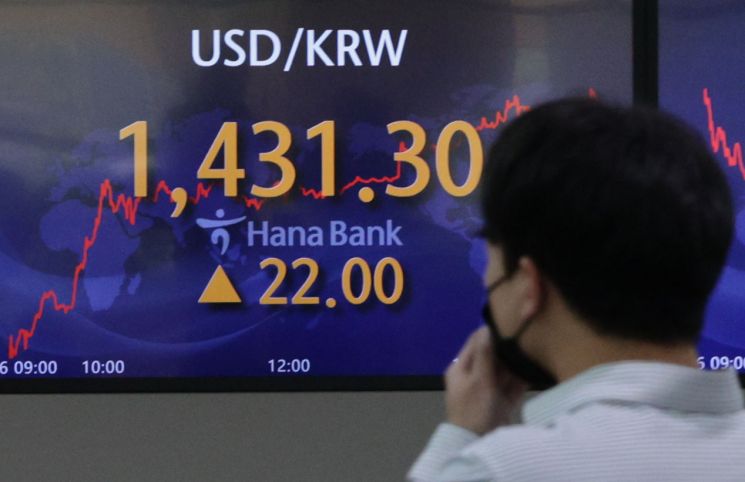
On the 26th, the won-dollar exchange rate, which started at 1,419.0 won, up 9.7 won from the previous trading day in the foreign exchange market, surged to 1,435.4 won at 3:17 p.m., quickly surpassing the 1,430 won level. The daily fluctuation was as much as 26.1 won.
The sharp rebound in the exchange rate that day was due to the possibility of an additional giant step (a 0.75 percentage point increase in the base interest rate) by the U.S. Federal Reserve (Fed), combined with the pound's sharp decline in the UK, as well as remarks by Governor Lee Chang-yong, who appeared at the National Assembly's Planning and Finance Committee plenary session.
Governor Lee said in response to questions from ruling and opposition lawmakers regarding the Korea-U.S. currency swap agreement, "The U.S. Fed has internal criteria for currency swaps," adding, "Swaps are discussed when there is a liquidity shortage in the global dollar market, and during the last two Korea-U.S. currency swaps, the agreement was not made only with our country but simultaneously with nine countries." He emphasized, "Theoretically, there is no need for a currency swap right now. However, since the public is very anxious, it would be good to secure a swap."
Regarding the controversy over the government's submissive stance, he actively rebutted, saying, "The currency swap is discussed when the prerequisites are met. If we ask for a swap when the prerequisites are not met, it could create adverse effects as if our country has a problem, and that stance itself could be seen as submissive." However, Governor Lee added, "As Fed Chair Jerome Powell mentioned, I can say that there is information exchange (with the Bank of Korea)," and "If market conditions arise to activate the swap, information will be exchanged, and related channels are already established."
In response to a question from Lee Soo-jin, a member of the Democratic Party of Korea, about measures to defend the exchange rate before the Korea-U.S. currency swap agreement, Governor Lee replied, "The situations in 1997, 2008, and now are different, so if we can solve the problem this time without a U.S. currency swap, it will be a good lesson," adding, "Currency swaps will be discussed internationally when the time comes, and for now, overcoming the crisis on our own is the best solution." Effectively, Governor Lee suggested that the likelihood of a short-term Korea-U.S. currency swap agreement is slim and that there are no special cards for the foreign exchange market, which rapidly spread anxiety in the market.
Moon Hong-cheol, a researcher at DB Financial Investment, said, "Last week, due to the UK government's large-scale tax cut plan, the pound hit an all-time low, and with the depreciation of Asian currencies such as the yen and yuan, there was significant volatility. In a situation where there are no factors supporting the won's strength, Governor Lee's remarks extinguished expectations for a Korea-U.S. currency swap, causing the exchange rate to surge," adding, "The authorities' awareness and response are insufficient to reassure the market." Researcher Moon also said, "Since major currencies other than the U.S. dollar are depreciating in a panic, joint action is necessary," and "The 1,450 won level, which was considered the upper limit in the market, is likely to be broken soon."
Professor Kim Jin-il of Korea University’s Department of Economics said, "In the absence of a card to calm the exchange rate, Governor Lee's usual frank speaking style rather poured fuel on the fire in the market," adding, "With high inflation around 5% expected to continue until the first half of next year, a big step is anticipated next month, and economic growth is expected to be revised downward at the Monetary Policy Committee meeting next month, so market volatility will increase further for the time being."
© The Asia Business Daily(www.asiae.co.kr). All rights reserved.
![Clutching a Stolen Dior Bag, Saying "I Hate Being Poor but Real"... The Grotesque Con of a "Human Knockoff" [Slate]](https://cwcontent.asiae.co.kr/asiaresize/183/2026021902243444107_1771435474.jpg)












