[Asia Economy Yeongnam Reporting Headquarters, Reporter Hwang Doo-yeol] A technology that cleanly removes infectious disease agents such as viruses from a patient's blood has been developed. It is also possible to remove variants like coronaviruses from the blood.
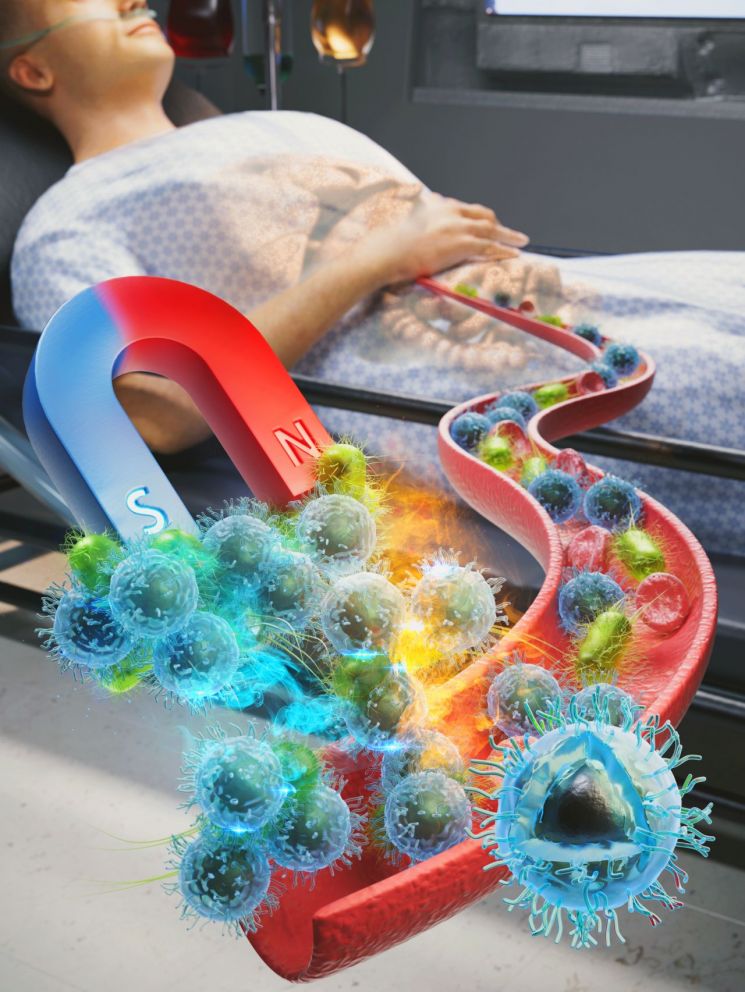
Professor Kang Joo-heon’s team from the Department of Biomedical Engineering at UNIST developed ‘blood cell membrane-coated magnetic nanoparticles’ by wrapping the surface of magnetic nanoparticles with blood cell membranes.
When these particles react with the patient's blood circulating outside the body, they capture pathogens such as bacteria or viruses and can then be retrieved using a magnet.
Red blood cells and white blood cells have the characteristic of capturing pathogens to protect the human body, and this characteristic was utilized to create ‘functional magnetic nanoparticles.’
The developed ‘blood purification technology using blood cell membrane-coated magnetic nanoparticles’ is expected to have a significant therapeutic effect when used alongside treatment for sepsis or secondary bacterial infections in intensive care unit patients.
In particular, as cases of secondary antibiotic-resistant bacterial infections in intensive care units are increasing, this technology can greatly assist in the treatment and management of critically ill patients hospitalized due to COVID-19 and other conditions.
Excessive immune responses such as sepsis and cytokine storm can lead to death.
Although antibiotics, antivirals, and vaccines have been developed to counter these, it is difficult to cope with the emergence of superbugs, side effects of antibiotics, and new pathogens like COVID-19.
 Researchers who participated in the study (from left): Research Professor Kwon Se-yong, Researcher Lee Min-seok, Researcher Park Sung-jin.
Professor Kang Joo-heon’s team stated that the developed treatment is ‘effective and versatile’ because it removes pathogens from the blood using the characteristics of blood cell membranes and magnetic nanoparticles.
Blood cell membrane-coated magnetic nanoparticles circulate outside the body in the patient’s blood, capturing pathogens and then being extracted with a magnet to remove them from the body, making it applicable to anyone and any pathogen.
The research team quantitatively demonstrated that multidrug-resistant bacteria and viruses, the main causes of infectious diseases, are captured by substances derived from red and white blood cell membranes coated on the surface of magnetic nanoparticles, and that interaction with opsonins in the blood enhances pathogen removal effects.
In experiments using mice, the treatment effect was also proven for methicillin-resistant Staphylococcus aureus (MRSA) and carbapenem-resistant Escherichia coli, which are known to be difficult to treat with existing antibiotics.
Mice infected with bacteria all survived after undergoing the newly developed blood purification treatment. Furthermore, their immune systems returned to normal one week after treatment.
Seongjin Park, the first author and a researcher in the Department of Biomedical Engineering at UNIST, explained, “We used blood cells present in the body, and the magnetic nanoparticles that captured pathogens are completely removed from the blood,” adding, “This minimizes treatment side effects and allows treatment without immune rejection.”
When continuous blood purification treatment was performed on infected experimental mice, the concentration of pathogenic microorganisms that had invaded the lungs and kidneys due to bacterial infection also decreased.
Se-yong Kwon, co-first author and research professor in the Department of Biomedical Engineering at UNIST, expressed hope, saying, “Continuous blood purification treatment will also help treat organ failure caused by pathogenic infections.”

Professor Kang Joo-heon, the principal investigator, said, “This technology mimics the innate immune response of our body to collectively remove many types of infectious agents without prior diagnosis,” and added, “We plan to develop it as a next-generation infectious disease treatment technology that can quickly respond to future antibiotic-resistant bacterial infections and new infectious disease outbreaks.”
The research involved Minseok Lee, Bonghwan Jang, and Axel E. Guzm?n-Cedillo from the Department of Biomedical Engineering at UNIST.
The research was supported by the Samsung Electronics Future Technology Development Center and UNIST.
The research results were published online on September 7 in the world-renowned academic journal Small, published by Wiley, and are forthcoming in print.

© The Asia Business Daily(www.asiae.co.kr). All rights reserved.
![A Woman Who Jumps Holding a Stolen Dior Bag... The Mind-Shaking, Bizarre Con of a "Human Knockoff" [Slate]](https://cwcontent.asiae.co.kr/asiaresize/183/2026021902243444107_1771435474.jpg)


















