Ramen Industry Sees Price Increase Wave After One Year
High Exchange Rates and Raw Material Cost Rise Are Main Causes
High Proportion of Imported Ingredients... "Decline Not Reflected"
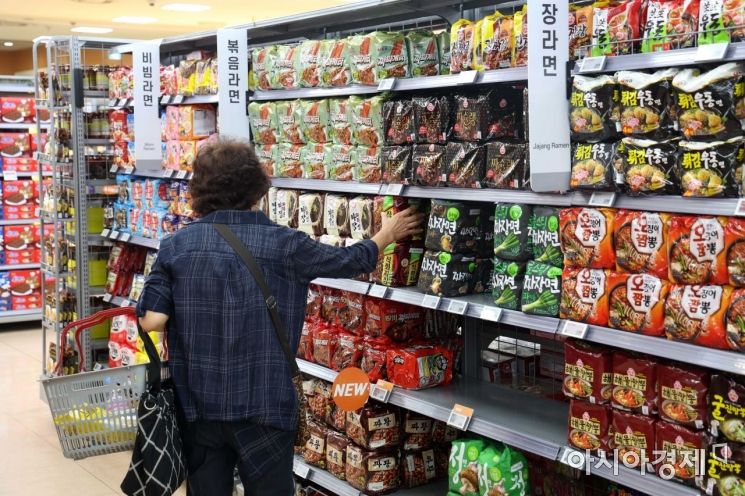
[Asia Economy Reporter Song Seung-yoon] The recent price hikes in the ramen industry are primarily attributed to the global rise in raw material and logistics costs since early this year, coupled with the increase in the won-dollar exchange rate.
According to industry sources on the 27th, the main raw materials used in ramen production last year were wheat flour, palm oil, and potato starch, in that order. The proportion of domestically sourced raw materials accounts for only 3.5% of the total. Due to the high proportion of imported raw materials, dependence on imports is also high.
In the case of wheat flour, it is common to import wheat from overseas, process it into flour domestically, and then use it for ramen production. Most of it comes from the United States and Australia, but due to global demand exceeding supply, prices have been steadily rising. Since the COVID-19 pandemic, disruptions in international supply chains and logistics, along with poor harvests caused by abnormal weather such as heatwaves and droughts, have also had an impact. International wheat prices rose to $450 per ton in May this year due to the Russia-Ukraine war but fell somewhat to $320.71 in July. Currently, prices are around $290, recovering to normal levels.
However, food companies usually purchase raw materials 6 months to a year in advance, so the impact of such price drops is limited. The international grain prices that peaked in the second quarter are reflected in import prices in the third quarter. This explains why prices continue to rise despite the drop in wheat prices compared to the first half of the year. Palm oil is also entirely imported, with Malaysia and Indonesia each accounting for 50%. Previously, palm oil prices surged due to production disruptions caused by COVID-19 in Indonesia and export suspension measures. Potato starch prices are also rising due to increased demand.
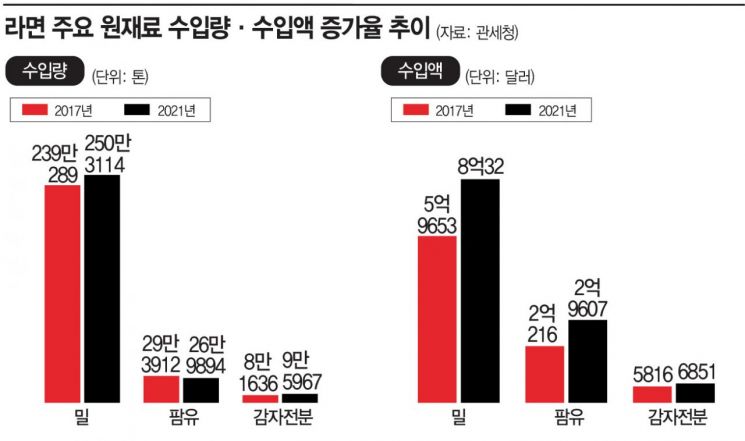
For these reasons, the rate of increase in import value is rising faster than the increase in import volume in major countries. According to the Korea Customs Service, wheat imports last year were 2,503,114 tons, a 4.7% increase from 2,390,289 tons in 2017. However, during the same period, import value rose by 34.2%, from $596.53 million to $803.2 million.
Palm oil imports decreased by 8.2%, from 293,912 tons in 2017 to 269,894 tons last year, but import value increased by 46%, from $202.16 million to $296.07 million.
Potato starch imports increased by 17.6%, from 81,636 tons in 2017 to 95,967 tons last year, while import value rose by 17.8%, from $58.16 million to $68.51 million.
Additionally, the prolonged rise in the exchange rate has fueled ramen price increases. As of the 26th, the won-dollar exchange rate surpassed 1,420 won for the first time in 13 years. Given the high dependence on imported raw materials, the burden of purchasing costs inevitably increases significantly under a high exchange rate environment.
An industry official said, "Ramen is a staple food for the common people and holds symbolic meaning, so a price increase within a year is an unusual situation," but added, "It means that companies have reached a level where they can no longer absorb the rising costs."
© The Asia Business Daily(www.asiae.co.kr). All rights reserved.
![From Hostess to Organ Seller to High Society... The Grotesque Scam of a "Human Counterfeit" Shaking the Korean Psyche [Slate]](https://cwcontent.asiae.co.kr/asiaresize/183/2026021902243444107_1771435474.jpg)

















