Assemblyman Kim Won-i: "Increased Inconvenience for Residents in Medically Underserved Areas"
Need to Promote Regional Doctor System and Public Medical Schools
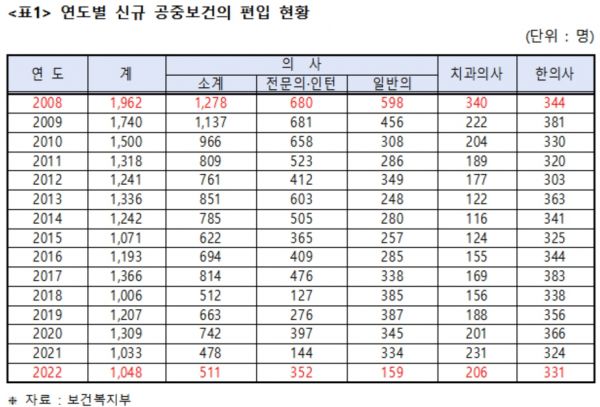
The number of public health doctors, who mainly work in medically underserved areas, continues to decline, causing increased inconvenience for residents. It has been pointed out that this is because the introduction of graduate medical schools has led to a large influx of students who have completed military service, resulting in an absolute decrease in medical conscription targets.
According to data submitted by the Ministry of Health and Welfare to Kim Won-i, a member of the Health and Welfare Committee of the National Assembly from the Democratic Party of Korea, the number of newly enlisted public health doctors per year decreased by 46.6%, from 1,962 in 2008 to 1,048 in 2022.
The number of public health doctors excluding dentists and Korean medicine doctors dropped by more than half (60%), from 1,278 in 2008 to 511 this year.
Public health doctors serve as an alternative to military service by working at city or county health centers, with a service period of 36 months. The increase in military service completers due to the introduction of graduate medical schools and the rise in female medical students have contributed to this decline.
In particular, the number of personnel centrally assigned to treatment detention centers, correctional facilities, and the Korea Disease Control and Prevention Agency increased by 29.4% (35 people), from 119 in 2018 to 154 this year. In contrast, the number of personnel assigned to cities and provinces nationwide decreased by 5.3% (182 people), from 3,417 to 3,235 during the same period. The region with the largest decrease in public health doctors was Gyeonggi-do, which saw a 10.2% (27 people) reduction compared to five years ago.
The decrease in public health doctors has caused a serious gap in local public healthcare, but the lack of appropriate legislation to address this is an even bigger problem.
Currently, bills such as the 'Regional Doctor System,' which mandates 10 years of compulsory service in specific areas like medically underserved regions, and the 'Establishment of Public Medical Schools' to train doctors specifically for public medical institutions, have been halted due to opposition from the medical community.
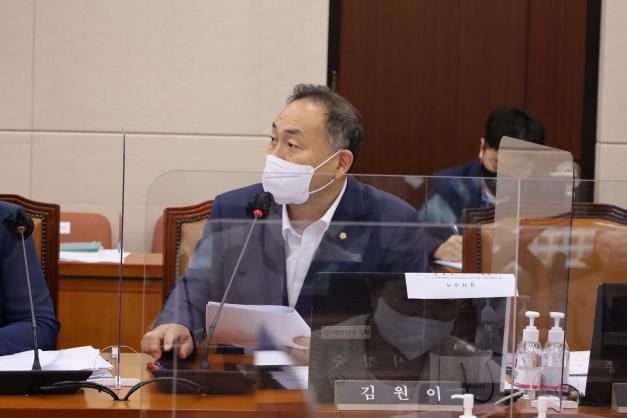
Rep. Kim said, "The people most affected by the shortage of public health doctors are residents of medically underserved local areas, yet the Ministry of Health and Welfare has been inactive regarding this foreseeable issue." He added, "We must devise proactive measures to resolve medical imbalances, such as expanding public healthcare through the Regional Doctor System and establishing public medical schools."
© The Asia Business Daily(www.asiae.co.kr). All rights reserved.


















