Consumer Prices Maintain High Increase of 5-6% for Extended Period
Won-Dollar Exchange Rate Surpasses 1420 Won
Continued Exchange Rate Rise Exerts Inflationary Pressure
Baby Step May Trigger Capital Outflow
Government Indirectly Urges Big Step Restraint Amid Household Debt and Domestic Economy Concerns
[Asia Economy Reporter Seo So-jeong] The won-dollar exchange rate has surpassed the 1,420 won mark for the first time in 13 years and 6 months, raising concerns that domestic inflationary pressures could intensify further. The Bank of Korea (BOK) is repeatedly deliberating over whether to implement an additional big step hike as the value of the won has plummeted helplessly amid fears of aggressive tightening by the U.S. Federal Reserve. While voices calling for a larger interest rate hike are growing due to the expectation that high inflation above 5% will continue for some time, concerns remain about the heavy interest burden on borrowers if a big step is taken.
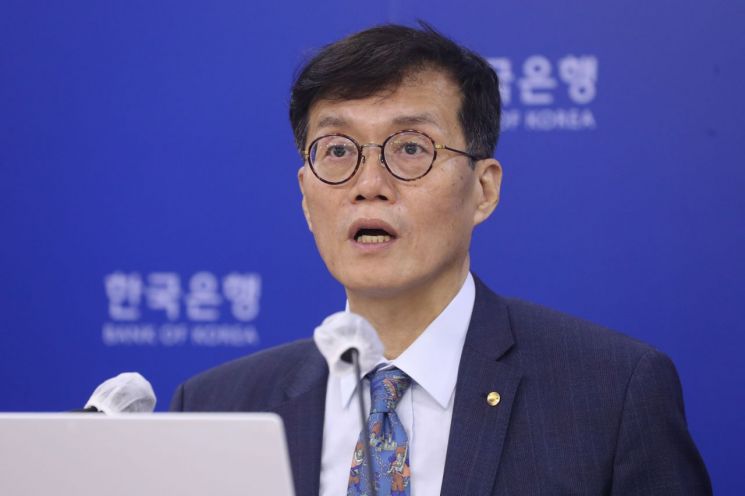
On the 26th, BOK Governor Lee Chang-yong appeared before the National Assembly’s Planning and Finance Committee for a full session to report on current issues, expressing concern that "consumer prices are expected to continue rising sharply at 5-6% for a considerable period, and if the exchange rate remains at a high level, it could act as an additional inflationary pressure." Earlier, on the 22nd, Governor Lee hinted at the possibility of a big step by stating that "the preconditions for a 0.25 percentage point base rate hike have changed significantly."
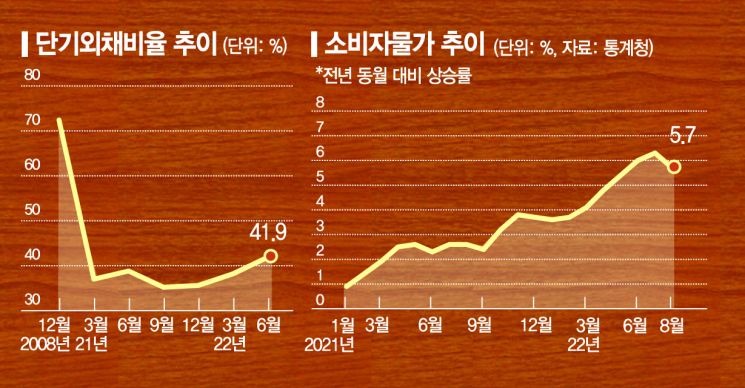
Recently, the consumer price inflation rate has somewhat eased due to a drop in international oil prices but still remains at a high level well above 5%. Agricultural product prices have surged sharply due to heavy rains and typhoons, and food prices are soaring due to a domino effect of price increases in the food industry. Personal service prices have maintained a high rise of around 6% for a considerable period, expanding upward pressure on core inflation (excluding food and energy).
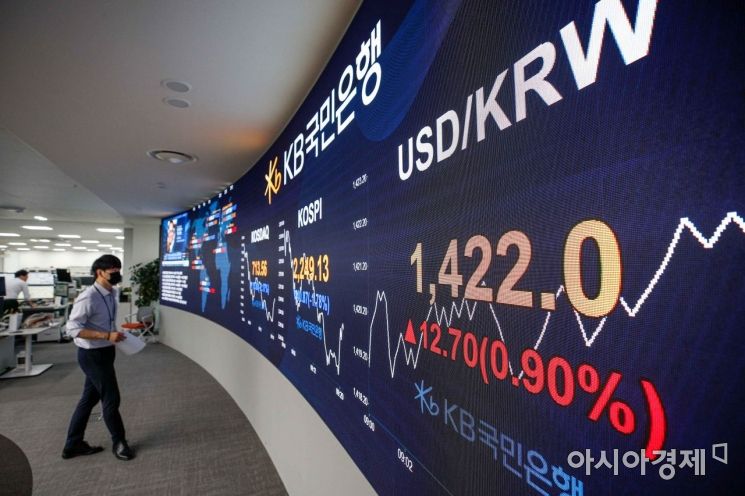 On the 26th, when the won-dollar exchange rate surpassed 1,420 won for the first time in about 13 years and 6 months, dealers were working in the dealing room of KB Kookmin Bank in Yeouido, Seoul. On the same day, the KOSPI index opened at 2,260.80, down 29.20 points (1.28%) from the previous trading day, continuing its downward trend. Photo by Jinhyung Kang aymsdream@
In particular, the recently soaring exchange rate is adding to the already high domestic inflation burden. The won-dollar exchange rate broke through the psychological resistance level of 1,400 won on the 22nd due to the Fed’s tightening, the Russia-Ukraine war causing a strong U.S. dollar, and the weakening of Chinese and Japanese currencies, and then easily surpassed the 1,420 won level on this day. The BOK explained, "The demand for overseas investment has increased, with Korean residents’ direct overseas investment reaching $42.67 billion from January to July this year, influencing the rise in the exchange rate." During the same period, the National Pension Service’s overseas securities investment reached $38.82 billion (based on the balance of payments), contributing to the exchange rate rise. In response, the BOK and the National Pension Service agreed on the 23rd to conduct a $10 billion foreign exchange swap transaction, but the exchange rate shows no signs of calming down. Professor Kim Jeong-sik, Emeritus Professor at Yonsei University, diagnosed, "The rapidly rising exchange rate leads to increased costs for companies and higher import prices. The won’s depreciation will strengthen inflationary pressures from rising import prices, adversely affecting the overall economy."
According to the BOK, every 1% increase in the won-dollar exchange rate raises the inflation rate by 0.06 percentage points, and the rise in expected inflation pulls prices up again with a lag of 3 to 4 quarters. The BOK pointed out, "During the recovery from the COVID-19 crisis, supply bottlenecks and overall inflationary trends overlapped, strengthening companies’ tendency to pass on prices compared to past low-inflation periods. As the pass-through rate of exchange rates to prices increases, attention should be paid to the impact of future exchange rate rises on domestic inflationary pressures."
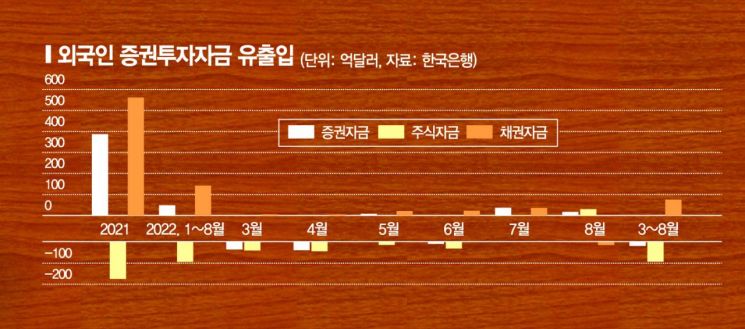
If the BOK responds only with baby steps (0.25 percentage point hikes) until the end of the year, there is concern that foreign capital outflows will accelerate due to the interest rate gap between Korea and the U.S. Since the Fed’s rate hikes in March, foreign securities investment funds have recorded a net outflow of $1.77 billion, mainly from stocks. Although bond funds have mostly continued net inflows, the scale of inflows has significantly shrunk compared to last year, resulting in a net outflow of $1.31 billion last month.
The short-term external debt ratio has also risen to its highest level in 10 years since 2012. As of the second quarter of this year, the short-term external debt ratio was 41.9%, the highest in 10 years since the second quarter of 2012 (45.5%). The short-term external debt ratio had risen to the 70% range during the 2008 global financial crisis. A high short-term external debt ratio means overseas investment funds can quickly exit, potentially damaging the overall economy.
However, the government is indirectly requesting restraint on big steps. Deputy Prime Minister and Minister of Economy and Finance Choo Kyung-ho said the day before, "If the interest rate gap between the U.S. and Korea widens, it could act as a source of instability in the foreign exchange and financial markets," adding, "Rapidly following rate hikes could cause serious problems for the domestic economy and household debt, making it difficult for many borrowers to bear the interest burden." According to the BOK’s household credit (debt) statistics, household loans totaled 1,757.9 trillion won as of the end of June this year.
On the same day, Governor Lee emphasized, "Regarding the future inflation path, there are mixed risks: upside risks from geopolitical risks and abnormal weather related to international raw material prices, and downside risks from a global economic recession," adding, "If the won-dollar exchange rate deviates excessively from our economy’s fundamentals and the movements of major currencies, intensifying polarization, we will actively implement market stabilization measures."
Park Seok-gil, Head of JP Morgan’s Financial Market Operations Department, commented, "If the September Consumer Price Index (CPI) falls short of expectations or if the nominal effective exchange rate’s depreciation trend suddenly stabilizes, the BOK may maintain the existing 0.25 percentage point hike policy, but currently, this is unlikely," forecasting, "The BOK will raise the base rate by 0.50 percentage points at next month’s Monetary Policy Committee meeting to prevent an excessively large policy rate gap with the U.S."
© The Asia Business Daily(www.asiae.co.kr). All rights reserved.



















