Seobu Power's Pyeongtaek Power Headquarters... Korea's Oldest Thermal Power Plant
Fuel Switched to LNG in 2020... Reduced Fine Dust by 84%
Planning Leap to Hydrogen Economy Frontline... Pursuing 50% Co-firing Demonstration
Utilizing Existing Thermal Power Infrastructure... Easing Financial Burden
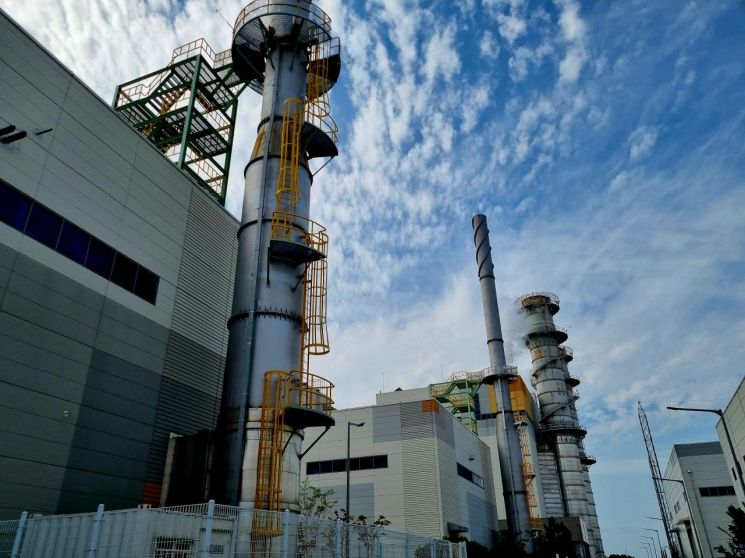 Korea Western Power Pyeongtaek 2 Combined Cycle Power Plant located in Pyeongtaek, Gyeonggi.
 Photo by Lee Jun-hyung
[Asia Economy Pyeongtaek=Reporter Lee Junhyung] Korea Western Power Pyeongtaek Power Plant Headquarters, located in Pyeongtaek, Gyeonggi Province. Operating since 1980, this facility is considered the oldest thermal power plant in South Korea. It supplies an average of 4602 GWh of electricity annually to approximately 900,000 households in Seoul and Gyeonggi, and over the past 42 years, it has been recognized as a key player in the metropolitan area’s power grid. In 2020, the plant converted the fuel for its four 350MW steam power units from heavy oil to liquefied natural gas (LNG), reducing fine dust emissions by nearly 84%. The annual reduction in fine dust is about 1.2 million tons, equivalent to removing 100,000 passenger cars from the roads.
Since last year, the Pyeongtaek Power Plant Headquarters has been attempting another 'eco-friendly transformation.' The plan is to position the Pyeongtaek Power Plant as the forefront of the hydrogen economy, which is central to achieving carbon neutrality by 2050. Accordingly, Western Power has partnered with Hanwha Impact to conduct a demonstration project on hydrogen co-firing since March last year. The goal is to develop power generation equipment capable of more than 50% hydrogen co-firing by early 2023, utilizing an 80MW gas turbine from the Pyeongtaek 1 Combined Cycle Power Plant, which ceased operation in 2017 due to end of service life. If Western Power succeeds in this demonstration, it will possess world-class hydrogen co-firing gas turbine technology.
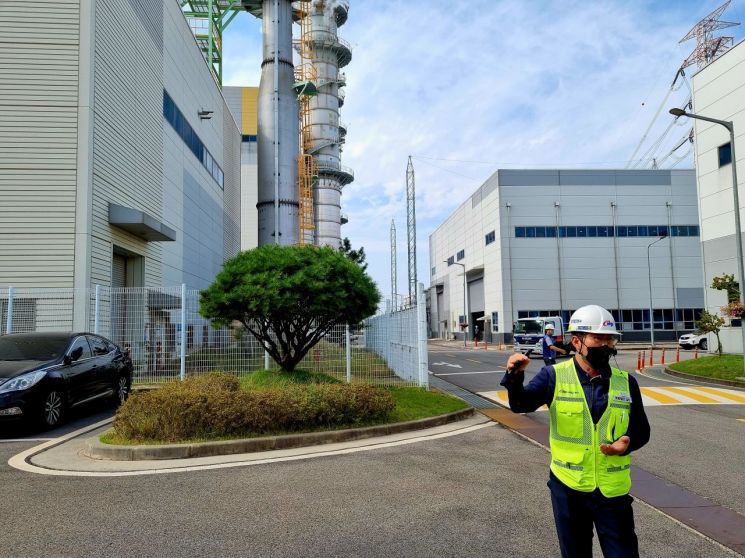 A representative from Korea Western Power is explaining about the Pyeongtaek 2 Combined Cycle Power Plant.
 [Photo by Lee Jun-hyung]
Gas Turbine 'Exit Strategy'
The greenhouse gas reduction effect of hydrogen co-firing is significant. According to Western Power, increasing the hydrogen co-firing rate in LNG gas turbines to 10% can reduce carbon dioxide (CO2) emissions by 10%. The gas turbines targeted by Western Power with a 50% hydrogen co-firing rate emit 21% less CO2 compared to existing power generation facilities. Western Power expects that once hydrogen co-firing is fully implemented, CO2 emissions from existing combined cycle power plants can be reduced from 389g per kWh to as low as 233g per kWh, a decrease of 156g.
The advantages of hydrogen co-firing do not end there. Western Power is accelerating the development of hydrogen co-firing technology to establish an exit strategy for gas turbines. To achieve carbon neutrality by 2050 and reduce greenhouse gas emissions to zero, LNG-based gas turbines will effectively be phased out. A Western Power official explained, “To prevent thermal power infrastructure from becoming stranded assets, greenhouse gas emissions must be reduced through hydrogen co-firing,” adding, “By utilizing existing facilities as they are, financial burdens from large-scale investments such as site acquisition can also be alleviated.”
This is why major countries are focusing not only on hydrogen co-firing but also on ammonia co-firing technology development. Like hydrogen, increasing the co-firing ratio of ammonia reduces greenhouse gas emissions. For example, co-firing 20% ammonia at Western Power’s 2100MW Taean Thermal Power Plant Units 1 and 2 can reduce annual CO2 emissions by approximately 2.2 million tons. Japan has already developed gas turbines capable of co-firing up to 20% ammonia and is conducting demonstrations at the 1000MW Hekinan coal power plant located in Aichi Prefecture.
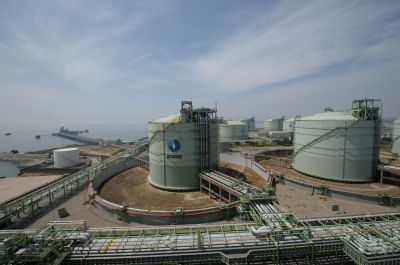 A view of the Korea Gas Corporation Pyeongtaek Liquefied Natural Gas (LNG) terminal located in Pyeongtaek, Gyeonggi Province. [Photo by Korea Gas Corporation]
Hydrogen Infrastructure is Key
The key issue is the hydrogen supply infrastructure. Ammonia storage and transportation technologies are already commercialized domestically, so large-scale supply is not a major problem. In contrast, liquefied hydrogen must be stored and maintained at minus 253 degrees Celsius, which is 92 degrees lower than the LNG storage temperature of minus 161 degrees Celsius, presenting technical challenges that are still under development.
Western Power intends to establish a stable hydrogen supply system in collaboration with Korea Gas Corporation. Gas Corporation has decided that hydrogen will become the ultimate eco-friendly fuel and has begun full-scale investment in liquefied hydrogen this year. They believe that the cryogenic technology accumulated through the LNG business can be applied to the liquefied hydrogen sector, providing sufficient global competitiveness. A Gas Corporation official stated, “The technical approaches for LNG and liquefied hydrogen businesses are similar,” adding, “The receiving terminal processes are also the same, allowing us to apply existing LNG design and operational know-how.”
© The Asia Business Daily(www.asiae.co.kr). All rights reserved.



















