Concerns That Criticism of Industrial Accident Response Ability May Turn into Attacks on Entrepreneurs, Leading to Management Contraction and Setting Industry Precedents
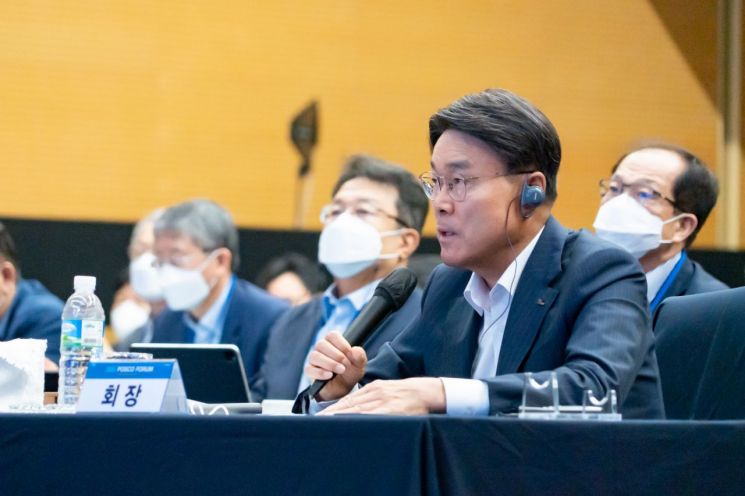 Choi Jung-woo, Chairman of POSCO Group, is seen having a video discussion with Barry Eichengreen, Professor of Economics at UC Berkeley, at the '2022 POSCO Forum' held at the POSCO Human Resources Creation Center on the 30th of last month. Photo by POSCO Group
[Asia Economy Reporter Choi Seoyoon] The steel industry is on edge amid political messages aiming to summon Choi Jung-woo, chairman of POSCO Group, as a witness for this year's National Assembly audit. With social concerns growing over production disruptions caused by Typhoon Hinnamnor and the death of subcontracted workers at the Gwangyang Steelworks, the anticipated political criticism could expand management risks. There are also voices warning that the old practice of summoning business leaders not for policy verification but for showy 'scolding audits' may continue.
According to political circles on the 27th, each standing committee held a plenary session the day before, one week prior to the audit, and adopted the list of witnesses and reference persons. In POSCO's case, the National Assembly's Public Administration and Security Committee selected Chairman Choi as a witness, threatening to hold him accountable for inadequate response to Typhoon Hinnamnor. The Industry, Trade, Small and Medium Enterprises and Startups Committee also selected POSCO President Jeong Tak as a witness to question the response to flooding at the Pohang Steelworks. In the Environment and Labor Committee, Im Eija, the senior member of the People Power Party, summoned Chairman Choi as a witness citing the 'serious accident workplace' reason, but he was excluded in that day's meeting.
Within the industry, attention is focused on whether the audit practice of summoning witnesses first and seeing what happens will be revived, despite Chairman Choi visiting the site and taking charge of recovery efforts after the Hinnamnor flooding damage. The criticism is not about POSCO's overall industrial accident response capabilities but concerns that the focus might be limited to Chairman Choi's personal reappointment issues or general industrial accident response measures. There is a risk it could turn into a business leader bashing.
A bigger issue is that this practice may not be limited to Chairman Choi and POSCO but could set a precedent for the entire industry. While it has been common for CEOs to be summoned to audit hearings when industrial accidents cause social outrage, since last year, major policies such as the Serious Accident Punishment Act and Carbon Neutrality 2050 have been introduced, especially in the environmental and labor sectors, leading to stronger oversight by political circles and authorities. This means there is a greater possibility of applying stricter standards than in the past, even for similar accidents.
For example, Chairman Choi was summoned as a witness to the first-ever standalone 'Industrial Accident Hearing' held by the Environment and Labor Committee last year. Opposition lawmakers from the Justice Party and others in the Environment and Labor Committee have inspected factories in Pohang and elsewhere whenever industrial accidents occurred. Political circles and authorities have strengthened related policies and legislative activities, and companies have reluctantly presented reform plans accordingly.
In particular, since the steel industry is pointed out as a high carbon-emitting sector, the burden to reform both safety (industrial accidents) and environment (carbon neutrality) is increasing. This inevitably raises the steel industry's interest in the background of Chairman Choi's selection as a witness for the audit. A steel industry official said, "It is not a welcome situation for a CEO to appear at the audit hearing and receive nationwide attention," adding, "It could cause a chilling effect on corporate management."
© The Asia Business Daily(www.asiae.co.kr). All rights reserved.
![A Woman with 50 Million Won Debt Clutches a Stolen Dior Bag and Jumps... A Monster Is Born [Slate]](https://cwcontent.asiae.co.kr/asiaresize/183/2026021902243444107_1771435474.jpg)
















