Starting Today, ROK-US Navy Carrier Strike Group Conducts Joint Drills in East Sea
First Training in Korean Operational Area in 5 Years Since November 2017
High-Intensity Provocations Possible After Next Month's Chinese Party Congress, Including North Korea's SLBM and Nuclear Tests
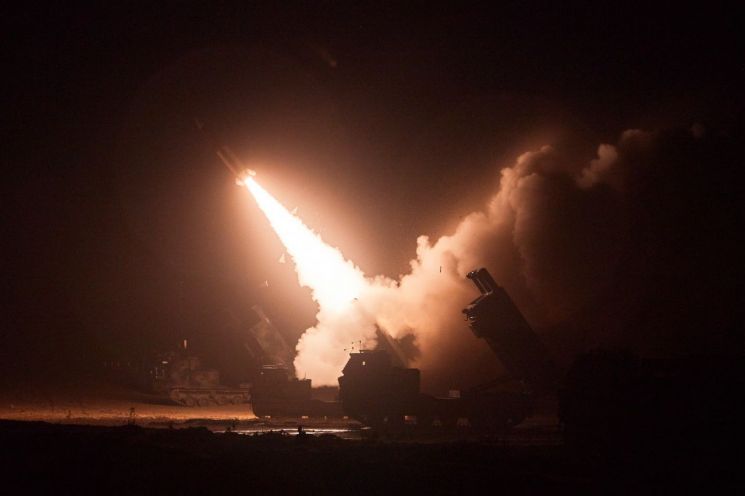
[Asia Economy military specialist Yang Nak-gyu, reporter Lee Ki-min] As the South Korea-U.S. joint naval exercises begin in the East Sea from the 26th, there are growing expectations that North Korea will escalate its military provocations. It is anticipated that missile provocations will continue from the joint exercise period until the Chinese Communist Party Congress on the 6th of next month, followed by a possible 7th nuclear test. President Yoon Suk-yeol stated in an interview with foreign media, "In the Republic of Korea, responding to North Korean provocations based on a strong South Korea-U.S. alliance will be the top priority."
According to the Joint Chiefs of Staff on the 26th, the South Korean Navy will start joint exercises with the U.S. nuclear aircraft carrier Ronald Reagan Carrier Strike Group from that day. This is the first time in five years since November 2017 that a U.S. nuclear aircraft carrier is conducting exercises in the Korean operational area.
More than 20 warships from both countries have been mobilized for this exercise. The South Korean Navy deployed the Aegis destroyer Ryu Seong-ryong (DDG-993, 7,600 tons) and the Korean-style destroyer Munmu the Great (DDH-II, 4,400 tons). The U.S. Carrier Strike Group, led by the Ronald Reagan, includes the guided missile cruiser USS Chancellorsville (CG 62, 9,800 tons), Aegis destroyers USS Barry (DDG 52, 6,900 tons) and USS Benfold (DDG 65, 6,900 tons). U.S. carrier-based aircraft such as the FA-18, maritime patrol aircraft including the P-3 and P-8, maritime operational helicopters like the AW-159 and MH-60R, as well as naval aircraft from both countries, South Korean Air Force fighters including the F-15K and KF-16, and U.S. Army Apache helicopters (AH-64E) are also deployed. The nuclear submarine USS Annapolis, equipped with Tomahawk cruise missiles capable of striking all of North Korea and known for its stealthy maneuvers, is also participating, significantly increasing the threat to North Korea.
North Korea launched a short-range ballistic missile (SRBM) the day before. Considering its range of 600 km, the dominant interpretation is that it was aimed at the U.S. nuclear aircraft carrier.
President Yoon expressed his intention to prioritize changes in the Korean Peninsula situation amid the increased possibility of North Korean provocations. In an interview aired on the 25th (local time) on the U.S. CNN current affairs program ‘Fareed Zakaria GPS,’ when asked whether South Korea would support the U.S. in defending Taiwan, he said, "If China attacks Taiwan, North Korea is also very likely to provoke." This implies that preparations for potential changes in the Korean Peninsula situation due to military conflicts related to Taiwan are a priority.
Even if China does not attack Taiwan immediately, North Korea is expected to focus on provocations using short-range missiles ahead of the 20th National Congress of the Chinese Communist Party (Party Congress) opening on the 16th of next month. After the Party Congress, there is a high possibility of high-intensity provocations aimed at strengthening their position ahead of the U.S. midterm elections in November.
Particular attention is being paid to North Korea’s SLBM (Submarine-Launched Ballistic Missile) developments. On the 23rd, the Presidential Office unusually disclosed that President Yoon Suk-yeol, returning from an overseas trip, chaired a security situation briefing on Air Force One and monitored signs and movements of North Korean provocations, including SLBMs. North Korea has previously revealed new SLBMs, Pukguksong-4 and Pukguksong-5, but has not conducted test launches or revealed the 3,000-ton submarine under development.
Interest is also focused on the possibility of a 7th nuclear test. North Korea is reported to have completed restoration work on Tunnel No. 3 at the Punggye-ri nuclear test site in Kilju County, North Hamgyong Province, which was closed in May 2018. The focus is on verifying the performance of miniaturized nuclear warheads that can be mounted on short-range ballistic missiles, solidifying its status as a nuclear-armed state. Professor Yang Moo-jin of the University of North Korean Studies said, "North Korea intends to prepare for SLBMs and the 7th nuclear test while exploring the extended deterrence capabilities of the South Korea-U.S. alliance, including the deployment of U.S. aircraft carriers on the Korean Peninsula."
© The Asia Business Daily(www.asiae.co.kr). All rights reserved.
![Clutching a Stolen Dior Bag, Saying "I Hate Being Poor but Real"... The Grotesque Con of a "Human Knockoff" [Slate]](https://cwcontent.asiae.co.kr/asiaresize/183/2026021902243444107_1771435474.jpg)
















