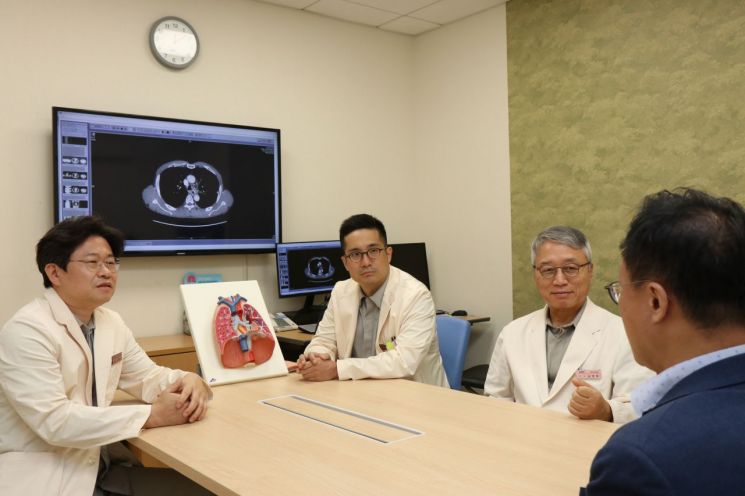
 Samsung Seoul Hospital Esophageal Cancer Team. From the left, Professors Hong-Kwan Kim, Sung-Yong Park, and Young-Mok Shim.
[Asia Economy Reporter Lee Gwan-joo] Samsung Medical Center announced on the 26th that its Esophageal Cancer Team has achieved the first 4,000 esophageal cancer surgeries in Korea. This milestone was reached 28 years after the hospital opened in 1994.
In the past decade, esophageal cancer surgeries at Samsung Medical Center have shown a sharp growth trend, with around 200 surgeries performed annually. Last year, 240 surgeries were conducted, marking the highest annual number in the country. Considering that approximately 600 esophageal cancer surgeries are performed nationwide each year, one out of every three esophageal cancer patients undergoes surgery at Samsung Medical Center.
The surgical outcomes are also excellent. The 30-day postoperative mortality rate for patients who underwent surgery at Samsung Medical Center in the last five years was found to be 0.17%. The average surgery time is 4 hours and 30 minutes, and the average hospital stay is 16 days, which is considered world-class.
Additionally, an analysis of the survival outcomes of 3,000 patients who underwent surgery from 1994 to 2017 showed that the 5-year relative survival rate for those who received curative resection surgery reached 70.2%. The subsequent survival rate for patients who survived up to 5 years was reported to be 86.4%.
The growth of Samsung Medical Center’s Esophageal Cancer Team is supported by a multidisciplinary system. This system includes the Department of Thoracic and Esophageal Surgery, which directly treats esophageal cancer, as well as Gastroenterology, Hematology-Oncology, Radiation Oncology, Critical Care Medicine, and Anesthesiology and Pain Medicine, forming an integrated multidisciplinary team. It is the only hospital in Korea to operate a dedicated intensive care unit for thoracic and esophageal cancer surgery patients, where a thoracic surgeon in charge of critical care closely monitors patients’ postoperative conditions.
Professor Park Sung-yong of the Department of Thoracic and Esophageal Surgery, who performed the world’s first single-port robotic esophagectomy, stated, “Most early-stage esophageal cancers can be treated with robotic or thoracoscopic surgery. Even in advanced esophageal cancer, robotic surgery is actively applied after preoperative chemoradiotherapy.”
Kim Hong-kwan, head of the Department of Thoracic and Esophageal Surgery, who mainly performs thoracoscopic and robotic surgeries for esophageal cancer, said, “Pneumonia and related mortality, which are among the most serious complications after esophageal cancer surgery, have significantly decreased with robotic surgery, and patients recover noticeably faster compared to open surgery. Moving forward, the entire esophageal cancer team will continue to work together to achieve better treatment outcomes for patients.”
© The Asia Business Daily(www.asiae.co.kr). All rights reserved.

















