Choi Yeon-sook, People Power Party Lawmaker: "52.1% Fail to Arrive Within the Golden Time"
[Asia Economy Reporter Lee Ji-eun] It has been revealed that more than half of critically ill emergency patients fail to arrive at emergency medical institutions within the 'golden time' (appropriate time).
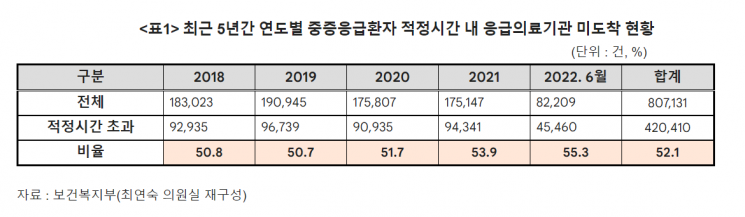
According to data submitted by the Ministry of Health and Welfare on the 26th to Choi Yeon-sook, a member of the National Assembly's Health and Welfare Committee from the People Power Party, over the past five years, the number of critically ill emergency patients who did not arrive at emergency medical institutions within the golden time reached 420,410 cases (52.1%) out of a total of 807,131 cases.
By year, the rates of failure to arrive within the appropriate time were ▲2018: 50.8% ▲2019: 50.7% ▲2020: 51.7% ▲2021: 53.9% ▲2022: 55.3%, showing an overall increasing trend.
By region, the rates of failure to arrive within the appropriate time were highest in ▲Gwangju (61.4%), followed by ▲Gangwon (59.7%), ▲Daegu (59.4%), ▲Daejeon (55.9%), ▲Jeonbuk (54.5%), ▲Seoul (53.7%), ▲Gyeongnam (52.1%), ▲Busan (52.1%), ▲Sejong (51.9%), ▲Chungnam (51.7%), ▲Gyeonggi (51.0%), ▲Jeonnam (49.8%), ▲Ulsan (49.1%), ▲Gyeongbuk (48.0%), ▲Chungbuk (44.2%), ▲Jeju (44.0%), and ▲Incheon (43.0%).
By disease, the rates were ▲severe trauma (53.4%), ▲myocardial infarction (53.2%), and ▲ischemic stroke (49.2%). Currently, the golden time for emergency patients is considered to be 1 hour for severe trauma, 2 hours for myocardial infarction, and 3 hours for ischemic stroke.
Meanwhile, despite the increasing rate of failure to meet the golden time each year, some budgets related to the Ministry of Health and Welfare's projects have continued to remain unused.
The 'Establishment of a Severe Trauma Specialized Medical System' project, which supports the installation and operation of regional trauma centers and the training of specialized personnel for severe trauma patients, has seen 3 to 9 billion KRW unused annually over the past five years due to unpaid labor costs caused by under-recruitment of medical staff at regional trauma centers. The 'Emergency Medical Institution Support Development Program' project has had 600 million to 1.7 billion KRW unused annually over the past five years due to disqualification of medical institutions applying for pediatric specialized emergency medical centers.
Representative Choi stated, "The increasing rate of critically ill emergency patients failing to arrive on time each year and the repeated non-utilization of related budgets are serious issues," and emphasized, "The government must ensure the training and appropriate regional allocation of medical personnel in essential medical fields such as public healthcare policy expansion, establish a close cooperative system with local governments, and lay the foundation for rapid transport and treatment."
© The Asia Business Daily(www.asiae.co.kr). All rights reserved.

















