Interview with Hwang Di, Head of Huawei Korea Enterprise Business Division
"Contributing to Korea's Digital Transformation"
"Security Should Not Be Politicized... Overcoming US Sanctions Through R&D Investment"
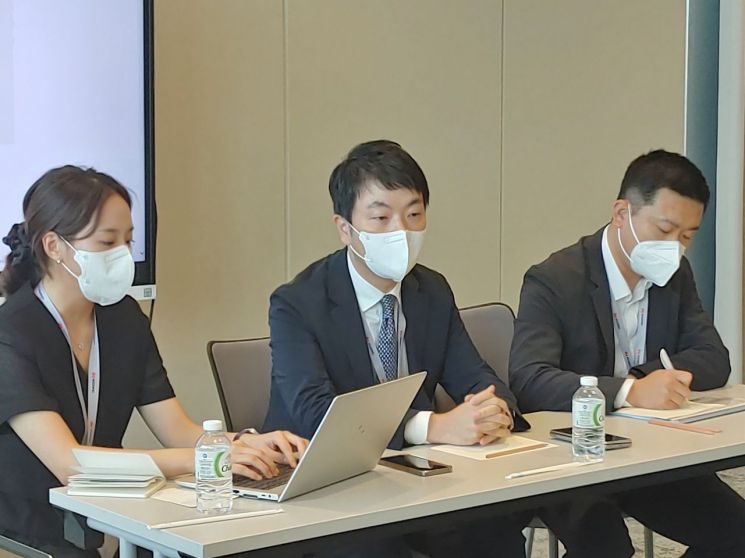 Hwang Di, Head of Korea Huawei EBG (center), is answering reporters' questions in Bangkok, Thailand on the 20th. Photo by Korea Huawei
[Bangkok (Thailand) = Asia Economy Reporter Oh Su-yeon] "Within the next 2 to 3 years, the Enterprise Business will achieve 50% of the total sales of Huawei Korea and become a core business."
Hwang Di, Head of Huawei Korea's Enterprise Business Group (EBG), stated this at the 'Huawei Connect 2022' event held in Bangkok, Thailand on the 22nd.
The EBG division supports digital transformation across various industries. Although its sales share in Korea is not yet large, it is growing globally within Huawei's business and rapidly expanding in Korea, aiming to establish itself as a core business sector.
Currently, Huawei Korea is collaborating with Korean partners in various fields such as manufacturing, finance, and public sectors. Hwang explained, "Korean manufacturing companies have introduced Huawei storage to operate stable manufacturing processes, and a well-known logistics company has implemented an intelligent campus using Huawei Wi-Fi 6."
Last year, Huawei Korea recorded approximately 281.7 billion KRW in domestic sales. Huawei's total sales last year reached 636.8 billion yuan (about 127 trillion KRW). From the company's overall perspective, Korea's share is very small, but Hwang emphasized the importance of the Korean market.
He said, "The Korean information and communication technology (ICT) industry leads the world, and there are many renowned companies in the global market. Korea has the most mature 5G network among global countries, and based on this, we expect high demand for business-to-consumer (B2C) and business-to-business (B2B) transactions for digital transformation." He added, "We want to participate in a market like Korea, where the ICT industry is advanced, and satisfy customers with Huawei's innovative products and solutions to achieve good results."
He continued, "In the Korean market, Dorado storage and Wi-Fi 6 solutions are recognized by many customers. The DCI (Data Center Interconnect) product has realized efficient and flexible interconnection between data centers of Korean Internet Service Providers (ISPs)." He added, "Going forward, we aim to contribute to digital transformation based on various innovative solutions such as data storage, IP networks, and optical transmission."
However, Huawei's business expansion in Korea is not entirely smooth. Concerns about security are continuously raised. Regarding this, Hwang said, "Cybersecurity should be addressed from a technical perspective, not politically," and emphasized, "Cybersecurity verification through third parties and independent organizations is necessary, and unified standards must be applied."
At the same time, Huawei plans to continue investing in security research and development (R&D) to dispel customer concerns. Huawei invests 5% of its annual R&D budget in cybersecurity and personal information protection and operates cybersecurity centers not only in China but also in the UK, Germany, and Belgium for transparent technical verification and product evaluation. It has obtained more than 270 global certifications related to cybersecurity.
Besides security concerns, difficulties in supplying some components due to U.S. sanctions also pose obstacles. Hwang proposed securing innovative technology as a solution. He said, "Huawei currently has 100,000 R&D engineers. Last year's R&D investment was 22.4 billion USD (about 32 trillion KRW), and the investment over the past 10 years has increased to 132.5 billion USD (about 189 trillion KRW). Thanks to this investment, we have secured innovative technologies in connectivity, computing, and cloud fields." He added, "Due to U.S. sanctions, there are difficulties in supplying some components, so we maintain business continuity through R&D investment and continuously seek alternative methods."
Hwang concluded, "Huawei will cooperate with partners to accurately understand the difficulties and demands of Korean customers and deeply analyze various scenarios to create value for customers."
© The Asia Business Daily(www.asiae.co.kr). All rights reserved.

















