500,000 Households Power Outage... No Casualties Confirmed
Prime Minister Trudeau Cancels Attendance at State Funeral of Former Japanese PM Shinzo Abe
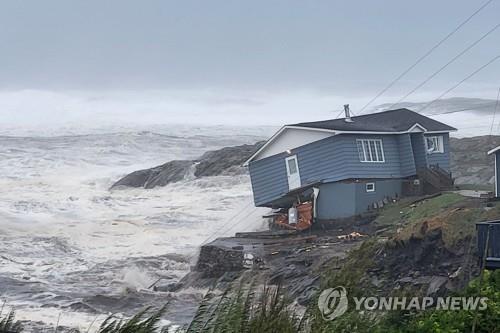 On the 24th (local time), Hurricane Fiona struck the eastern coast of Canada. The photo shows a house precariously standing on the coast of Port au Basque, Newfoundland. Photo by Yonhap News
[Asia Economy Reporter Kim Hyunjung] Hurricane Fiona struck eastern Canada after hitting islands near the Caribbean Sea, causing widespread damage including power outages affecting hundreds of thousands of households.
According to reports from major foreign media such as the Associated Press on the 24th (local time), 415,000 households, equivalent to 79% of customers of the Nova Scotia power company located on the Atlantic coast of eastern Canada, experienced power outages, and in Prince Edward Island, electricity was cut off for 82,000 households, accounting for 95% of customers.
Due to the flooding, Port aux Basques, the largest city in southwestern Newfoundland, declared a state of emergency and evacuated affected residents. In this Atlantic coastal region, many coastal buildings were damaged by strong winds and waves, and two women were swept into the sea; one was rescued. Official casualty figures have not yet been released.
Canadian Prime Minister Justin Trudeau canceled his visit to Japan for the funeral of former Prime Minister Shinzo Abe scheduled for the 27th and immediately began crisis response efforts.
The Canadian Hurricane Center stated on Twitter, "Hurricane Fiona recorded the lowest pressure of any storm to ever make landfall in Canada." Previously, meteorologists warned that "Fiona could be one of the most powerful storms to hit Canada." Although Fiona weakened from a hurricane to a tropical storm on the 23rd (local time), it still demonstrated a maximum strength of 160 km/h (99 mph) upon landing in Canada, causing heavy rain and strong winds. In response, the Canadian government issued warnings for the eastern coastal areas and recommended stockpiling supplies for 72 hours.
It is rare for Canada to suffer hurricane damage because storms weaken when they meet the cold northern seawater. The last time Nova Scotia experienced hurricane damage was in 2003 with Hurricane Juan, which resulted in two deaths.
Earlier, Fiona caused significant damage when it struck Caribbean island nations earlier this week.
In Puerto Rico, a U.S. territory with a population of 3.2 million, about 1,000 people were displaced, and 200,000 received aid from relief organizations due to a shortage of drinking water. At one point, the entire island of Puerto Rico experienced a blackout. The Dominican Republic also suffered damage such as housing destruction and road flooding. At least eight deaths have been reported in Caribbean countries near the sea due to Fiona.
© The Asia Business Daily(www.asiae.co.kr). All rights reserved.

















