Exemption from Summons for Financial, IT, Telecommunications, and State Media Workers
Controversy over Discrimination Against Ethnic Minorities
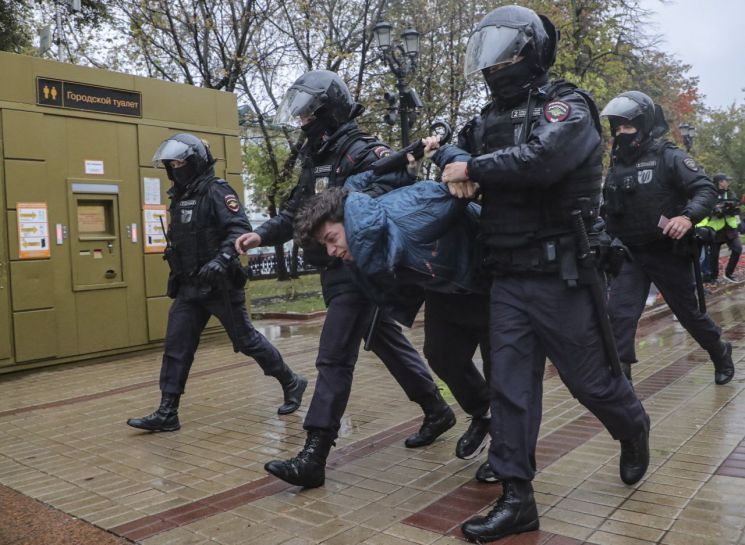 The Russian Ministry of Defense announced on the 23rd (local time) that Russian men with university education working in finance, IT, and other sectors are exempt from conscription. The photo shows Moscow police arresting participants of an anti-mobilization rally on the 24th (local time). Photo by Yonhap News
[Asia Economy Reporter Kim Hyunjung] The Russian Ministry of Defense has decided to exempt highly educated white-collar workers in key sectors from conscription.
According to the New York Times on the 24th (local time), the Russian Ministry of Defense announced on the 23rd that Russian men with university education working in finance, telecommunications, information technology (IT), and state-run media sectors are exempt from conscription.
Notably, workers in the aviation industry were excluded from the exemption. One media outlet analyzed that although the aviation industry is expected to suffer significant damage from conscription, if airlines continue to operate smoothly, it would be impossible to prevent young men from fleeing abroad.
Earlier, the Russian economic newspaper Kommersant reported that 50-80% of employees in Russian companies such as airlines and IT firms could be mobilized for the war. Company representatives expressed deep concerns in interviews with the media, stating, "Even if only a few employees leave, operations will be paralyzed." Moreover, since Russia's invasion of Ukraine in February, there has already been a wave of overseas migration among Russian workers, causing serious labor shortages in companies even before conscription. Some companies even requested conscription deferments for essential personnel.
Meanwhile, the announcement of conscription exemptions has also sparked controversy over discrimination against ethnic minorities.
Initially, Russian authorities stated they would mobilize men with military service experience, but claims have emerged that even those without military experience are being conscripted in ethnic minority regions. This has led to criticism that the Russian government is placing the burden of war only on poor ethnic minority residents to minimize backlash from young people in the capital and cities. Russia announced the mobilization order on the 21st of this month without clearly specifying the conscription criteria, and subsequent reports that individuals without military experience or beyond conscription age have received summonses have intensified opposition to the mobilization order.
As Russia intensifies mobilization, it has also strengthened punishment regulations related to soldiers' duties. Russian President Vladimir Putin signed a bill allowing the detention of Russian soldiers who surrender, desert, or refuse to fight for up to 10 years. He also signed an order granting citizenship to all foreigners who serve one year of military service in Russia. Normally, obtaining Russian citizenship requires five years of residence.
Incentives for conscription were also introduced. The Russian Central Bank recommended commercial banks and lending institutions to grant deferments on debt repayments to reservists subject to the military mobilization order, including provisions to prevent eviction from mortgaged homes.
© The Asia Business Daily(www.asiae.co.kr). All rights reserved.

















