International Energy Price Surge... Russia-Ukraine War Triggers
Significant Impact on Korea's Oil and Chemical Industries with High Imported Raw Material Ratios
Production Costs Rise 28% and 10% Respectively in One Year
Russia Indefinitely Halts Gas Supply to Europe Early This Month
Energy Supply Uncertainty Expected to Widen in Second Half of Year
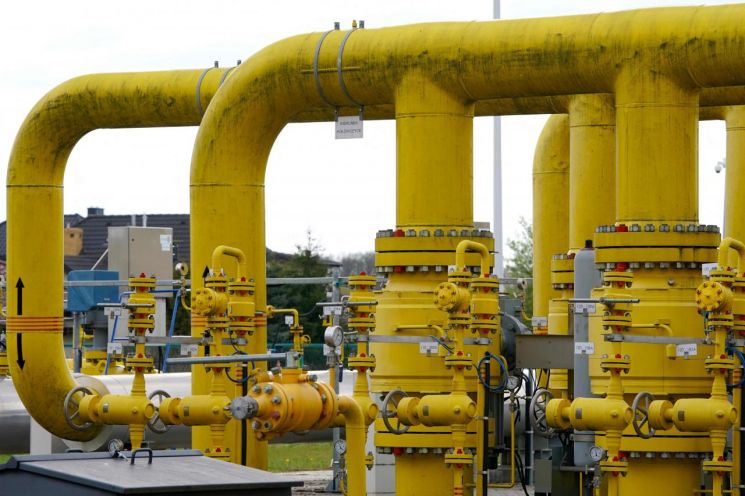 A gas pipeline inside the natural gas relay station in Lembelski, near Warsaw, the capital of Poland. Russia has completely cut off gas supplies to Poland and Bulgaria, members of the European Union (EU) and the North Atlantic Treaty Organization (NATO), which have heavily relied on Russian natural gas.
 [Image source=AFP Yonhap News]
[Asia Economy Reporter Choi Seoyoon] Even before the full-fledged winter season, when heating demand surges, an energy cold wave originating from Europe is becoming a reality. Due to supply chain disruptions caused by geopolitical risks, liquefied natural gas (LNG) import prices hit an all-time high last month. Ultimately, with Russia indefinitely cutting off gas supplies to Europe, the upward trend in international energy prices is expected to continue for the time being.
According to the Ministry of Trade, Industry and Energy on the 25th, LNG import prices have risen 2.2 times over the past year. The LNG import price, which was $535 per ton in August last year, rose to $1,194.6 per ton in August this year, marking a record high.
The surge in international energy prices triggered by the Russia-Ukraine war has ignited a sharp increase in production costs for domestic industries with a high proportion of imported raw materials. According to the "Estimation and Implications of Corporate Production Cost Increase" recently released by the Sustainable Growth Initiative (SGI), a research institute under the Korea Chamber of Commerce and Industry, the petroleum and chemical sectors, which have a high share of imported materials among domestic manufacturing industries in the first half of this year, showed the highest production cost increase rates.
During this period, the production cost increase rates for petroleum refining and chemical industries, which mainly use crude oil as raw material, were 28.5% and 10.5% respectively compared to the same period last year, ranking first and second among nine manufacturing sectors. Following these were non-metallic minerals (9.7%), primary metals (8.2%), and metals (7.2%), which use minerals such as copper, aluminum, and iron ore as intermediate inputs, in order of production cost increase.
The rise in LNG prices causes domestic gas rates to increase, which could lead to burdens on both manufacturing industries and households. Recently, the Korea Electric Power Corporation's wholesale electricity price (SMP, System Marginal Price), applied when purchasing power from power producers, hit a record high. Last month, the inflation rates for electricity and city gas were in the 18% range, which is more than three times the consumer price inflation rate (5.7%).
Experts generally agree that global energy supply and demand uncertainties will increase in the second half of the year. Russia reduced natural gas supply to Europe by 40% in June in response to EU sanctions, cut it further to 20% in July, and completely stopped it this month. According to the EU, Europe depended on Russia for 40% of its natural gas imports before the Russia-Ukraine war. Due to Russia's strong countermeasures against Western sanctions, European natural gas prices have surged 300% since the beginning of the year.
An industry insider said, "Major European countries such as Germany, which have moved to nationalize their largest gas companies, have taken measures so their LNG stock status is relatively better, but some European countries like Austria and Hungary still have not found alternatives," adding, "Concerns over energy supply from Russia this winter are growing."
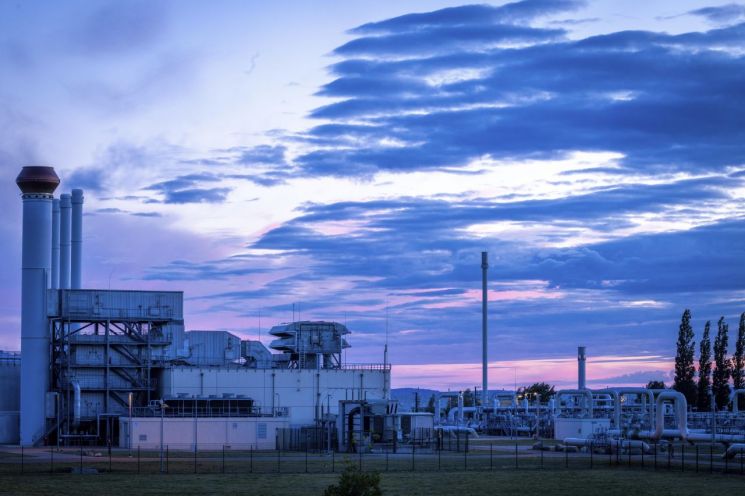 The Nord Stream 1 natural gas offshore pipeline from Russia to Germany has stopped operating.
 [Image source=AP Yonhap News]
The rise in energy prices leads to increases in consumer goods prices, intensifying inflationary pressures. The Organisation for Economic Co-operation and Development (OECD) recently raised South Korea's inflation forecast for this year from 4.8% to 5.2%, an increase of 0.4 percentage points.
The OECD stated, "In Korea, inflation was already rising due to supply disruptions caused by COVID-19 and the surge in energy prices," and added, "With the addition of the Ukraine war, energy prices have risen further, and inflation has increased accordingly."
The high exchange rate trend also acts as a burden on manufacturing industries based on imported raw materials. According to a recent survey by the Federation of Korean Industries targeting research center heads of 15 securities firms, the won-dollar exchange rate is expected to rise to as high as 1,480 won. They analyzed that "the cost burden caused by exchange rates, including rising raw material prices, will offset export growth."
Such a situation also raises warnings that it could shake the domestic industrial base, which is highly dependent on overseas energy. Researcher Byun Junho evaluated, "Due to the deterioration of energy supply and demand, resulting in reduced operating rates, production contraction, and continued expansion of trade deficits, the possibility of competitive energy acquisition wars among major global countries is increasing," adding, "This could work disadvantageously for South Korea, where overseas energy dependence remains high at 91%."
© The Asia Business Daily(www.asiae.co.kr). All rights reserved.


















