The 5th Missile Launch Since the Inauguration of the Yoon Seok-yeol Government
Joint Chiefs Chairman Holds Coordination Meeting with Combined Forces Commander
Maritime Combined Exercise Scheduled as Planned from 26th to 29th
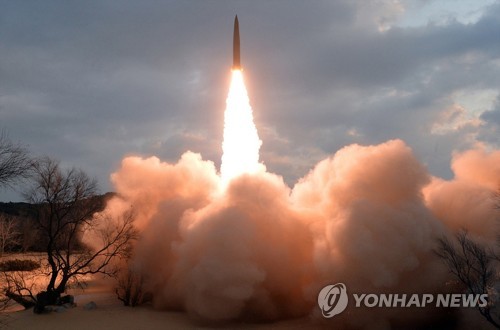
[Asia Economy Reporter Han Jinju] North Korea launched a short-range ballistic missile into the East Sea on the 25th. This marks the fifth missile launch since the inauguration of the Yoon Suk-yeol administration and is analyzed as a show of force in response to the South Korea-U.S. joint naval exercises.
The Joint Chiefs of Staff announced that they detected one short-range ballistic missile launched from the Taechon area in North Pyongan Province toward the East Sea at around 6:53 a.m. on the same day.
The missile flew approximately 600 km at an altitude of 60 km and was detected traveling at about Mach 5 (five times the speed of sound). It is estimated to have been launched from a vehicle-mounted transporter erector launcher (TEL).
The military is reportedly focusing on analyzing the missile's specifications as a North Korean version of the Iskander ballistic missile (KN-23).
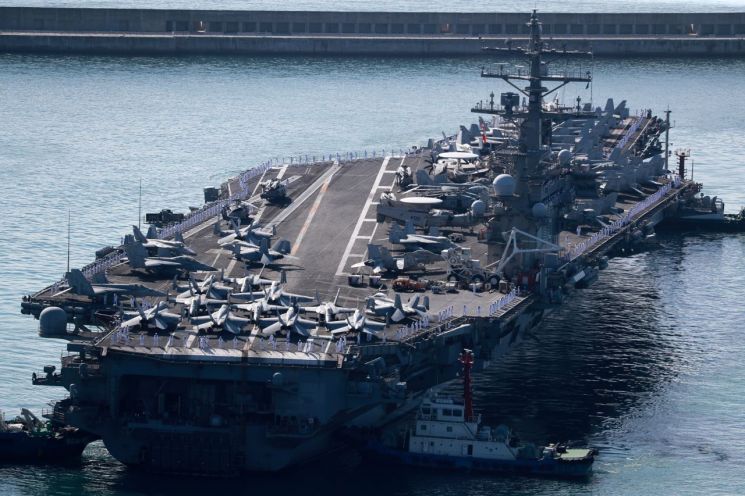
North Korea appears to have provoked the missile launch in response to the arrival of a U.S. aircraft carrier ahead of the South Korea-U.S. joint naval exercises.
On the 23rd, the U.S. carrier strike group, including the nuclear-powered aircraft carrier USS Ronald Reagan (CVN-76), guided missile cruiser USS Chancellorsville (CG 62), and Aegis destroyer USS Barry (DDG 52), entered the Busan operational base.
The U.S. carrier strike group is scheduled to conduct joint naval exercises with the South Korean Navy from the 26th to the 29th. Given the expectation of high-intensity joint exercises, there are concerns about potential additional provocations from North Korea, such as submarine-launched ballistic missile (SLBM) launches.
This missile is reported to be a surface-to-surface ballistic missile and is not considered a means to target maritime assets such as aircraft carriers.
Some have speculated that nuclear-related activities might be underway, considering that the launch site, Taechon, houses a uranium enrichment facility and a 200 MW nuclear power plant. However, the military does not place significant importance on the launch location, as the use of a mobile launcher is characteristic of short-range ballistic missiles (SRBMs).
A military official explained, "Considering North Korea's overall activities, it is appropriate to view this as part of a long-term testing or weapons development process under Kim Jong-un's directive to strengthen national defense capabilities. This is also why we remain vigilant about the possibility of additional provocations."
After the missile launch, the Presidential Office held a National Security Council (NSC) standing committee meeting chaired by National Security Office Director Kim Sung-han to discuss response measures, stating, "This launch is a clear violation of United Nations Security Council resolutions and a provocative act that escalates tensions on the Korean Peninsula and in the region."
Joint Chiefs of Staff Chairman Kim Seung-gyeom shared the situation immediately after the missile launch through a video conference with U.S. Forces Korea Commander Paul LaCamera. The Joint Chiefs confirmed their commitment to strengthening the combined defense posture against any threats or provocations from North Korea through the planned South Korea-U.S. joint naval exercises, according to the Joint Chiefs.
The military stated, "North Korea's ballistic missile launch is a serious provocation that threatens peace and security not only on the Korean Peninsula but also in the international community, and it is a clear violation of UN Security Council resolutions. We condemn this and strongly urge an immediate halt."
It added, "In preparation for further provocations by North Korea, we will maintain a firm readiness posture based on the capability to overwhelmingly respond to any provocations by closely monitoring related developments in close cooperation between South Korea and the U.S."
The NSC standing committee noted that this provocation is the first ballistic missile launch since North Korea officially announced its tactical nuclear first-use policy on the 8th and decided to actively respond based on cooperation with the U.S. and allied countries, the Presidential Office said.
It also reaffirmed a strong will to neutralize any form of missile provocations by North Korea through the South Korea-U.S. joint naval exercises scheduled from the 26th to the 29th with the USS Ronald Reagan carrier strike group and decided to strengthen combined defense capabilities.
The U.S. Indo-Pacific Command emphasized, "We are aware of the ballistic missile launch and are closely consulting with our allies and partners. The U.S. defense commitment to South Korea and Japan is ironclad." It also assessed that "this launch does not pose an immediate threat to Americans, U.S. territory, or allies."
Meanwhile, Japanese Defense Minister Hamada Yasukazu said that North Korea's missile "may have flown on an irregular trajectory," referring to the KN-23's characteristic pull-up maneuver during flight. However, Japan assessed the missile's maximum altitude at 50 km and range at 400 km, showing a difference from South Korea-U.S. analysis.
© The Asia Business Daily(www.asiae.co.kr). All rights reserved.
![User Who Sold Erroneously Deposited Bitcoins to Repay Debt and Fund Entertainment... What Did the Supreme Court Decide in 2021? [Legal Issue Check]](https://cwcontent.asiae.co.kr/asiaresize/183/2026020910431234020_1770601391.png)

















