The US increased from 24.4 to 27.1 years by 2.7 years
Japan rose from 27.2 to 30.7 years by 3.5 years
Issues include long working hours, cost burden, career breaks
"Women face difficulties balancing work and childcare and are forced to choose"
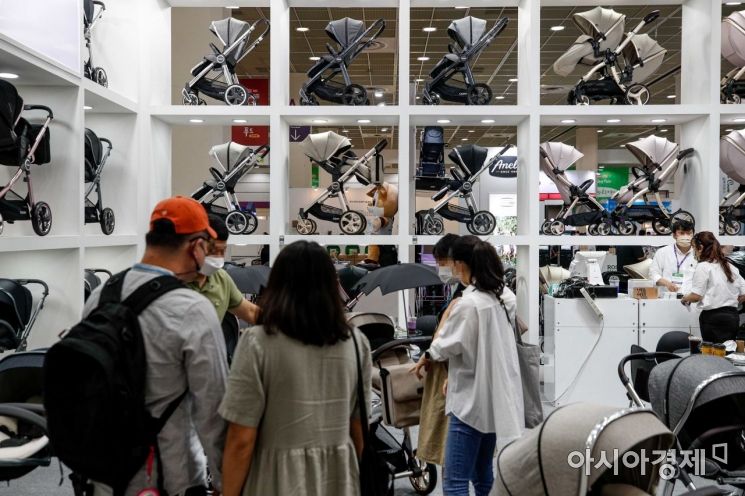 On the 15th, expectant parents attending the '42nd BEFE Baby Fair' held at COEX in Gangnam-gu, Seoul, are looking at childcare products. Photo by Jinhyung Kang aymsdream@
[Asia Economy Reporter Han Jinju] The average age of Korean women giving birth to their first child has risen from 26 to around 32 over 27 years. This increase is more than twice as large compared to countries like Japan and the United States.
According to the OECD's "2022 Korea Economic Report" released on the 25th, the average age of first-time mothers in Korea rose by 6.07 years from 26.23 in 1993 to 32.30 in 2020 over 27 years.
During the same period (1993?2020), the average age increased by 2.7 years in the U.S. from 24.4 to 27.1, by 3.3 years in the U.K. from 25.8 to 29.1, and by 3.9 years in Norway from 26.0 to 29.9.
Japan's average age rose by 3.5 years from 27.2 to 30.7 during the same period. Japan recorded an average first birth age in the 30s (30.1) in 2011, but the increase plateaued at 30.7 for six consecutive years starting in 2015.
In contrast, Korea's average first birth age has continued to rise, recording 30.10 in 2010, 31.20 in 2015, 32.16 in 2019, and reaching 32.6 last year.
As of 2020, the number of births in Korea was 272,300, dropping to the 200,000 range for the first time ever. The total fertility rate (TFR) is 0.84, the lowest among OECD countries. The TFR refers to the average number of children a woman is expected to have during her lifetime.
Korea's TFR has declined from 6.0 in 1960 to 3.0 in 1976, 2.06 in 1983, 1.05 in 2017, 1.0 in 2018, and further down to 0.81 last year.
In the second quarter of this year, Korea's TFR hit a record low of 0.75 for the same quarter.
Other countries have experienced a more gradual decline in TFR compared to Korea. Looking at the TFR in 1960, 2000, and 2020: the U.S. had 3.65, 2.06, and 1.64; the U.K. had 2.72, 1.64, and 1.56; Norway had 2.91, 1.85, and 1.48; and Japan had 2.0, 1.36, and 1.33 respectively.
The OECD stated, "Korean women face harsh choices between work and family, leading them to delay childbirth," and added, "although gender equality has progressed in education and employment, the high costs associated with having children make it difficult for women to balance work and childcare, forcing them to make tough choices."
The OECD also pointed out that in Korea, there is a culture of long working hours and a heavy burden of household chores on women. Additionally, the high costs of child education and housing, as well as career interruptions for women due to childbirth and childcare, are problematic.
The OECD emphasized that "because of these factors, women delay starting families and reduce the number of children they have," calling for measures related to childbirth and childcare such as free childcare and expanded paid parental leave, as well as changes in work culture.
Along with this, the OECD proposed alternatives such as increasing real wages for young people through job matching and public support, and fully guaranteeing paid parental leave through taxes or social security contributions.
© The Asia Business Daily(www.asiae.co.kr). All rights reserved.
![User Who Sold Erroneously Deposited Bitcoins to Repay Debt and Fund Entertainment... What Did the Supreme Court Decide in 2021? [Legal Issue Check]](https://cwcontent.asiae.co.kr/asiaresize/183/2026020910431234020_1770601391.png)















