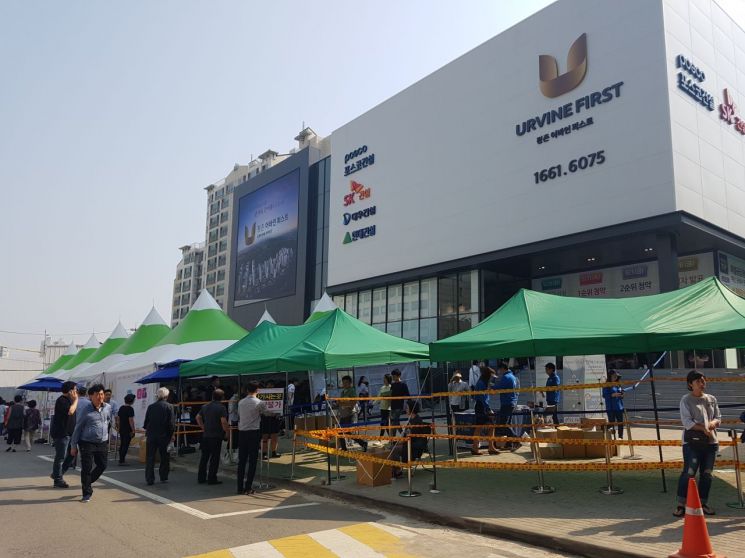
[Asia Economy Reporter Cha Wanyong] This year, the nationwide new apartment pre-sale market has shown severe contraction. Industry insiders express concerns that the volume of new pre-sales could shrink to levels seen during the financial crisis.
According to the Korea Housing Association on the 25th, the total pre-sale volume nationwide from January to August this year was 99,709 households. This is less than half of last year's 200,993 households. Although four months remain, with rising interest rates and economic uncertainty causing more sites to postpone pre-sales, there are concerns that the pre-sale volume will reach levels similar to those during the 2008 financial crisis.
In fact, during the six years considered a real estate slump, an average of 108,334 households were pre-sold (2008: 105,050 households; 2009: 113,445 households; 2010: 62,345 households; 2011: 126,006 households; 2012: 119,947 households; 2013: 123,211 households).
In the market, a significant portion of the scheduled pre-sale volume is being postponed. Even this month, 71 complexes nationwide were scheduled for pre-sale, totaling 47,105 households (40,791 general pre-sale units). However, according to the Korea Real Estate Board's Subscription Home as of this date, only 19 complexes with a total of 6,264 households have actually proceeded with pre-sales.
It is highly likely that the supply of pre-sale units will continue to fall short of market plans until the end of this year. There are increasing conflicts between reconstruction/redevelopment associations and construction companies due to rising construction costs caused by surging raw material and labor costs, and developers and construction companies are postponing schedules out of concern for unsold units amid the housing market slump.
In fact, the outlook for the apartment pre-sale market has deteriorated to an all-time low. According to the Korea Research Institute for Human Settlements, the nationwide apartment pre-sale outlook index for September recorded 43.7, down 17.6 points (29.4%) from last month’s 61.3. This is the lowest level since the related survey began in November 2017.
The pre-sale outlook index is a numerical indicator created by the Korea Research Institute for Human Settlements based on a survey of about 500 housing businesses regarding the conditions of complexes about to be pre-sold or currently in pre-sale. The index ranges from 0.0 to 200.0. A value above 100.0 indicates a positive pre-sale outlook, while below 100.0 indicates the opposite.
© The Asia Business Daily(www.asiae.co.kr). All rights reserved.

















