Government Monitors Price Increases Amid Food Industry's Successive Hikes in Kimchi, Ramyeon, and More... Urges Minimization of Price Hikes
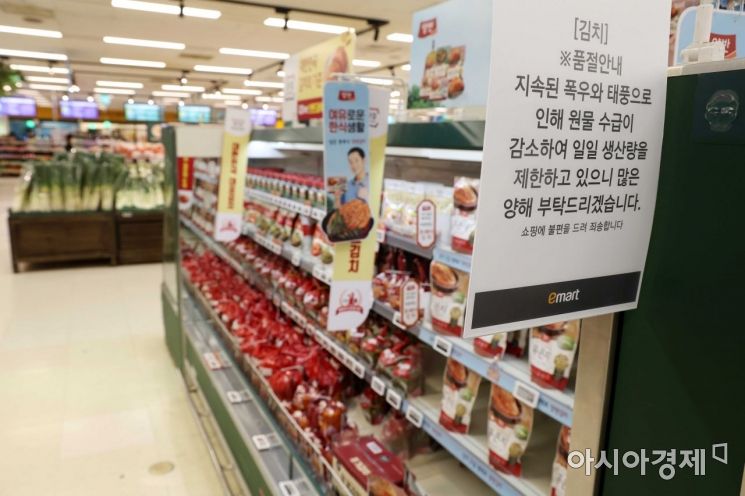 On the 23rd, the prices of kimchi-making vegetables such as napa cabbage and radish continue to soar. At a large supermarket in Seoul, a notice about the sold-out status of some products due to heavy rain and typhoons is displayed at the packaged kimchi sales counter. Photo by Mun Ho-nam munonam@
[Asia Economy Reporter Eunmo Koo] The price increase cycle in the food industry, including kimchi and ramen, is shortening, increasing the burden on consumers. In response to the successive price hikes, the government has also pledged to monitor price increases and urged companies to minimize them.
According to the industry on the 24th, Daesang, the No. 1 company in the packaged kimchi market, will raise the price of its 'Jongga Jip Kimchi' products by an average of 9.8% starting next month on the 1st. This is the second price increase this year, about seven months after the average 7% increase in kimchi prices in March. Daesang explained the reason for the increase, saying, "The minimum wage continues to rise, and packaging and logistics costs have increased due to the rise in international oil prices." Additionally, Daesang temporarily suspended sales of some products, such as pogi kimchi, on its official online mall 'Jeongwon e-Shop' due to a shortage in raw material supply.
CJ CheilJedang also raised the price of its representative product, Bibigo 'Pogi Baechu Kimchi' (3.3kg), from 30,800 won to 34,800 won starting on the 15th, increasing kimchi prices by an average of 11.3%. This is also the second increase following an average 5% hike in February. CJ CheilJedang explained the background of the increase, stating, "Prices of major raw materials such as cabbage, young radish, and garlic have risen due to damage caused by Typhoon Hinnamnor, and especially cabbage is in a difficult supply situation."
Earlier, price increases continued in the ramen industry as well. Nongshim raised the wholesale prices of major ramen products, including Shin Ramyun, by an average of 11.3% starting on the 15th. This is the first price adjustment in about a year since the increase in August last year. The items raised this time include 26 ramen brands. The price increase for major products based on wholesale prices is 10.9% for Shin Ramyun and 9.9% for Neoguri.
Ottogi will also raise the wholesale prices of ramen products by an average of 11.0% starting from the 10th of next month. This is the first price adjustment in 1 year and 2 months since the last change in August last year, which was the first in 13 years. Based on large supermarket retail prices, Jin Ramen will increase from 620 won to 716 won (15.5%), Jin Bibimmyun from 970 won to 1,070 won (10.3%), Jin Jjambbong from 1,495 won to 1,620 won (8.4%), and Cup Noodles from 1,280 won to 1,380 won (7.8%).
Paldo will also raise ramen prices by an average of 9.8% starting next month on the 1st. The price increase applies to 12 ramen brands. The increase rates for major products based on supply prices are 9.8% for Paldo Bibimmyeon, 11.0% for Wang Ttukgeong, and 9.9% for Teumsae Ramyeon Bbalgyettok. A Paldo official said, "The pressure on manufacturing costs has intensified due to rising raw material, logistics, and labor costs," adding, "We decided to minimize the increase considering the impact on consumer prices."
The government has called on the food industry to minimize price increases to stabilize food prices. Bang Ki-seon, First Vice Minister of Strategy and Finance, said at an emergency economic vice ministerial meeting held at the Government Seoul Office on the 23rd, "The Ministry of Agriculture, Food and Rural Affairs is monitoring related trends regarding price increases in ramen, snacks, and other food products," and added, "We plan to strengthen communication with the industry for price stabilization through meetings with major food companies next week." He also urged, "Considering the recent stabilization of grain prices, we ask the industry to demonstrate wisdom in coexistence by minimizing price increases."
© The Asia Business Daily(www.asiae.co.kr). All rights reserved.

















