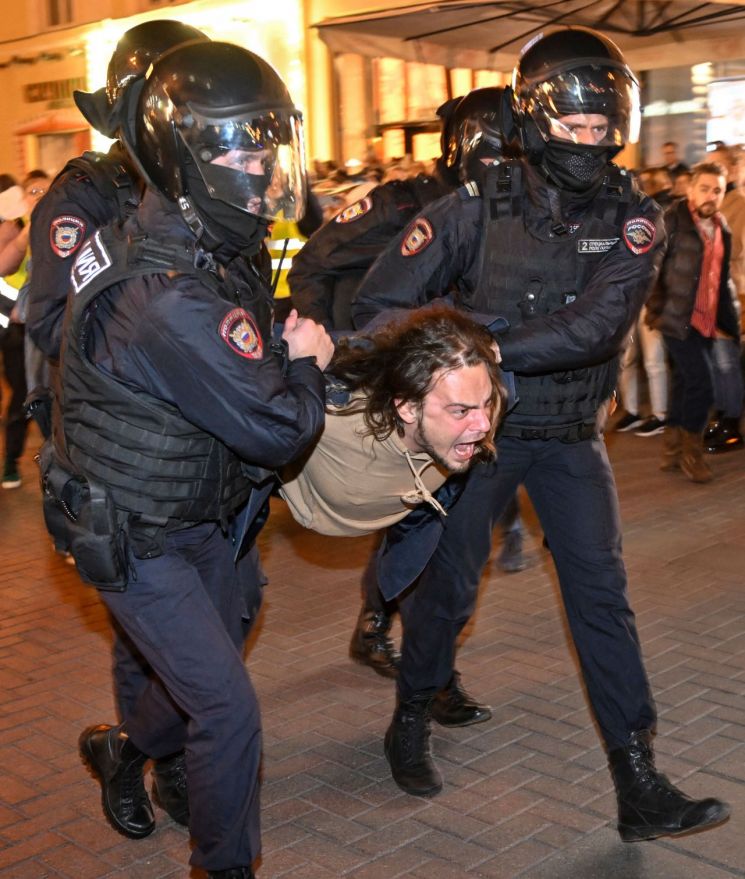
 Russian police are arresting protesters opposing the mobilization order issued by President Vladimir Putin on the 21st (local time).
 [Image source=Yonhap News]
[Asia Economy Reporter Hwang Sumi] Recently, in Russia, where a military mobilization order has been issued, there appears to be a continuous exodus of Russians trying to avoid it. Especially, the flow of avoidance is concentrated mainly in countries neighboring Russia. Among them, Finland has announced that it will significantly restrict the entry of Russians in the future.
On the 23rd (local time), according to major foreign media, Pekka Haavisto, Finland's Minister of Foreign Affairs, stated, "Entry will be restricted for those attempting to cross the border for tourism purposes." He added, "A final decision will be made within the next few days and implemented quickly." However, entry will be allowed for other reasons such as work, study, or family reunions.
The background for this policy is the recent increase in Russians entering Finland. Earlier, Russian President Vladimir Putin announced on the 21st that a partial mobilization order would be issued for reservists to protect Russia's sovereignty and territory. According to the mobilization order, about 300,000 of the total 2.5 million reservists are expected to be conscripted.
As a result, a stream of Russians trying to avoid the mobilization order is flocking to Finland. Finland, which shares a 1,300 km border with Russia, has been regarded as a gateway for Russians entering Europe since the Ukraine war.
In fact, on the 23rd, media reported that a long line of vehicles formed in front of the Valimaa checkpoint in southern Finland. A border checkpoint official told the media, "More than 6,000 Russians entered Finland just yesterday," which is double the number from the previous week. These people are mainly known to have come to Finland to avoid conscription orders and secure safety.
In addition, Russians are also flocking to Kazakhstan, a Central Asian country bordering Russia, to avoid mobilization. Furthermore, flights to countries where Russians can enter and exit visa-free, such as T?rkiye (Turkey) and Uzbekistan, are reportedly selling out continuously.
Meanwhile, President Putin, after issuing Russia’s first mobilization order since World War II, is pushing a plan to increase next year’s defense spending by more than 40% compared to the existing budget. According to Bloomberg on the 23rd, Russia plans to spend 5 trillion rubles (approximately 119 trillion won) on defense next year. This is more than a 43% increase compared to the initial budget proposal. Accordingly, the defense budget is expected to account for 3.3% of the gross domestic product (GDP), making it the second largest expenditure after social programs.
© The Asia Business Daily(www.asiae.co.kr). All rights reserved.
![From Bar Hostess to Organ Seller to High Society... The Grotesque Con of a "Human Counterfeit" [Slate]](https://cwcontent.asiae.co.kr/asiaresize/183/2026021902243444107_1771435474.jpg)
















