Government: "Rising Energy Prices Make Industrial Electricity Rate Hikes Inevitable"
Attitude Shift Two Months After Discussing Semiconductor Power Infrastructure Support
Semiconductor Industry Faces Burden Due to High Electricity Usage
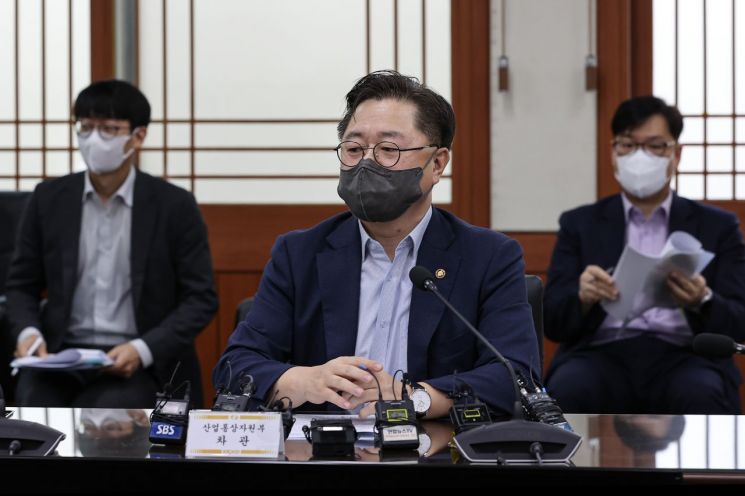 Park Il-jun, 2nd Vice Minister of the Ministry of Trade, Industry and Energy, attending the industry meeting held on the 23rd [Image source=Yonhap News]
[Asia Economy Reporter Kim Pyeonghwa] The government announced plans to raise national funds to support the power infrastructure for semiconductor facilities, but shortly after the plan was scrapped, it introduced a measure that increases the burden instead of providing support. Given the sharp rise in energy prices, the government insists that an increase in industrial electricity rates is inevitable. This will inevitably be a burden for the semiconductor industry, which consumes a large amount of electricity.
60% of Industrial Electricity Cost... "Increase is Essential"
On the 24th, according to the Ministry of Trade, Industry and Energy, Korea Electric Power Corporation (KEPCO), and the semiconductor industry, the government announced an increase in electricity rates due to the surge in energy prices. On the 23rd, the Ministry of Trade, Industry and Energy held an industry meeting to discuss energy crisis response measures at KEPCO Namseoul Headquarters and conducted related discussions.
Park Iljun, Vice Minister of the Ministry of Trade, Industry and Energy, said at the meeting, "In the current crisis situation, we can no longer postpone electricity rate increases," adding, "Rate increases for large-scale consumers are also inevitable."
According to KEPCO, industrial electricity consumption accounted for 53.8% of total consumption last year. The industrial electricity rate per kilowatt-hour (kWh) is 105.48 won, which is 3.38% lower than the residential rate of 109.16 won. This corresponds to about 60% of the cost. With KEPCO facing significant operating losses and energy import prices soaring, the government has decided to rationalize the rates.
The Ministry of Trade, Industry and Energy pointed out that international energy prices have shown unprecedented increases from the first quarter of last year to August this year, with LNG rising 5.5 times and thermal coal 4.7 times. As competition for energy procurement intensifies worldwide ahead of winter, the energy crisis is expanding. The ministry also cited as reasons for the rate increase that governments in countries such as the UK have raised electricity rates significantly and that domestic industrial electricity rates are low compared to the Organization for Economic Cooperation and Development (OECD). The ministry also hinted at applying a progressive rate system to industrial electricity charges, similar to residential rates.
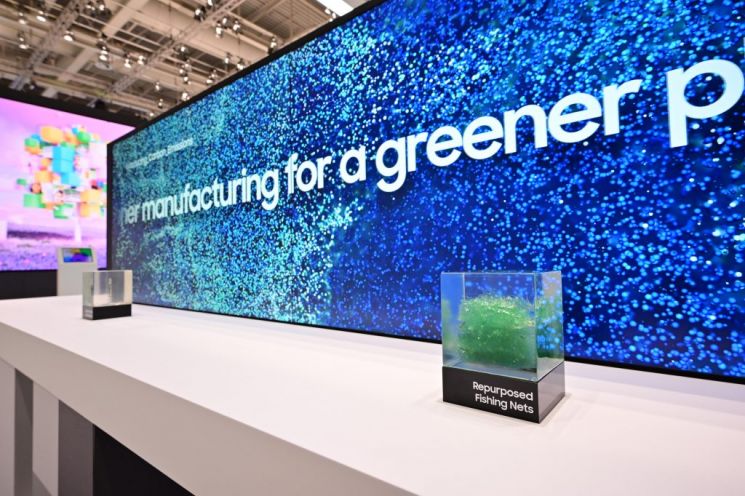 Samsung Electronics showcasing its eco-friendly efforts at the IFA exhibition held this month in Berlin, Germany / Source=Samsung Electronics
Semiconductor Industry, Heavy Electricity Users, Faces 'Dilemma'
The semiconductor industry, which consumes a large amount of electricity, is concerned that the rate increase will become a burden. The industry structure inevitably leads to increased electricity use as semiconductor production volume and related production facilities expand, which could result in higher production costs. In fact, Samsung Electronics is expanding its production facilities at the Pyeongtaek campus, and SK Hynix is doing the same in the Cheongju industrial complex. Moreover, the power consumption of advanced extreme ultraviolet (EUV) equipment, which has been increasingly introduced recently, is substantial, so the more production facilities are advanced, the more electricity consumption inevitably increases.
An industry insider said, "Given the difficult (energy) situation, it seems the government has no choice but to raise rates," but added, "We need to make efforts to reduce electricity use, but the burden is real."
Earlier, the Ministry of Trade, Industry and Energy announced in July that it would consider raising national funds to support infrastructure such as power and water supply necessary for the establishment of semiconductor complexes. However, the plan was scrapped during the budget review process for next year, and the requested budget was ultimately cut. With the announcement of electricity rate increases just two months after discussions on power infrastructure support, the semiconductor industry experienced mixed feelings.
The domestic semiconductor industry, recognizing the growing importance of Environmental, Social, and Governance (ESG) management, states that it will focus on reducing electricity consumption regardless of the electricity rate increase. Following SK Hynix, Samsung Electronics recently announced its participation in RE100 (100% renewable energy use), accelerating each company's eco-friendly strategies. They plan to expand low-power semiconductor production and the use of renewable energy, but unlike overseas, the lack of renewable energy infrastructure domestically may pose challenges to achieving RE100.
© The Asia Business Daily(www.asiae.co.kr). All rights reserved.


















