Lack of Community Spirit Cited as Cause
Consensus on Need for Director Not Formed
Political Sphere's Efforts to Persuade Public Insufficient
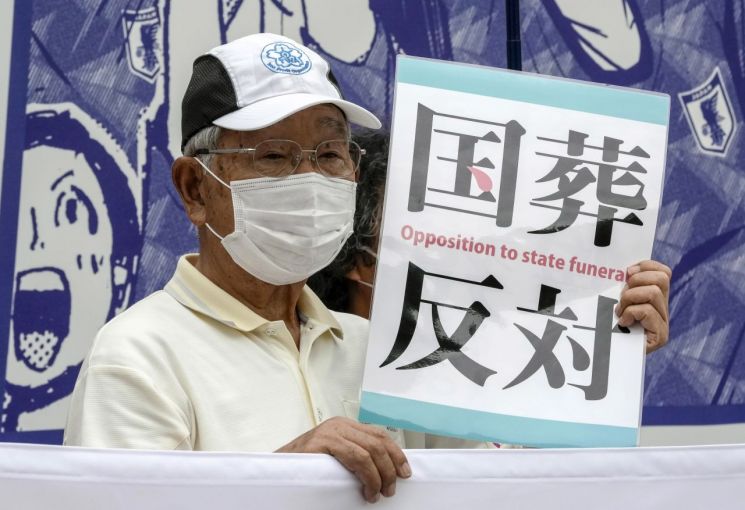
[Asia Economy Reporter Lee Ji-eun] Opposition voices are growing among the Japanese public regarding the state funeral of former Prime Minister Shinzo Abe scheduled for the 27th. Last month, 4,000 people attended a protest organized by civic groups calling for the cancellation of the state funeral, and on the 21st, a man in his 70s left a document expressing his opposition to the state funeral before attempting self-immolation.
Considering the nationwide wave of mourning that swept Japan when Prime Minister Abe was shot and killed in July, this atmosphere is difficult to readily understand. Experts in Japan analyze that the intense public backlash was caused by a social atmosphere where a sense of unity with the nation has disappeared and the political sphere’s inadequate persuasion.
A public opinion survey conducted by the Mainichi Shimbun on the 17th and 18th targeting voters nationwide showed that 62% opposed the state funeral for former Prime Minister Abe, more than double the 27% who supported it. The opposition rate, which was 53% in last month’s survey, exceeded 60% within a month. This means that six out of ten Japanese people strongly oppose holding the state funeral.
◆State Funeral as a Means to Foster Patriotism... Opposition Grows as Sense of Community Disappears
Commentators in Japan believe that the lack of consensus among the public on the necessity of the state funeral has fueled the opposition. This lack of consensus stems from the absence of a communal sense among the people.
Previously, Japan held state funerals for Commander Isoroku Yamamoto, who led the Japanese Navy during World War II, and former Prime Minister Shigeru Yoshida, and at that time, the public did not show significant opposition to these decisions.
Japanese media critic Morinobu Hiro explained to the Asahi Shimbun, "The Japanese people shared a consensus that these two figures made great contributions to the development of the nation." NHK Broadcasting analyzed that despite the lack of legal grounds for holding a state funeral for former Prime Minister Yoshida, the opposition parties and the public were able to unite because of his significant influence on Japan’s reconstruction.
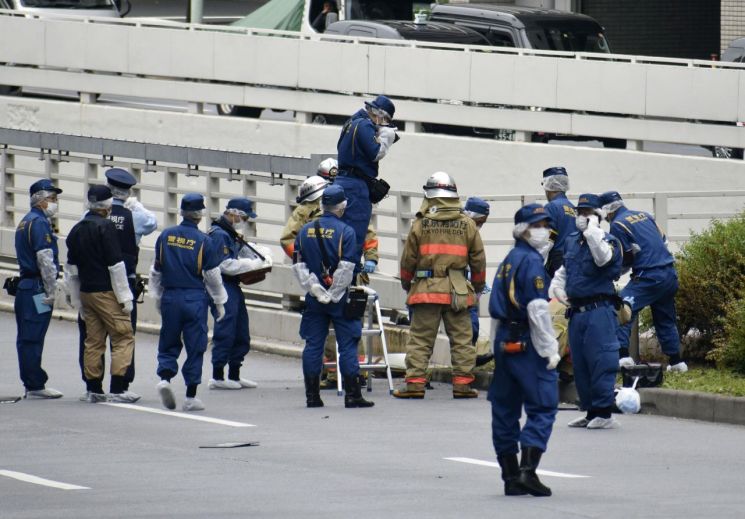 On the 21st, police officers and firefighters are investigating the scene near the Prime Minister's Official Residence in Tokyo where a citizen allegedly attempted self-immolation in protest against the state funeral.
 [Image source=Yonhap News]
After the defeat, when the Japanese people were engulfed in defeatism and felt lethargic, the state funeral served as a means to foster a sense of unity and cohesion within the community. Morinobu stated, "At that time, the people felt a sense of unity and nostalgia for the past through the state funeral," adding, "The media also did not question the holding of the state funeral."
This social trend began to disappear as individualism started to emerge with rapid economic growth and the development of democracy. As the social atmosphere to feel unity with the nation faded, the political sphere’s efforts to promote patriotism through the state funeral led to public backlash. As a culture prioritizing individual life over national success emerged, more people developed resentment toward the social atmosphere honoring politicians’ contributions.
Professor Junichi Miya of Chuo University said, "The fact that no state funeral was held for 55 years after former Prime Minister Yoshida is due to significant changes in the public’s values after the defeat," adding, "Because state funerals were largely used to mobilize war efforts and promote national prestige, they inevitably feel unfamiliar in a society where democracy has taken root."
◆Inadequate Political Justification... Worsening Opposition
The attempt to push through the state funeral without political consensus also spread opposition. Prime Minister Kishida has been criticized for unilaterally deciding to hold the state funeral at the Cabinet meeting without parliamentary discussion after former Prime Minister Abe’s death.
Japanese media pointed to the case when former Prime Minister Eisaku Sato, a Nobel Peace Prize laureate, passed away, and the Takeo Miki Cabinet conducted sufficient discussions regarding whether to hold a state funeral. At that time, the Cabinet’s Legal Affairs Bureau argued that since the state funeral was fully funded by national taxes, the legislature and judiciary’s approval was necessary, so the funeral was held as a "national funeral" with partial government funding.
Constitutional scholar Minamino Mori explained to the Asahi Shimbun, "According to Article 66 of the Constitution, the Cabinet has the obligation to bear collective responsibility with the Diet," adding, "Administrative acts requiring legal grounds must obtain the Diet’s approval."
Since the state funeral is held unilaterally without the consent of the Diet representing the people’s will, issues such as wasteful spending of taxpayers’ money and forced mourning have also emerged. The Japanese government plans to spend 1.66 billion yen (16.2 billion KRW) on the state funeral for former Prime Minister Abe. In response, some civic groups have filed injunction requests with the Tokyo District Court demanding the suspension of the Cabinet’s decision and budget execution.
The civic groups filing the injunction argued, "The state funeral forces citizens to offer condolences, violating the constitutionally guaranteed freedom of thought," and criticized the court’s dismissal as "a decision that disregards the will of the people."
Political commentators point out that since public opinion remains divided on former Prime Minister Abe’s achievements, sufficient grounds to persuade the public were necessary. Former Prime Minister Abe has been suspected of selling Osaka national land at a low price to the Morimoto Educational Foundation in 2016. Additionally, it was revealed that Abe invited members of his support group to the government event "Cherry Blossom Viewing Party" and used it for election campaigning, causing a scandal.
Media expert Komaki Matsuda told the Asahi Shimbun, "Among the elderly, many harbor resentment toward the 'Morimoto scandal' and 'Cherry Blossom scandal' surrounding former Prime Minister Abe," adding, "Unlike the younger generation, the elderly who are highly interested in political issues are very dissatisfied with holding a state funeral for a prime minister who did not even receive one after the postwar reconstruction of Japan."
© The Asia Business Daily(www.asiae.co.kr). All rights reserved.


















