Asahi: "Talks Naming Issue Is Childish"
Some Say It Overlooks LDP Conservative Views
Calls for Proactive Approach to Restoring Relations
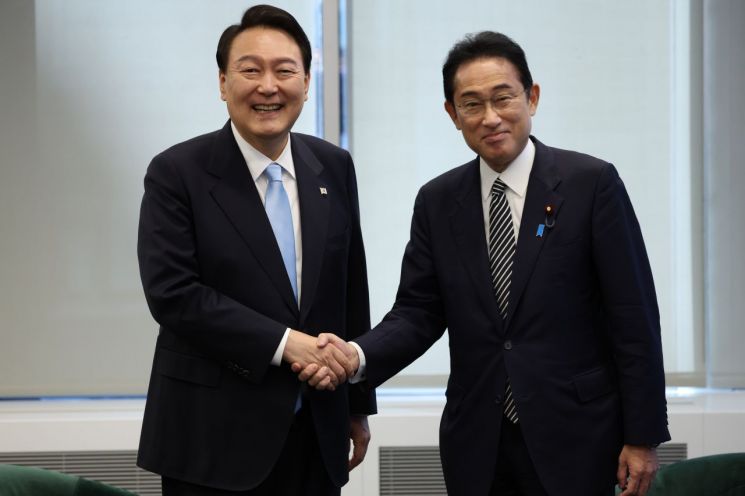
[Asia Economy Reporter Lee Ji-eun] Regarding the meeting between the South Korean and Japanese leaders on the 21st (local time) in New York, USA, Japanese media have urged Prime Minister Fumio Kishida to engage in active dialogue, stating that "there is no benefit to be gained by cornering the Yoon Seok-yeol administration."
On the 23rd, Japanese foreign media pointed out that although the South Korean side used the term 'brief meeting' for the 30-minute talks, the Japanese side defined it as an 'informal discussion.'
The Nihon Keizai Shimbun editorial stated, "It is natural for the Japanese government to maintain its position on the principles of the Korea-Japan Claims Agreement," and criticized, "There is no advantage in cornering the Yoon administration, which is actively working on solutions led by South Korea."
The Nihon Keizai also called for Prime Minister Kishida's bold decision to normalize Korea-Japan relations. Given the current situation where Japan is pursuing rearmament, including increasing defense spending under the protection of the United States, taking a confrontational stance against South Korea, a U.S. ally, is strategically undesirable.
The Nihon Keizai said, "Now that a new president with similar values to the U.S. and Japan has emerged, it is a good opportunity to rebuild Korea-Japan relations," adding, "We should approach Korea-Japan relations not only as bilateral ties but also from the perspective of the international situation."
The progressive Asahi Shimbun gave a positive evaluation, calling it "the first step toward restoring relations to normal." Asahi mentioned, "Prime Minister Kishida is overly concerned about the views of the LDP conservative faction. It is childish and regrettable that there is a discrepancy in how the 30-minute diplomatic event was labeled," and noted that the South Korean government is steadily preparing measures to assist victims rather than cashing out Mitsubishi Heavy Industries' assets in South Korea.
Asahi emphasized, "The Japanese government must also approach historical issues with a humble attitude again, and progress in relations cannot be achieved without effort," stressing that for both Korea and Japan, there is no alternative but to cooperate with the United States to maintain regional stability in East Asia.
The Mainichi Shimbun also cited the increasing security crises such as the Russia-Ukraine war and U.S.-China conflicts as reasons, stating, "The Kishida Cabinet must not let the recent agreement to continue communication between the Korea-Japan leaders end as mere words."
© The Asia Business Daily(www.asiae.co.kr). All rights reserved.
!["The Woman Who Threw Herself into the Water Clutching a Stolen Dior Bag"...A Grotesque Success Story That Shakes the Korean Psyche [Slate]](https://cwcontent.asiae.co.kr/asiaresize/183/2026021902243444107_1771435474.jpg)
















