Announcement of Community Antibody Positivity Rate Survey Results for 10,000 People
[Asia Economy Reporter Kim Young-won] It has been found that 6 out of 10 people in the nation possess antibodies due to COVID-19 infection. This is about 19.5 percentage points higher than the cumulative confirmed case rate relative to the population, indicating the presence of undiagnosed infections not detected through the testing system.
On the 23rd, the Korea Disease Control and Prevention Agency announced the results of a nationwide COVID-19 antibody positivity rate survey conducted with approximately 10,000 people since last month, in collaboration with the Korean Society of Epidemiology and local community organizations. For this survey, from the 8th of last month to the 6th of this month, health centers and cooperating medical institutions across 17 cities and provinces nationwide conducted home blood collection from 9,959 individuals aged 5 and older.
'Natural Infection' Antibody Positivity at 57.65%... Higher in Younger Age Groups
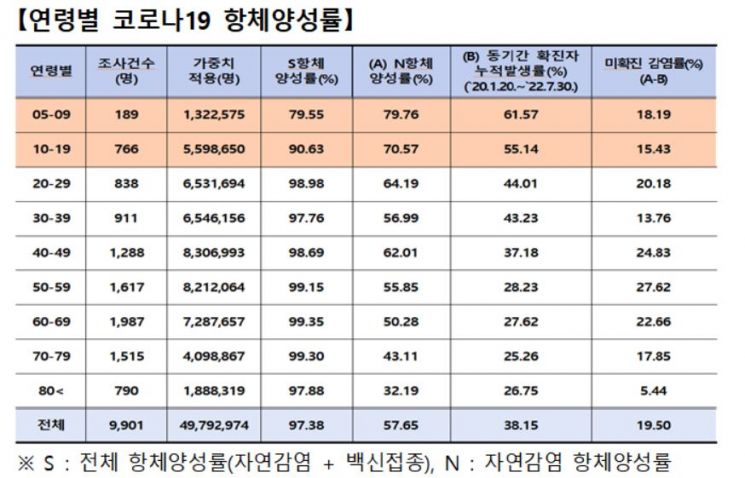
As a result of the survey, among 9,901 people, the N antibody positivity rate was 57.65%, and the S antibody positivity rate was 97.38%. The antibody positivity rate refers to the proportion of individuals possessing antibodies that bind to the S antigen and N antigen of the COVID-19 virus. S antibodies can be produced through both natural infection and vaccination, while N antibodies are formed only through natural infection.
The survey confirmed a trend where younger age groups had higher antibody positivity rates due to natural infection. The N antibody positivity rate in the 5-9 age group was 79.8%, the highest among all age groups. This means that 8 out of 10 children have been infected with COVID-19 at least once. The 10-19 age group followed with 70.6%.
On the other hand, the N antibody positivity rate was lowest among those aged 80 and above at 32.2%, and 43.1% in their 70s. Professor Kim Dong-hyun of Hallym University College of Medicine’s Department of Preventive Medicine stated, “The elderly have a very high vaccination rate of over 90%, while children have lower vaccination rates and more active social behaviors, which likely led to more transmission.”
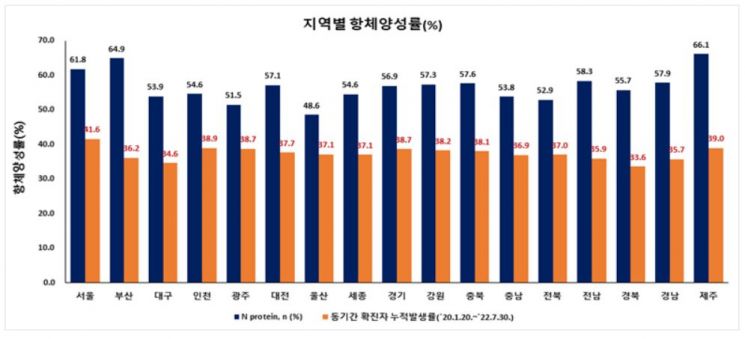
By region, Jeju showed the highest N antibody positivity rate at 66.1%, followed by Busan (64.9%) and Seoul (61.8%). The lowest region was Ulsan at 48.6%, showing a 17.5 percentage point difference from Jeju. Regarding regional differences, Professor Kim said, “Even considering uncertainties, it is almost certain that there are differences between regions,” and added, “We need to evaluate various factors such as testing strategies and transmission patterns. Since Korea’s quarantine response is centralized, further review is needed to understand what differences might have existed between regions.”
Undiagnosed Infections at 19.5%... Most Common in 40s and 50s
In this survey, the N antibody positivity rate was 19.5 percentage points higher than the cumulative confirmed case rate of 38.15% as of July 30. This indicates the scale of undiagnosed infections not identified through the testing system. Kwon Jun-wook, director of the National Institute of Health, explained, “It can be considered that about 20% of the total population are unidentified confirmed cases,” but added, “However, for Omicron, the asymptomatic infection rate can be as high as 56%, and in Korea, it is understood to be smaller than that.” Furthermore, although the N antibody positivity rate due to natural infection was high, experts believe that since immune antibodies decrease over time and new variants may emerge, additional vaccinations are still necessary for high-risk groups.
In the antibody positivity rate survey based on the National Health and Nutrition Examination Survey conducted in April, the gap between the N antibody positivity rate (36.1%) and the confirmed case rate (29.5%) was 6.6 percentage points. Regarding this, Director Kwon said, “The National Health and Nutrition Examination Survey targets those aged 10 and above, so it does not include the 5-9 age group, and the sample size is smaller than this survey,” and added, “Also, since asymptomatic infections have been high after the full-scale spread of Omicron, it can be understood that the undiagnosed infection rate is about 19.5% after the full-scale Omicron spread.”
The scale of undiagnosed infections is estimated to be largest among people in their 40s and 50s. This is because the gap between the N antibody positivity rate and the cumulative confirmed case rate was largest at 27.7 percentage points for those in their 50s and 24.8 percentage points for those in their 40s. Professor Kim said, “The research team is paying attention to the high undiagnosed infection rate in this age group,” and explained, “Our internal estimation is that this age group is economically active and responsible for households, and such behaviors may have been reflected.”
Experts evaluated that the scale of undiagnosed infections in Korea is relatively small compared to antibody positivity rates surveyed overseas. According to the UK Health Security Agency (UKHSA), which surveyed antibody positivity rates among those aged 17 and older until July 19, the N antibody positivity rate was 73.4%, and the cumulative incidence rate relative to the population was 34.6%. This means the actual infection scale is about twice the confirmed cases.
Director Kwon emphasized, “Considering the characteristics of Omicron, it is logically consistent that there are unidentified infections about twice the confirmed cases as in the UK, but in Korea, it is less than that,” and added, “Also, the UK survey was conducted on blood donors, not a community-representative sample like Korea, and there were age restrictions.”
The quarantine authorities plan to use the confirmed infection scale identified this time to prepare for quarantine and medical response systems in case of future resurgence. Second and third additional surveys are scheduled within this year. From next year, quarterly regular surveys will be promoted.
© The Asia Business Daily(www.asiae.co.kr). All rights reserved.
![From Bar Hostess to Organ Seller to High Society... The Grotesque Con of a "Human Counterfeit" [Slate]](https://cwcontent.asiae.co.kr/asiaresize/183/2026021902243444107_1771435474.jpg)

















