Official Letter Delivered to Ministry of Land... Includes 25% Cap on Burden Charge Rate
"Reconstruction Is a Common Experience Amid Apartment Popularization... Expecting Direction"
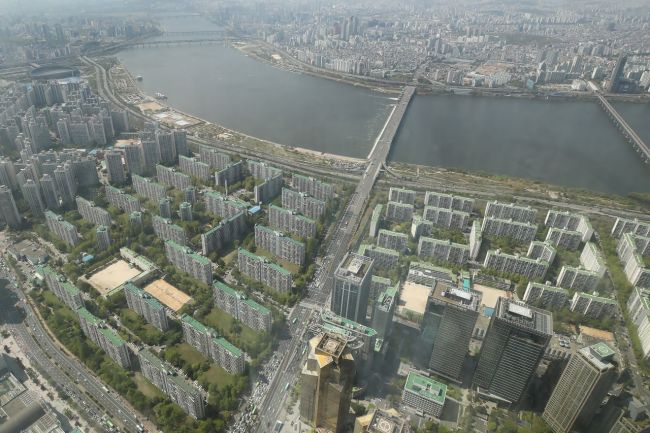 Apartment complexes undergoing reconstruction viewed from the Lotte World Tower observatory in Songpa-gu, Seoul.
 [Photo by Yonhap News]
[Asia Economy Reporter Noh Kyung-jo] As the government is scheduled to announce improvements to the Reconstruction Excess Profit Recovery System (재초환) next week, reconstruction associations have expressed their willingness to take collective action if necessary, depending on the extent of the improvements.
According to the maintenance industry on the 23rd, the National Reconstruction Maintenance Project Association recently sent an official letter to the Ministry of Land, Infrastructure and Transport pointing out the irrationality of the current 재초환 and requesting, among other things, to lower the upper limit of the reconstruction burden rate from the existing 50% to 25%.
The letter also included a request to change the timing of imposing the reconstruction excess profit from the approval date of the promotion committee to the start date of the association establishment approval, and to review parts that can be amended through presidential decree. It was also clearly stated that collective action would be taken if the revision of 재초환 is insufficient.
The 25% upper limit on the burden rate was borrowed from the Development Profit Recovery System (land). Under current law, a certain percentage (20-25%) of development profits generated from land is collected as a development charge to prevent speculation. Applying an excessive rate only to reconstruction is unfair, and it should be lowered at least to the level of the Development Profit Recovery Act.
They also emphasized the need to adjust the timing of imposition. As noted in a report published by the National Assembly Legislative Research Office in June, the promotion committee is not the subject of rights and obligations for reconstruction projects, so defining the promotion committee approval date as the project start date is unreasonable.
A representative of the association said, "Originally, we hoped for the abolition of 재초환, but considering the government's intention to secure tax revenue, we have settled for easing it. We should have actively worked for its abolition during the previous suspension period, but it seems too late now."
재초환 was introduced in 2006 during the Roh Moo-hyun administration. It was suspended for five years from 2013 to 2017 due to reasons such as the real estate market downturn. Before the suspension, many projects were canceled or waited for 재초환 to be halted, so there are reportedly few actual cases of its application.
On the previous day, Minister of Land, Infrastructure and Transport Won Hee-ryong said at the government Sejong office, "The 재초환 improvement plan will be announced next week," adding, "While the interests of landowners and building owners must be protected, public contributions are inevitable, so it is necessary to harmonize the two. Everything is open except abolition." The improvement plan was initially expected to be included in the 'National Housing Stability Realization Plan' announced by the Ministry of Land, Infrastructure and Transport on August 16, but the government postponed the timing to the end of September.
Earlier, the association said they met with National Assembly and government officials several times before and after the presidential election to request the abolition or suspension of 재초환, but these requests were not accepted. However, the Presidential Transition Committee showed a proactive attitude toward system improvement, which the association welcomed, but they expressed bitterness over the government's increasingly lukewarm stance. They also said there have been no meetings since the policy announcement last month.
A representative of the association said, "Real estate policy is sensitive under any government, but especially the 0.7 percentage point difference that decided the regime change in this year's presidential election can be attributed to real estate. Apartments are a common form of housing, and reconstruction is a process that the majority of the public cannot avoid, so we hope the government sets a clear policy direction."
© The Asia Business Daily(www.asiae.co.kr). All rights reserved.
![Clutching a Stolen Dior Bag, Saying "I Hate Being Poor but Real"... The Grotesque Con of a "Human Knockoff" [Slate]](https://cwcontent.asiae.co.kr/asiaresize/183/2026021902243444107_1771435474.jpg)











