Government Advances Public AI New Drug Development Platform and Promotes Achievements
Expert On-Site Meeting Held on the Morning of the 22nd to Share This Year's Projects
[Asia Economy Reporter Kim Bong-su] Developing new therapeutic drugs has traditionally required enormous resources, including time, funding, and manpower, for candidate substance exploration and clinical trials. For latecomers lacking technology, know-how, and capital, it was an insurmountable barrier. Global giant capital inevitably dominated the field. This was also why South Korea found it difficult to catch up with multinational global pharmaceutical companies, unlike other advanced sectors. However, with recent advancements in ICT such as artificial intelligence (AI) and big data, an era has opened where new drug development is possible with small-scale capital and in a short time. The government has stepped up to advance and activate this 'AI-based new drug development platform.'
On the morning of the 22nd, the Ministry of Science and ICT held an expert on-site meeting at Ewha Womans University in Seoul to share details and gather opinions on this year's newly launched 'AI Utilization Innovative New Drug Discovery Project.' The AI new drug development platform is a technology that creates AI models using supercomputers to analyze the mechanisms of target diseases and explore candidate substances, significantly reducing the time and cost involved in new drug development while increasing the success rate.
◇ The 'Startup Era' in New Drug Development
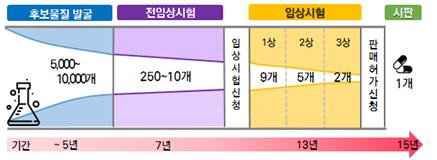
Traditionally, large-scale laboratories invested many personnel and equipment to conduct experiments on thousands to tens of thousands of drug candidates one by one to select a few candidate substances, requiring tremendous resources. On average, it took 15 years and over 1 trillion won to bring one drug to market, with a success rate of about 0.01%, making it a very high-risk, high-reward industry. Globally, the high entry barriers meant that large capital-holding global pharmaceutical companies dominated. However, with recent ICT advancements, techniques such as AI model development using ultra-high-performance supercomputers and big data analysis have dramatically reduced the time and cost of new drug development and increased success rates, ushering in the so-called New Drug Development 2.0 era.
In fact, various AI new drug development specialized companies have already emerged. For example, the U.S. company In Silico Medicine recently used its self-developed AI model (GENTRL) to discover a candidate substance for fibrosarcoma treatment in just 46 days with only $150,000, a task that typically takes 4-5 years and millions of dollars. AtomWise analyzed 7,000 drug repurposing candidates in 24 hours and succeeded in discovering a candidate substance for Ebola treatment. The UK company Benevolent obtained FDA approval last July by predicting and clinically verifying the COVID-19 treatment effect of the rheumatoid arthritis drug 'Baricitinib.' The AI-utilized new drug development market is rapidly growing. According to the Ministry of Science and ICT, it is expected to grow from $473.4 million in 2019 at an average annual rate of 28.63% to reach $3.5486 billion by 2027.
Governments worldwide are also investing strategically. Since 2017, the U.S. has been conducting the ATOM (Accelerating Therapeutics for Opportunities in Medicine) project. This AI development project for new drug (personalized cancer drug) development involves government-funded research institutes with world-class supercomputers and AI technology, the National Institutes of Health (NIH), pharmaceutical companies, and medical institutions. Japan operates the LINC (Life Intelligence Consortium) consortium, centered on the RIKEN Institute, involving academia, pharmaceutical companies, and IT firms in a Japan-style AI new drug development program. The European Union (EU) has formed the MELLODDY (Machine Learning Ledger Orchestration for Drug Discovery) consortium to develop an AI new drug development model training platform using blockchain for security freedom through public-private cooperation. Global IT companies such as Google, Amazon, and Microsoft (MS) have also started new drug development businesses, and collaborations between AI-utilizing new drug development specialized companies and global pharmaceutical companies are increasing.
◇ South Korea Builds Public Platform... Aims for Advancement and Achievements
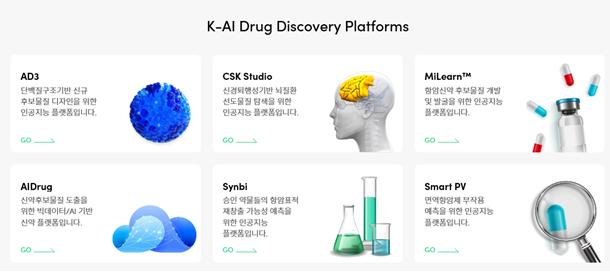
Since 2019, the government has been conducting the 'AI New Drug Development Platform Construction Project' and established the public platform 'KAIDD.' Six research projects in new drug candidate discovery, drug repurposing, and drug monitoring were selected to develop models applicable to neurodegenerative diseases and anticancer drugs, which were installed on KAIDD. Since December last year, it has been open and operated as a portal site for various industry, academia, and research researchers to freely utilize.
This year, the government will promote the 'AI Utilization Innovative New Drug Discovery Project' over five years to advance and expand the use of new drug development. By adding models for developing drugs for various diseases, the public platform will be advanced, and services targeting industry, academia, and research will be activated through improved data sharing and utilization environments. The goal is to achieve visible results by directly using the AI platform to develop new drug candidates at a level capable of IND (Investigational New Drug) application.
First, three new research projects will be selected and promoted this year and next year. This year, Professor Choi Seon of Ewha Womans University, CEO Ko Junsu of Arontier, and CEO Cho Sungjin of Simplex were selected as principal investigators. Professor Choi has already developed the big data and AI new drug development platform 'AIDrug,' which is installed and operated on KAIDD. Through this research project, a high-performance AI new drug development cloud platform equipped with a mix-based drug recommendation system, multimodal AI candidate substance design, liver toxicity prediction, and drug metabolism prediction functions will be provided in connection with the National Bio Data Station. CEO Ko operates the AI new drug development platform 'AD3,' centered on genome and protein target structures, installed on KAIDD. Additional services include target protein conformational change prediction, binding possibility prediction of substances to all human proteins, mutation structure prediction, and candidate substance exploration models. CEO Cho, a new principal investigator, plans to develop and advance the platform 'CEEK-KAIDD' for discovering lung cancer candidate substances.
Director Lee said, "Once the public platform is activated, AI-utilized new drug development will spread not only in the industry but also in schools and research sectors, accelerating domestic new drug development innovatively." He added, "In the future, we will link the public platform with related academic societies and educational programs and focus on activating safe data sharing to support the AI new drug development ecosystem."
© The Asia Business Daily(www.asiae.co.kr). All rights reserved.


















