Recruitment-Linked Semiconductor Department Sees Lower Early Admission Competition Than Last Year
Impact of Labor Surplus and Uncertain Outlook
Concerns Rise Despite Government's '150,000+α' Measures... "Structural Issues Must Be Addressed"
[Asia Economy Reporter Han Ye-ju] One of the biggest concerns in the domestic semiconductor industry is 'personnel.' With an estimated shortage of about 30,000 workers over the next 10 years, the government's declaration to train 150,000 semiconductor personnel is seen as a natural step. However, the competition rates for semiconductor departments linked to employment, which guarantee jobs at companies like Samsung Electronics and SK Hynix, are declining. Experts point out that the approach to nurturing semiconductor talent is flawed.
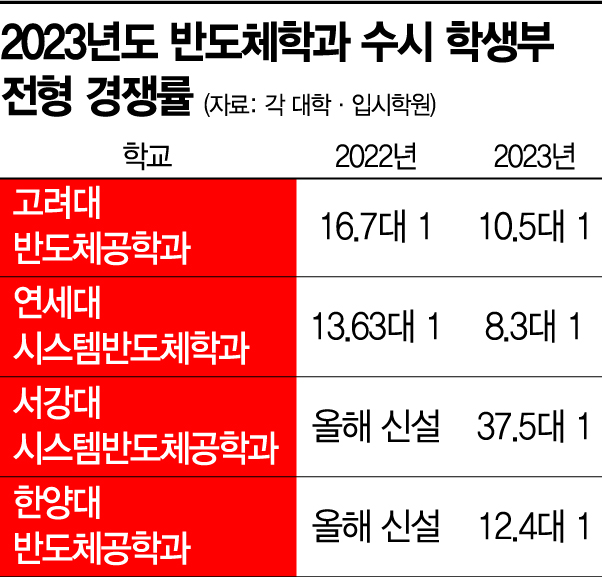
According to universities, entrance exam academies, and related industries on the 21st, the competition rate for the comprehensive student record screening at Korea University's Semiconductor Engineering Department, contracted with SK Hynix, dropped from 16.7:1 last year to 10.5:1 this year. The competition rate for Yonsei University's System Semiconductor Department, contracted with Samsung Electronics, also fell from 13.63:1 last year to 8.3:1 this year. Both departments maintained the same admission quotas as last year, but the number of applicants decreased this year.
Hanyang University's Semiconductor Engineering Department, which is recruiting freshmen for the first time this year, recorded a competition rate of only 12.4:1. On the other hand, Sogang University's System Semiconductor Engineering Department had a relatively high competition rate of 37.5:1 across all early admission types. Both schools have contract departments with SK Hynix, but Hanyang University's Semiconductor Engineering Department did not include an essay screening in the 2023 freshman recruitment, which is analyzed as the reason for the lower overall early admission competition rate.
The unexpected decline in competition rates for semiconductor departments can paradoxically be interpreted as a backlash against the government's semiconductor workforce development efforts. Analysts suggest that when the government announced plans to continuously increase semiconductor departments and quotas mainly at universities in the Seoul metropolitan area, concerns about workforce oversupply and uncertainty about the industry outlook influenced applicants' decisions.
Lee Man-gi, director of Uway Education Evaluation Research Institute, stated, "Government support measures have actually increased concerns about an oversupply of personnel in advanced industries such as semiconductors," adding, "The bleak outlook for the semiconductor industry reported daily likely discouraged top-tier students from applying."
Semiconductor departments or contract departments have a strong 'preemptive purchase' nature to secure personnel in advance. A semiconductor industry official explained, "There is no immediate shortage of personnel, but looking ahead 10 years, that scale of workforce will be necessary," and added, "Having graduates specialized only in semiconductors can also reduce personnel training costs."
However, experts criticize that increasing quotas at metropolitan universities and allowing non-majors to follow semiconductor-related tracks cannot solve structural problems. Professor Cho Joong-hwi of Incheon University's Department of Embedded Systems Engineering said, "It seems government ministries think differently from academia and industry about how to nurture talent," and pointed out, "To cultivate national talent, not only field-oriented and practical personnel but also basic science-focused foundational talents are needed, but our system is field-centered." He continued, "There is no such thing as a semiconductor (contract) department anywhere in the world," emphasizing, "For comprehensive semiconductor technology, it is necessary to combine the abilities of various majors from chemistry and physics to electronics, data, and mechanical engineering."
Concerns were also raised that students entering contract departments guaranteeing employment at some large companies might have limited motivation and potential for other research activities. Professor Ahn Jin-ho of Hanyang University's Department of Materials Science and Engineering said, "The idea of putting students into the narrow fence of contract departments and producing talent through a limited curriculum is fundamentally wrong," diagnosing, "In Korea, high-level engineers like those at Intel and Nvidia need to be nurtured, but the possibility of cultivating such talent in semiconductor contract departments is low." He advised that ultimately, universities should focus on nurturing high-level talents who research basic science rather than training engineers for immediate deployment in corporate fields.
© The Asia Business Daily(www.asiae.co.kr). All rights reserved.

















