Increase in Korean Corporate Value After US Inflation Reduction Act Implementation
Encouraging Investment and Attracting Local Factories
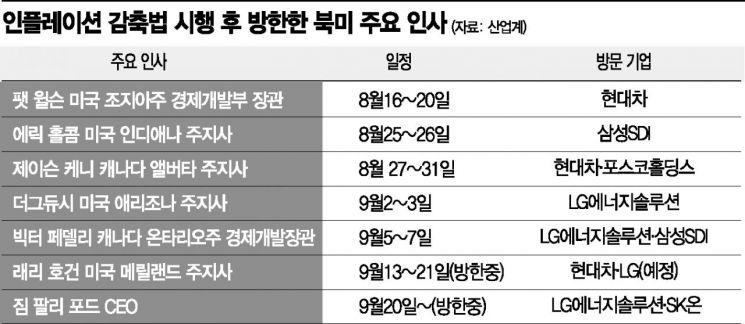
The stream of key political and business figures from North America visiting the Korean industrial sector continues. As the global supply chain dominance competition intensifies, state government officials aiming to attract factories locally through collaboration with Korean companies, as well as global CEOs seeking to overcome supply chain crises together, are boarding flights to Korea one after another.
According to the industry on the 21st, since the implementation of the U.S. Inflation Reduction Act (IRA) on the 16th of last month, a total of seven major North American figures have visited or are scheduled to meet with domestic companies in Korea.
Starting with Pat Wilson, Director of the Georgia Department of Economic Development, who visited Korea immediately after U.S. President Joe Biden signed the Inflation Reduction Act, the list includes Eric Holcomb, Governor of Indiana, Jason Kenney, Premier of Alberta, Canada, Doug Ducey, Governor of Arizona, Victor Fedeli, Minister of Economic Development for Ontario, Canada, Larry Hogan, Governor of Maryland, and Jim Farley, CEO of Ford. This is the number of visitors within just over a month since the IRA came into effect. Many Korean battery cell and material companies collaborate with U.S. automakers, and more than ten local factories have been built in North America alone, so the number of visitors to Korea is expected to increase further.
Although their reasons for visiting Korea vary slightly, they share a common goal of responding to the Inflation Reduction Act. In particular, efforts to encourage investment and attract local factories are most active. Both Eric Holcomb, Governor of Indiana, and Doug Ducey, Governor of Arizona, who visited Korea at the end of last month, are reported to have persuaded domestic battery companies to establish new factories.
Officials from Canadian provincial governments rich in minerals used in batteries have also rushed to Korea. Jason Kenney, Premier of Alberta, Canada, visited Korea from the 27th to the 31st of last month and reportedly met with Choi Jeong-woo, Chairman of POSCO Group. Premier Kenney explained the value of lithium brine deposits (lakes with inorganic salt content of 500 mg per liter or more) abundant in Alberta. Victor Fedeli, Minister of Economic Development for Ontario, Canada, visited LG Energy Solution and Samsung SDI consecutively to discuss factory attraction.
The significance of Korean battery and automaker companies in the electric vehicle market is exceptional enough to attract repeated visits from major North American figures.
According to SNE Research, excluding the Chinese market, the combined market share of the three Korean companies?LG Energy Solution, SK On, and Samsung SDI?in global electric vehicle battery usage from January to July this year was 55.6%. The scale of new factories to be operated by these three battery companies in the second half of this year is expected to exceed 63 GWh, which corresponds to batteries for approximately 880,000 electric vehicles. This year, LG Energy Solution’s Ohio plant and SK On’s Georgia plant will begin full-scale operations in North America. The three Korean companies have established close cooperative systems with all three major U.S. automakers (GM, Ford, Stellantis), and with Toyota and Volkswagen confirming plans to build battery factories in the U.S., there is a high possibility of additional cooperation with Korean battery companies.
Hyundai Motor Group ranked third globally in the first half of this year with sales of 3,299,000 units worldwide, following Japan’s Toyota Group (5,138,000 units) and Germany’s Volkswagen Group (4,006,000 units), and holds the second position in electric vehicle market share in the U.S., following Tesla.
© The Asia Business Daily(www.asiae.co.kr). All rights reserved.
![Clutching a Stolen Dior Bag, Saying "I Hate Being Poor but Real"... The Grotesque Con of a "Human Knockoff" [Slate]](https://cwcontent.asiae.co.kr/asiaresize/183/2026021902243444107_1771435474.jpg)
















