Analysis of Kim Hoe-jae, Democratic Party Lawmaker
[Asia Economy Sejong=Reporter Dongwoo Lee] An analysis has emerged that Korea Electric Power Corporation (KEPCO) needs to raise electricity rates by an average of more than 80,000 KRW per household this year to resolve its record-breaking deficit.
According to data submitted by KEPCO to Kim Hoe-jae, a member of the National Assembly’s Industry, Trade, Energy, Small and Medium Enterprises Committee from the Democratic Party of Korea, KEPCO reported that an increase of about 261 KRW per kWh (kilowatt-hour) in electricity rates is necessary next month to eliminate this year’s deficit. Typically, a 261 KRW increase per kWh means that a four-person household using the average monthly electricity consumption (307 kWh) would face an increase in costs of more than 80,000 KRW. This figure is calculated based on the assumption of a 35.4 trillion KRW deficit forecasted in a report by Hana Securities.
According to financial information provider FnGuide, the average annual operating loss forecast for KEPCO by securities firms is 28.8423 trillion KRW. Among the 10 securities firms with performance forecasts, Meritz Securities estimates the lowest loss at 25.4629 trillion KRW, while Hana Securities estimates the highest at 35.4309 trillion KRW.
The wholesale electricity price (SMP, System Marginal Price) applied when KEPCO purchases power from power generation companies recorded 227.48 KRW per kWh on the mainland from the 1st to the 20th of this month. This far exceeds the record high monthly average of 201.58 KRW recorded in April of this year. In contrast, the electricity selling price averages between 100 and 110 KRW, meaning KEPCO’s deficit grows the more electricity it sells.
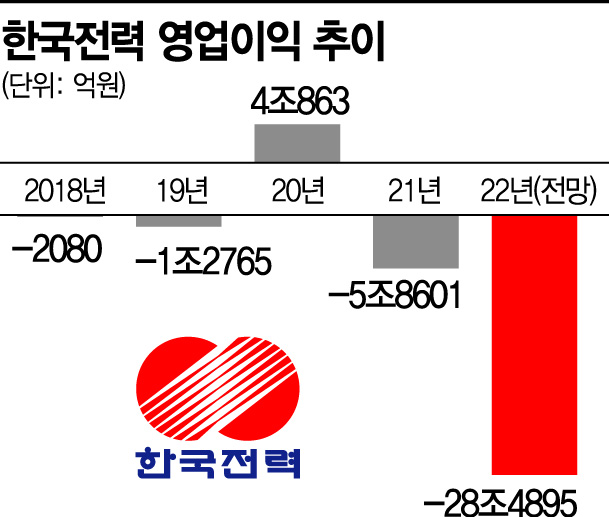
The problem is that KEPCO cannot raise electricity rates by more than 260 KRW per kWh even if the deficit continues. Typically, electricity rates consist of a basic charge, electricity consumption charge (based on standard fuel costs), climate environment charge, and fuel cost adjustment charge. The fuel cost adjustment charge can be adjusted quarterly, and the government is currently discussing the scope of the adjustment increase.
To break even in the fourth quarter, KEPCO needs to raise the fuel cost adjustment unit price by 50 KRW per kWh, but the current adjustment range is limited to ±5 KRW, so options such as expanding the upper and lower limits through legal amendments are being considered. However, with ongoing inflation, the government finds it difficult to implement electricity rate hikes easily. Last month, the consumer price inflation rates for electricity and city gas were 18.2% and 18.4%, respectively, more than three times the overall average of 5.7%.
Assemblyman Kim Hoe-jae said, "Increases in public utility rates such as electricity and gas should be minimized until price stability is achieved, and the crisis should be overcome by significantly expanding support for vulnerable groups."
© The Asia Business Daily(www.asiae.co.kr). All rights reserved.
![User Who Sold Erroneously Deposited Bitcoins to Repay Debt and Fund Entertainment... What Did the Supreme Court Decide in 2021? [Legal Issue Check]](https://cwcontent.asiae.co.kr/asiaresize/183/2026020910431234020_1770601391.png)

















