In the Power Imbalance Between Telecom Operators and Content Providers,
Legislation Aims to Resolve Market Failures
Opponents: "Global Communication Will Become Difficult"
Supporters: "Only Some CPs Disrupting Market Order Will Be Regulated"
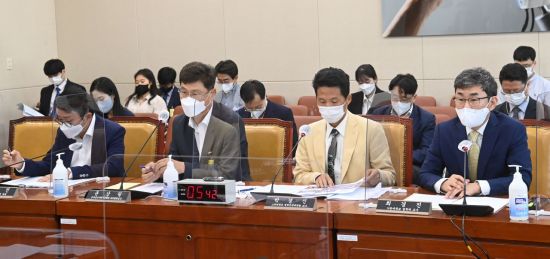 On the morning of the 20th, Professor Choi Kyung-jin of Gachon University’s Department of Law is speaking at a public hearing held by the National Assembly’s Science, Technology, Information and Broadcasting and Communications Committee to review the amendment to the Telecommunications Business Act related to the payment of information and communication network usage fees.
From the right: Professor Choi, Professor Park Kyung-shin of Korea University Law School, Yoon Sang-pil, Director of External Cooperation at the Korea Telecommunications Operators Association, and Choi Sung-jin, CEO of Korea Startup Forum.
[Image source=Yonhap News]
Photo by Yonhap News
[Asia Economy Reporter Minyoung Cha] A public hearing on the so-called "Network Free-Riding Prevention Act," an amendment to the Telecommunications Business Act aimed at preventing free-riding by big tech companies such as Google and Netflix, was held at the National Assembly on the 20th. Amid the global agenda of sharing network investment costs amid the power imbalance between telecommunications operators and content providers (CPs), the hearing aimed to explore the possibility of resolving the issue through legislation. On the other hand, CP representatives argue that the bill is a "telecom company enrichment scheme" that will hinder domestic CPs and damage the connectivity of the internet world.
Science, ICT, Broadcasting and Communications Committee Democratic Party Members Hold Legislative Hearing
On the 20th, members of the Democratic Party belonging to the National Assembly’s Science, Technology, Information and Broadcasting and Communications Committee held a public hearing during the morning plenary session to discuss the necessity of the Network Free-Riding Prevention Act. Park Sung-joong, the senior member of the People Power Party, stated, "Due to a lack of bipartisan agreement, preparations were insufficient," and expressed willingness to attend if another hearing is held in the future.
The Network Free-Riding Prevention Act collectively refers to seven similar amendments to the Telecommunications Business Act, including a bill that mandates network usage contracts for value-added telecommunications service providers above a certain scale. In the first half of the year, the committee’s bill review subcommittee deferred the bill’s approval, concluding that additional discussions such as public hearings were necessary due to the bill’s significance and complexity. Amid repeated disruptions caused by partisan conflicts in the committee, the hearing was held after five months in a "half-hearted" manner.
Panelists representing Internet Service Providers (ISPs) included Yoon Sang-pil, Director of External Cooperation at the Korea Telecommunications Operators Association, and Professor Choi Kyung-jin of Gachon University. Representing CPs such as Netflix were Professor Park Kyung-shin of Korea University and Choi Sung-jin, CEO of the Korea Startup Forum.
Opponents: "Global Communication Will Become Difficult... Digital Isolation"
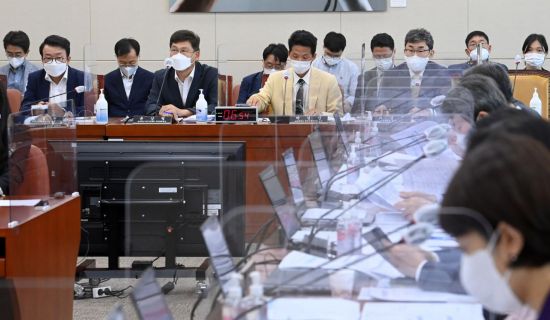 On the morning of the 20th, Professor Choi Kyung-jin of Gachon University’s Department of Law is speaking at a public hearing held by the National Assembly’s Science, Technology, Information and Broadcasting and Communications Committee to review the amendment to the Telecommunications Business Act related to the payment of information and communication network usage fees.
From the right: Professor Choi, Professor Park Kyung-shin of Korea University Law School, Yoon Sang-pil, Director of External Cooperation at the Korea Telecommunications Operators Association, and Choi Sung-jin, CEO of Korea Startup Forum.
[Image source=Yonhap News]
Photo by Yonhap News
Professor Park Kyung-shin, a CP-side witness at the hearing, argued that due to the nature of the internet as a product, only internet access fees should be charged. He warned that if telecommunications operators separately charge CPs for network usage fees, it would lead to difficulties in global communication and undermine the spirit of mutual cooperation. In particular, charging more fees where CP traffic is higher is akin to "asking a successful business for additional money."
Professor Park stated, "The internet is a product that allows anyone worldwide to communicate, and if transmission fees like those for telephone calls are exchanged, the system will collapse. Just as light reflecting off a mirror does not incur costs, signals passing through optical cables do not cost money, so ISPs should only charge CPs internet access fees proportional to access capacity."
He added, "Although the network usage fee bill is framed with the euphemism of 'fair compensation,' it could cause various problems such as digital gentrification and digital isolation. I make this statement for activists and citizens who maintain platforms, send messages of peace, upload their content, and sustain their livelihoods."
Choi Sung-jin, CEO of the Korea Startup Forum, representing the startup industry, argued that a survey on the current status of domestic network usage fee contracts should be a "prerequisite" before the bill. He expressed concern that the bill, which increases telecom companies’ bargaining power amid a lack of transparency in contracts between telecom operators and CPs, could strangle startups. According to Choi, Naver pays over 70 billion KRW and the small-to-medium online video service (OTT) company Watcha pays over 7 billion KRW in network usage fees to telecom companies. Despite the huge traffic difference, the 10:1 ratio is excessively disadvantageous to Watcha.
Choi stated, "Although telecom companies deny it, Korea pays higher network fees compared to overseas, and startups pay much more than mega CPs. A precise survey based on the public goods principle of network publicness beyond net neutrality is necessary."
Regarding the clause mandating network usage fees, he expressed concern that "forcing domestic telecom companies to sign access contracts only with domestic services could lead to similar situations when Korea provides global content in the future." While agreeing with the legislative intent regarding network quality management, he worried that the precedent might increase the burden only on domestic operators.
Supporters: "Regulate Only Some Mega CPs Abusing Market Power"
Conversely, Yoon Sang-pil, representing ISPs, argued for the necessity of the bill as a measure to prevent "market failure" caused by the power imbalance in negotiations between global CPs and ISPs. Since the bill regulates only some mega CPs abusing superior market power, concerns about startups and SMEs in Korea are excessive.
Yoon pointed out, "In the past decade, internet cost patterns have changed due to the surge in streaming services like OTT, with video and media accounting for 82% of wireless traffic. The top five companies, including Google, Meta, Naver, and Kakao, account for 41% of daily domestic traffic, causing expansion costs."
He added, "Google and Netflix, which occupy 33% of the total, are disrupting domestic transaction order. If free-riding is left unchecked, problems such as the 'tragedy of the commons' turning pastures into wastelands, internet ecosystem degradation, continued reverse discrimination against domestic CPs, and deterioration of telecommunications infrastructure competitiveness due to difficulties in network advancement will arise."
Professor Choi Kyung-jin specified that discussions about the internet should focus on "concrete and individual networks." For example, like real estate, the internet network itself can be either paid or free depending on the case, but the focus should be on individual network elements.
Professor Choi emphasized, "The internet belongs to no one and everyone, but specific networks as individual units must ultimately be built, operated, and managed by someone. Under the current Telecommunications Business Act, service providers can determine methods, prices, and content."
He added, "Personally, I support the principle of net neutrality, which means ISPs should treat all users equally. However, the issue we face is between ISPs and CPs, where a few CPs occupy excessive traffic, infringing on ISPs."
Meanwhile, at the National Assembly Members’ Office Building on the same day, Lee Sang-heon, a Democratic Party member of the Culture, Sports and Tourism Committee, held a "Discussion on K-Content Industry and Desirable Network Usage Policy Directions," showing a stance opposite to that of the Science and ICT Committee. This highlights the discord between the two committees. Lee pointed out that "the U.S. government views our network usage fee bill as effectively taxing U.S. companies to benefit domestic telecom companies," warning of potential damage to the content industry if the bill passes.
© The Asia Business Daily(www.asiae.co.kr). All rights reserved.


















