Supreme Court: "Introduce 'Conditional Release System' with Victim Access Prohibition to Replace Detention"
Sentencing Commission to Review Establishing Sentencing Guidelines for Stalking Crimes
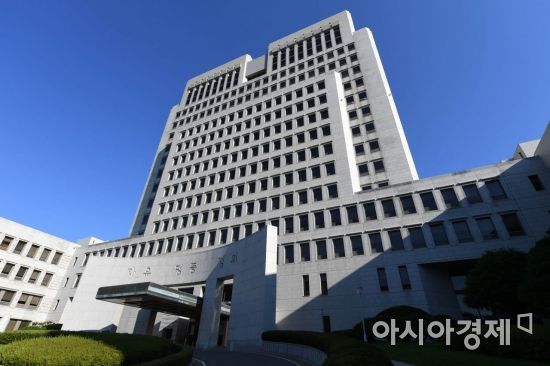
[Asia Economy Reporter Heo Kyung-jun] The Supreme Court stated that under the current detention system, the principle of presumption of innocence and victim protection do not harmonize, and therefore alternatives are needed, such as attaching electronic monitoring devices (electronic anklets) or issuing restraining orders against stalking crime suspects who are investigated without detention.
On the 20th, the Supreme Court explained, "The current system only allows a binary decision of detention or non-detention, which limits the ability to reach appropriate conclusions for each specific case," adding, "It is necessary to introduce a conditional release system at the warrant stage to replace detention under certain conditions, thereby harmonizing the principles of presumption of innocence and non-detention investigation with victim protection."
The conditional release system at the warrant stage is a system where a judge dismisses a detention warrant request but releases the suspect with certain conditions such as payment of bail, residence restrictions, third-party appearance guarantees, attachment of electronic devices, or prohibition of approaching the victim.
Currently, courts have established and operate the "Regulations on the Procedures for Handling Emergency and Provisional Measures under the Act on the Punishment of Stalking Crimes" in accordance with the enforcement of the Stalking Punishment Act.
Additionally, the Criminal Justice Research Group, organized and active within the Court Administration Office, is conducting research and review on "Practical Issues of the Stalking Punishment Act," and the Court Administration Office is preparing reference materials (Stalking Punishment Act Q&A) for frontline court practitioners regarding post-approval of emergency measures and provisional procedures under the Stalking Punishment Act.
Furthermore, the Supreme Court Sentencing Commission will also deliberate on whether to establish sentencing guidelines for stalking crimes.
A Supreme Court official stated, "The courts will actively participate in discussions related to amendments to the Stalking Punishment Act, such as the abolition of the non-prosecution upon victim's withdrawal for stalking crimes, and will devote special attention and efforts to prevent further unfortunate incidents."
Jeon Ju-hwan (31, detained), who killed a station worker at Sindang Station of the Seoul subway, was subject to a detention warrant request last October for illegally filming the victim, but the court dismissed the warrant. He later killed the victim, which has sparked public criticism toward the court.
© The Asia Business Daily(www.asiae.co.kr). All rights reserved.

















