Over 300 Calls and Messages Left
Significant Increase in Stalking Cases Reported to Police and Prosecutors
Probation Officer Shortage Limits Response
Practical Measures Needed to Strengthen Effectiveness
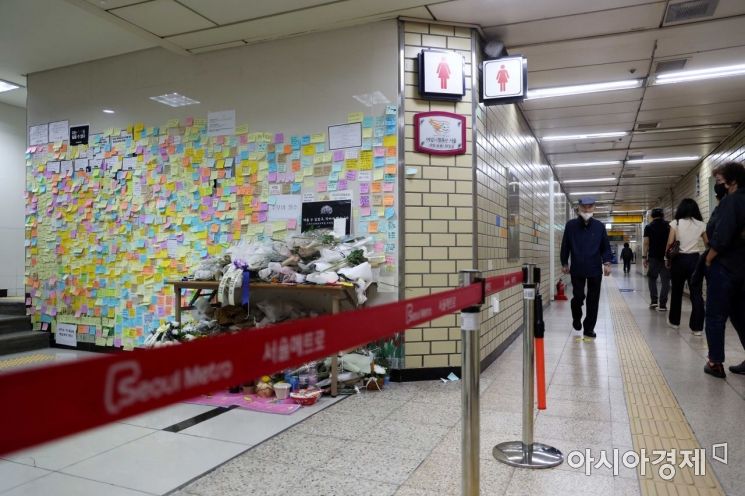 A memorial procession of citizens continues on the 19th at the women's restroom of Sindang Station on Seoul Subway Line 2, where a 20-year-old station attendant was murdered after stalking. Photo by Moon Honam munonam@
[Asia Economy Intern Reporter Kim Gun-chan] Although the Stalking Punishment Act was enacted last October, stalking crimes have actually increased significantly. The Ministry of Justice added stalking crimes to the list of offenses subject to electronic anklet orders, but criticism has arisen that its effectiveness is low, highlighting the need for practical measures.
On the 19th, the personal information of Jeon Ju-hwan (31), who was arrested on charges of murdering a female subway staff member in her 20s in the women's restroom at Sindang Station on Seoul Subway Line 2, was made public. Jeon Ju-hwan was indicted on stalking charges and was on trial without detention when, on the night of the 14th, a day before the first trial verdict, he followed the victim patrolling the women's restroom and killed her with a weapon (charged with retaliatory murder under the Act on the Aggravated Punishment of Specific Crimes).
This Sindang Station staff murder case was revealed to be a stalking-related murder. According to the victim's lawyer, Jeon had stalked the victim for about three years. After joining Seoul Metro in 2018, he began stalking her from November of the following year, reportedly leaving over 300 calls and messages demanding meetings.
Eventually, the victim filed a complaint against Jeon for intimidation last October, and the police applied for an arrest warrant, but the court dismissed it, stating "he has a fixed residence and there is no risk of flight." Despite this, Jeon's stalking did not stop, and the victim had to file another complaint in January this year.
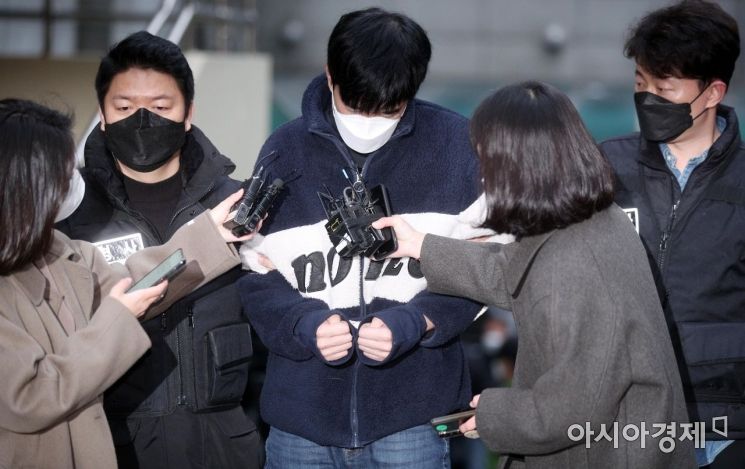 Kim Byung-chan, who is accused of murdering a woman in her 30s who had received personal protection after repeatedly reporting stalking, is heading to a transport vehicle at Seoul Namdaemun Police Station on November 29 last year.
There have been many cases where stalking escalated into violent crimes. For example, Kim Tae-hyun (25), who disguised himself as a delivery driver to break into a home and killed three family members including the victim in March last year, and Kim Byung-chan (36), who killed his ex-girlfriend under protective custody after holding a grudge over stalking reports in November last year, are examples of stalking cases leading to violent crimes.
Even after the Stalking Punishment Act (Act on the Punishment of Stalking Crimes) was enforced last October to strengthen penalties for stalking behavior, stalking crimes have increased significantly. According to the Supreme Prosecutors' Office, the number of stalking cases reported to prosecutors has increased more than fourfold monthly since the law's enforcement. In the fourth quarter of last year, an average of 136 stalking cases per month were reported to prosecutors. However, in the first quarter of this year, the monthly average rose to 486 cases, and in the second quarter to 649 cases, showing an increasing trend. The average monthly number of cases in the second quarter is 4.7 times that of the fourth quarter of last year.
Reports of stalking to the police have also increased. They have more than tripled in one year. According to data submitted by Lee Hyung-seok, a member of the National Assembly's Public Administration and Security Committee from the Democratic Party of Korea, the number of 112 emergency calls related to stalking was 4,515 in 2020 but surged to 14,509 in 2021. This year, as of July, the number of reported cases reached 16,571, already surpassing the total number of reports received last year.
In response to the increase in stalking crimes, the Ministry of Justice announced a legislative amendment on the 17th of last month to add stalking crimes to the list of offenses subject to electronic anklet orders. At that time, Minister of Justice Han Dong-hoon stated, "Stalking is the crime that most requires electronic monitoring," and "The amendment will provide a practical opportunity for the state to protect victims from stalking crimes."
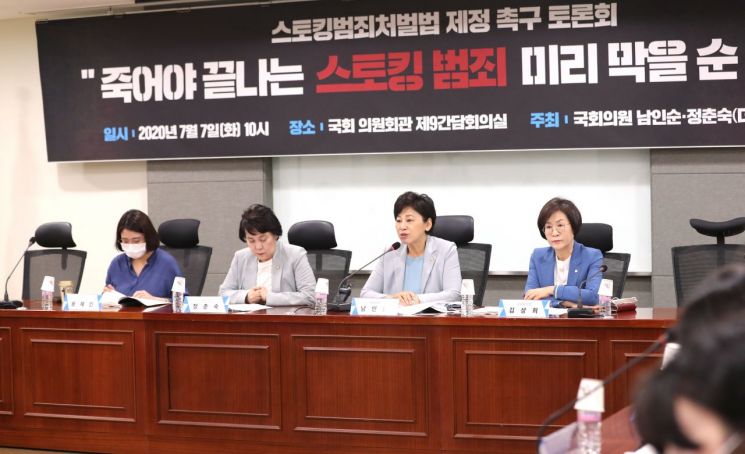 A discussion urging the enactment of the Stalking Crime Punishment Act was held in July 2020 at the National Assembly Members' Office Building in Yeouido, Seoul, hosted by Democratic Party lawmakers Nam In-soon and Jeong Chun-sook.
 [Image source=Yonhap News]
Under current law, crimes subject to electronic anklet orders include murder, sexual violence, robbery, and abduction of minors. The plan is to expand this scope to include stalking crimes. Once the amendment is implemented, stalking offenders sentenced to imprisonment will be subject to electronic anklet orders for up to 10 years after release, and those given suspended sentences may be ordered to wear anklets for up to 5 years within the court's discretion.
According to the Ministry of Justice, the recidivism rate for sexual violence offenders dropped significantly from 14.1% before the implementation of electronic anklets to 2.1% after. For murder offenders, it plummeted from 4.9% to 0.1%. This is why there are claims that attaching electronic anklets to stalking offenders would be effective.
However, some argue that the effectiveness in preventing stalking crimes may be low due to a shortage of probation officers responsible for electronic monitoring. As of June, there were 4,538 individuals under electronic anklet supervision in South Korea, but only 338 probation officers (as of 2021). One probation officer supervises 18 individuals, which is twice the ratio of major OECD countries.
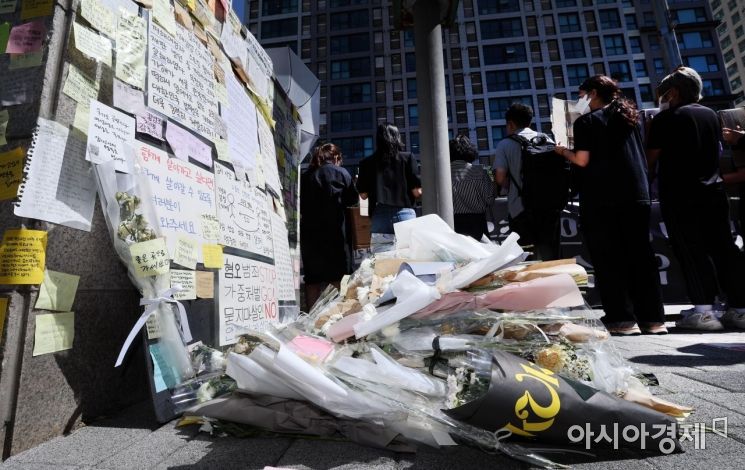 At an urgent press conference held on the 19th in front of Exit 10 of Sindang Station, Jung-gu, Seoul, youth and students demanded stronger punishment for stalking crimes and enhanced protection for victims in response to the murder of a female worker due to stalking. Photo by Kim Hyun-min kimhyun81@
Experts say practical measures are needed to strengthen effectiveness. Attorney Son Jeong-hye said on the 16th on Yonhap News TV's 'Issue+' program, "The sentencing for stalking crimes is less than 3 years, which is lower than the 7 years or less for illegal filming crimes," emphasizing, "A provision to impose aggravated punishment for stalking crimes should be created so that courts will more readily issue arrest warrants."
Professor Lee Soo-jeong of the Department of Criminal Psychology at Kyonggi University argued on the 19th on KBS Radio's 'Joo Jin-woo Live' that changes to the victim protection system are necessary. Professor Lee said, "(Current) protection is based on the idea that managing female victims well is sufficient," and added, "The protection method needs to shift from victim management to offender monitoring."
© The Asia Business Daily(www.asiae.co.kr). All rights reserved.



















