Global 3D Food Printing Market
Annual Growth Rate of 46.1%
Still in Early Stages Domestically
Major Changes in Food Culture Expected Upon Commercialization

[Asia Economy Reporter Song Seung-yoon] Food manufacturing technology using 3D printing is gaining global attention. If this technology is commercialized domestically in the future, it is expected to bring significant changes to food culture as it can be widely used not only in special foods or care foods but also in everyday life.
According to global market research firm BIS Research and others on the 20th, the global 3D food printing market reached $78.8 million in 2018. The 3D food printing market is estimated to grow at an average annual rate of 46.1% from 2019 and reach $525.6 million by 2023.
3D food printing is a concept that combines advanced 3D printing technology with food manufacturing, enabling the production of food using a 3D printer. It belongs to the so-called ‘food tech’ that combines food and technology.
When food is produced with a 3D printer, the texture and appearance can be finely adjusted, so the scope of application is wider compared to other fields, and the industry analyzes that research and development and industrialization can be applied quickly. Originally, it was used only for making decorative ingredients for desserts such as cakes and bread, but as the technology has advanced, it is now possible to produce a complete product.
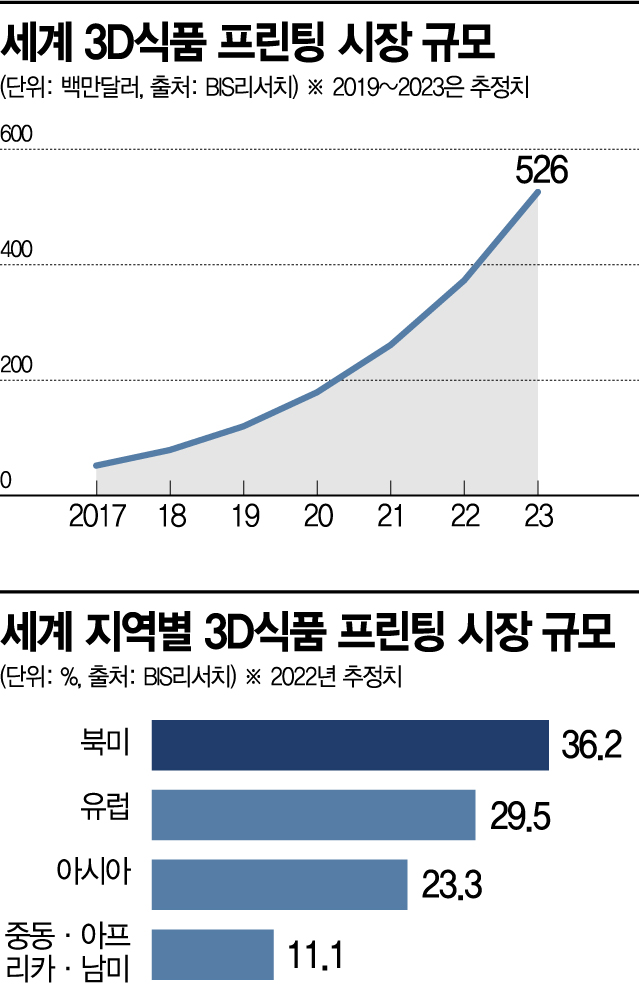
Countries around the world are also moving quickly. In the North American market, the market is rapidly expanding with revisions to food safety regulations for accepting 3D printed food and increasing demand for customized foods in bakeries and restaurants. The global fast-food chain KFC has collaborated with a Russian 3D biotechnology printing solutions institute to develop 3D printing technology for chicken production. Research and development are underway to replicate the taste and texture of real chicken by repeatedly using chicken cells.
Spain’s food machinery manufacturer ‘Natural Machines’ developed a 3D food printer called Foodini, and local restaurants have actually sold food made using it. In the United States, 3D printing company 3D Systems introduced 3D food printers called ‘ChefJet’ and ‘ChefJet Pro’.
Domestically, 3D food printing technology remains in its early stages. Due to restrictions on food production and sales through printers under the Food Sanitation Act, most products are for research purposes. Recently, a small and medium-sized company, TopTable, succeeded in developing a research-use 3D food printing device called ‘Foodian Pro’ and launched the product.
An industry official said, "If 3D food printing technology is commercialized in Korea, it will be highly utilized in everyday life like microwaves or ovens," and added, "Especially, due to the nature of the 3D printer’s process, food can be made without heat, so it can be used in special environments, and it will be possible to provide environment-customized meals by accurately measuring individual elements such as adding functional components or removing specific substances."
© The Asia Business Daily(www.asiae.co.kr). All rights reserved.


















