Union Notifies "Strike Action if Negotiations Fail"
Steel Production Disrupted... Industry Supply Emergency
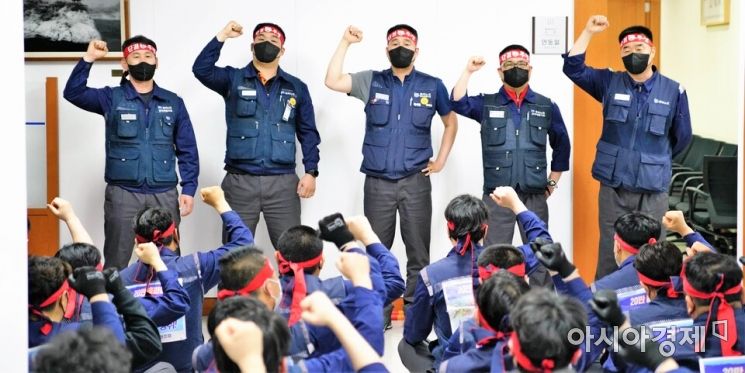 The Hyundai Steel labor union occupying the president's office within the Dangjin Steelworks (Photo by Hyundai Steel)
[Asia Economy Reporter Oh Hyung-gil] Hyundai Steel has entered the final countdown to a strike due to a breakdown in labor-management negotiations. With POSCO Pohang Steelworks unable to operate normally until the end of the year due to typhoon damage, concerns are rising that if Hyundai Steel also goes on strike, it will trigger alarm bells not only in the steel industry but across the entire industrial sector.
According to industry sources on the 20th, the four branches of the Hyundai Steel division of the Korean Metal Workers' Union (Dangjin, Incheon, Pohang, Dangjin Hysco) have sent a "final ultimatum" to management stating that if they do not attend the negotiation meeting scheduled for the 22nd, they will initiate dispute actions.
Hyundai Steel labor and management have been conducting wage collective bargaining since March. During this process, since May 2nd, union members have been occupying the president's office at the Dangjin Steelworks without permission, staging a sit-in. On May 3rd, union members at the Incheon, Pohang, and Suncheon plants also occupied the plant managers' offices, continuing the standoff.
The union stated, "Since June, management has not responded to the negotiations held so far," and criticized, "Despite efforts by the Ministry of Employment and Labor officials to urge participation in negotiations and the union's continuous demands, management has ignored them."
The labor-management conflict at Hyundai Steel was triggered last year over special incentive payments within the group. While employees of other group affiliates such as Hyundai Motor received a special incentive of 4 million KRW based on last year's business performance, Hyundai Steel internally demanded the same incentive payment, arguing that last year's record-high performance was due to Hyundai Steel's sacrifice in suppressing cost increases, which benefited the affiliates.
However, management took a firm stance against further negotiations, claiming they had already raised the base salary by 75,000 KRW and paid performance bonuses (200% of base salary + 7.7 million KRW), leading to a clash. The conflict has persisted since the start of the wage and collective bargaining negotiations.
Subsequently, in July, the union conducted a strike authorization vote among its members, receiving overwhelming support with 94.18% in favor. They secured the right to strike after obtaining a decision to suspend mediation from the Central Labor Relations Commission of the Ministry of Employment and Labor.
A union official warned, "Management should present a final proposal as they have had sufficient time to review the union's demands, not only to participate in negotiations," adding, "Without management's decision, the strike will not stop."
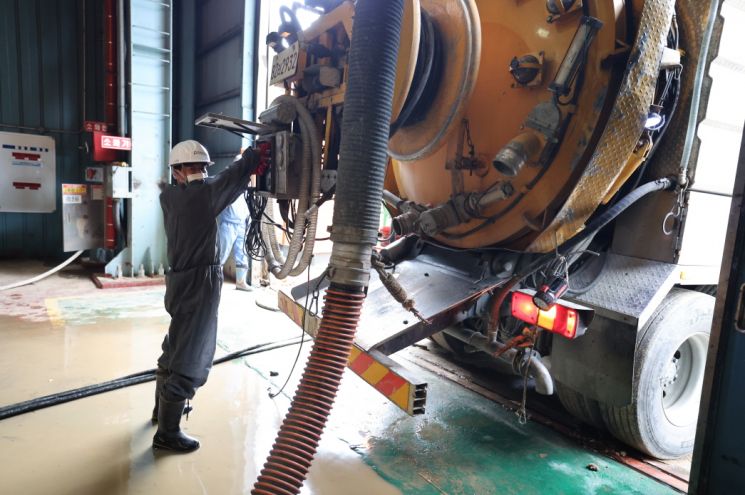
If Hyundai Steel goes on strike due to the breakdown of labor-management negotiations, significant disruptions to domestic steel production are inevitable.
POSCO Pohang Steelworks, currently undergoing typhoon damage recovery work, is expected to find it difficult to operate normally until the end of the year. Although three blast furnaces were operating normally as of the 13th, downstream processes such as rolling have yet to be fully restored.
POSCO plans to restart the No. 1 Cold Rolling and No. 2 Electrical Steel Sheet plants by the end of this month, No. 1 Hot Rolling and No. 2 and 3 Heavy Plate plants in October, No. 1 and 4 Wire Rod and No. 2 Cold Rolling plants in November, and early December for the No. 3 Wire Rod, Stainless Steel No. 2 Cold Rolling, and No. 2 Hot Rolling plants.
With major steel product prices rising due to the aftermath of the POSCO typhoon damage, production disruptions caused by a strike are expected to further fuel price increases.
The distribution price of hot-rolled steel rose 10% month-on-month to 1.1 million KRW per ton last week. Although the distribution price of heavy plate remained unchanged from the previous month, import prices rose 16.7% during the same period to 1.05 million KRW. The distribution prices of STS hot-rolled steel and rebar increased by 5% and 1%, respectively, compared to the previous month.
© The Asia Business Daily(www.asiae.co.kr). All rights reserved.


















