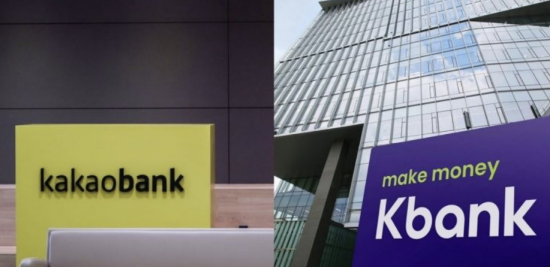
[Asia Economy Reporter Eunju Lee] This year, KakaoBank and K Bank have seen a significant decline in their non-interest income. The downturn in the virtual asset and stock markets has led to reduced earnings for internet-only banks. As the number of investors participating in the market decreased, account openings linked to these banks also declined, resulting in lower commission income.
According to the first half management disclosures of major banks on the 21st, KakaoBank's commission income dropped by 8.1 billion KRW, from 25.1 billion KRW in the same period last year to 17 billion KRW. K Bank recorded 8.4 billion KRW in commission income in the first half of last year, but this year it fell to 4 billion KRW, nearly halving. Toss Bank did not generate any commission income and recorded a commission deficit of 24.7 billion KRW in the first half of this year.
Commission income for internet banks mainly arises from services such as securities account openings and customer recruitment for affiliated credit cards. KakaoBank partners with Korea Investment & Securities, NH Investment & Securities, KB Securities, Hana Financial Investment, Shinhan Financial Investment, and Samsung Securities. K Bank collaborates with NH Investment & Securities, Mirae Asset, and Samsung Securities. Additionally, K Bank earns commission income by acting as an intermediary for Upbit’s real-name verified deposit and withdrawal accounts.
With the stock and virtual asset markets in a slump this year, investor sentiment has worsened, leading to a decrease in commission income for internet banks. The demand for easy account openings through internet bank platforms to participate in investments has declined compared to the previous year, naturally reducing commission income from these activities. Meanwhile, costs related to maintaining free ATM (deposit and withdrawal machine) usage for customers remained unchanged. This resulted in a sharp drop in commission income compared to the previous year.
KakaoBank explained that the increase in ATM fee burden for users was a contributing factor. A KakaoBank representative said, “Although commission income increased sufficiently, the growing number of customers led to a larger increase in ATM fee expenses,” adding, “This is a cost increase due to the influx of customers to internet banks.” K Bank attributed the decline to the downturn in the virtual asset market. A K Bank representative explained, “Virtual asset trading has not been active, and these factors have affected Upbit banking fees.”
Major commercial banks also experienced a decrease in commission income, though the decline was not as steep as that of internet banks. Woori Bank’s commission income fell from 473.9 billion KRW to 450 billion KRW, and Kookmin Bank’s dropped from 598 billion KRW to 549.1 billion KRW. Shinhan Bank, on the other hand, saw an increase in commission income, rising from 495.5 billion KRW to 503.5 billion KRW compared to the previous year. While non-interest income remains limited for commercial banks as well, they appear to have more diverse sources of commission income than internet banks.
Internet banks are also making modest efforts to diversify their commission income. They are increasing the number of affiliated securities accounts and exploring new revenue sources. KakaoBank added Mirae Asset Securities to its affiliated securities accounts this year and is seeking new commission income sources through a partnership agreement with the virtual asset exchange Coinone. K Bank is diversifying its non-interest income sources by adding partnerships with Danggeun Pay and Lotte Card. Toss Bank began offering issuance of promissory notes linked with Korea Investment & Securities starting in the second half of this year.
© The Asia Business Daily(www.asiae.co.kr). All rights reserved.
![Clutching a Stolen Dior Bag, Saying "I Hate Being Poor but Real"... The Grotesque Con of a "Human Knockoff" [Slate]](https://cwcontent.asiae.co.kr/asiaresize/183/2026021902243444107_1771435474.jpg)
















