UNIST and Ulsan National Institute Control Zero-Dimensional Voids and Atomic Interactions... Predict 'Dielectric Memory'
Technology to Control the Smallest Space Accessible to Humans, Applications in Digital Memory and Quantum Information Material
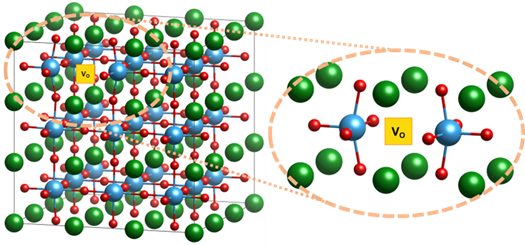 A research illustration showing the crystal structure deformation around a zero-dimensional vacancy created by an oxygen vacancy.
[Asia Economy Yeongnam Reporting Headquarters, Reporter Kim Yong-woo] Korean physicists have paved the way for the development of a completely new memory technology that does not rely on traditional semiconductor memory using binary resistance changes with only 0s and 1s, attracting global attention. This heralds the era of so-called ‘dielectric memory,’ which does not require the large amounts of energy and space typical of semiconductors.
A method to store information using ‘permittivity’ by controlling interactions of matter in ‘empty space’ has been developed for the first time in the world.
Permittivity is a physical quantity that indicates the degree of polarization caused by the influence of an electric field. It is a unique idea that controls the interaction between ‘0-dimensional void’?meaning empty space?and ‘matter’ to change permittivity into multiple states.
The research team led by Professor Oh Yoon-seok of the Department of Physics at Ulsan National Institute of Science and Technology (UNIST), in collaboration with Professor Kim Tae-heon’s team from the Department of Physics at the University of Ulsan, discovered that the interaction between the ‘0-dimensional void’ and ‘matter’ can change the magnitude of the material’s permittivity. They also found a new memory technology that controls permittivity into multiple distinct states by manipulating this interaction.
Even materials that do not conduct electricity have electric dipoles arranged inside them when placed in an electric field. Permittivity indicates how sensitively the material responds and is an intrinsic property of both the material and the space.
Professor Oh Yoon-seok explained, “Permittivity is a physical quantity that can be defined even in a vacuum where no material exists,” adding, “The reason starlight can travel through the near-vacuum of outer space to reach Earth can also be explained by permittivity.”
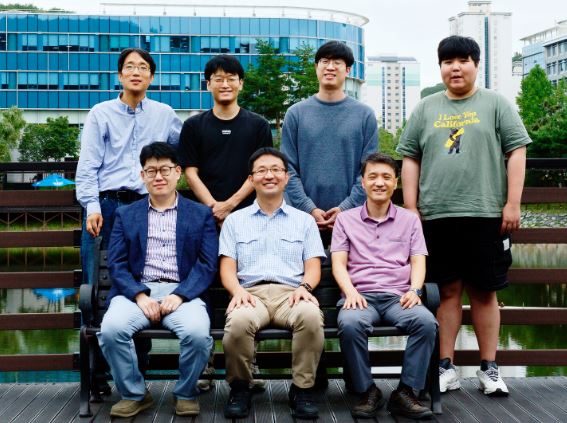 Professor Kim Taeheon of Ulsan University (first from the left in the front row) and Professor Oh Yunseok of UNIST (second) along with the research team posed in front of the camera.
The joint research team developed a new ferroelectric thin film to create the ‘0-dimensional void.’ Ferroelectrics are materials that possess spontaneous polarization even without an external electric field, and their polarization direction can be changed by an external electric field.
The new ferroelectric thin film was made by depositing a ‘barium titanate (BaTiO₃)’ thin film, developed by Professor Kim Tae-heon’s team, onto a newly developed wafer material called ‘barium zirconium oxide (BrZrO₃) single crystal’ created by Professor Oh Yoon-seok’s team. This thin film becomes a new ferroelectric with symmetry completely different from conventional barium titanate.
The lattice constant of the newly developed barium zirconium oxide by Professor Oh’s team is 4.189 ?, which is overwhelmingly larger than existing wafers.
Such an overwhelmingly large lattice constant creates a ‘0-dimensional void,’ or empty space, in the barium titanate thin film. The interaction between this 0-dimensional void and the surrounding atoms changes the permittivity magnitude of the thin film material.
The researchers focused on the advantages of using this variable permittivity for memory information. Compared to semiconductor memory that uses resistance, this allows for memory devices with higher energy efficiency and no heat generation.
Moreover, by utilizing the interaction between the 0-dimensional void and surrounding atoms, it is possible to implement ‘multinary memory’ with various combinations beyond the binary memory that uses only 1s and 0s. Furthermore, the quantum spins formed only around the 0-dimensional void can also be used for quantum information.
Professor Oh emphasized, “Thanks to the material technology we directly developed in this study, we were able to control and systematically regulate the influence of the 0-dimensional void on the polarization of surrounding atoms, enabling the realization of new permittivity memory materials. Utilizing this, it is possible to develop memory materials or devices that are completely different from traditional semiconductor materials.”
The results of this research were published on September 7 in ‘Advanced Materials,’ one of the world’s top two journals in the field of condensed matter physics.
© The Asia Business Daily(www.asiae.co.kr). All rights reserved.













