China Leads World in Industrial Robot Shipments
Declining Workforce and Rising Wages
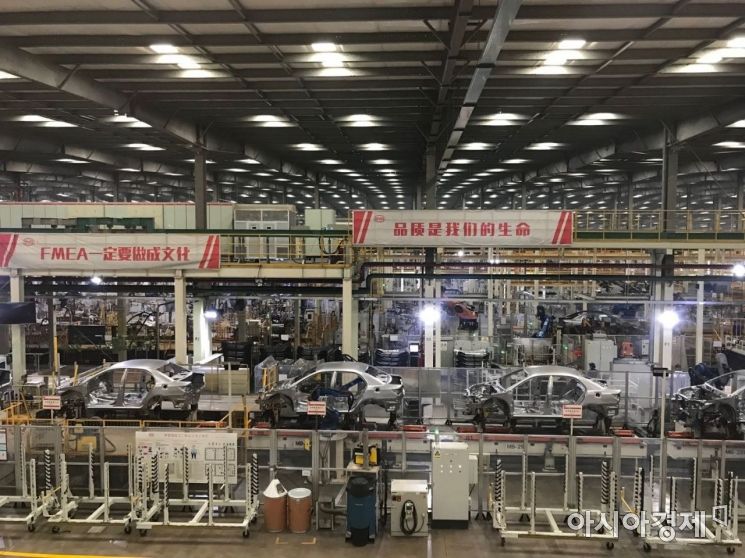
[Asia Economy Reporter Lee Ji-eun] Facing a decline in the labor force due to low birth rates, China is rapidly increasing the production of industrial robots. As it becomes increasingly difficult to rely solely on cheap labor, the country is accelerating the automation transition in manufacturing.
According to data from the International Federation of Robotics analyzed by the Wall Street Journal (WSJ) on the 18th (local time), the shipment volume of industrial robots to China last year reached 243,000 units, a 45% increase compared to the previous year. This accounts for half of the global industrial robot shipments. Despite being the world's second-largest economy, China had lagged behind manufacturing powerhouses like South Korea and Japan in terms of robot penetration in factories. WSJ reported, "China has installed twice as many robots as factories across the US and Europe," adding that "it is solidifying its position as the number one market for industrial robots."
The reason China is focusing on industrial robot production is that manufacturing, which had relied on cheap labor, is facing growth limits due to rising wages and a shrinking labor force. The United Nations (UN) has predicted that "India is expected to surpass China as the most populous country in the world as early as next year," and that "China's population aged 20 to 64, the core labor force, has already peaked." Furthermore, it forecasts that after 2030, China's population will sharply decline due to aging and falling birth rates.
In fact, as the labor force rapidly decreases, China's productivity growth is also showing signs of slowing. Last year, China's hourly output was only one-quarter of the average of the Group of Seven (G7) countries and one-fifth of the US output. Productivity, which grew at an average annual rate of 9% from 2000 to 2010, slowed to 7.4% annual growth from 2010 to 2020.
WSJ emphasized, "China can no longer sustain growth relying solely on labor," and stated, "Automation in manufacturing is the most certain way to increase productivity and is essential for China to move beyond the ranks of middle-income countries."
Currently, Chinese companies are introducing cutting-edge industrial robots to respond to the declining labor force and to improve the quality of precision work. 'Dobot,' a robot arm manufacturer based in Shenzhen, China, developed a robotic system for a Chinese company producing Apple's wireless earphones. While a team of general workers produces 650 units per hour, the robot arm manufactures 800 units.
US investment research firm Bernstein Research predicts that the number of industrial robots in China, currently at 1 million units, will increase to 4.2 million units by 2030.
Jay Huang, head of China research at Bernstein, said, "Production was disrupted as cities were locked down due to COVID-19," adding, "Chinese manufacturing companies realized through this experience that if they do not automate, they may not be able to produce products."
© The Asia Business Daily(www.asiae.co.kr). All rights reserved.

















