More than Double the IPO Price
Profit-Taking Volume Expected to Enter the Market
Positive Outlook Due to Increasing Demand for LNG Carriers
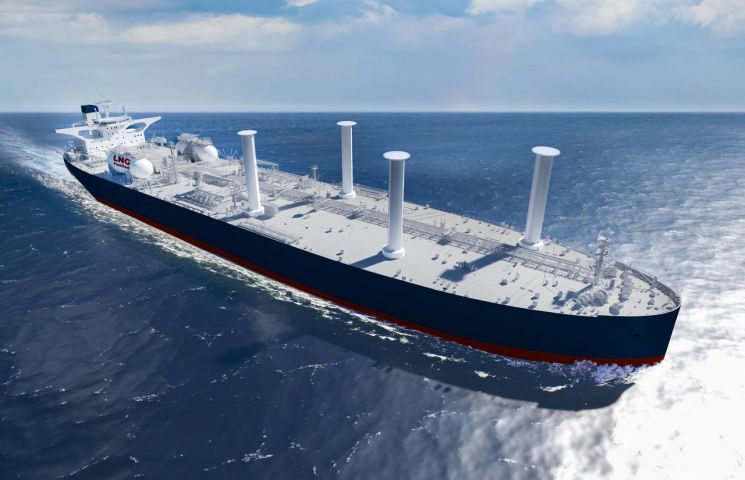
[Asia Economy Reporter Kwon Jae-hee] As the one-year lock-up period on the employee stock ownership association's shares of Hyundai Heavy Industries, which went public a year ago, has expired, investor interest is gathering. With the stock price having risen about twice the initial public offering (IPO) price, it is expected that shares will be released into the market for profit-taking, but the outlook for the shipbuilding industry remains bright. Can the rosy industry outlook overcome the pressure of the released shares?
As of 9:23 a.m. on the 19th, Hyundai Heavy Industries' stock price stood at 125,000 KRW, up 4.17% from the previous trading day. This price is more than double the IPO price of 60,000 KRW.
With the stock price rising significantly compared to the IPO price, it is anticipated that shares will be sold in the market for profit realization. Hyundai Heavy Industries, which was listed on the Korea Exchange on September 17 last year, has had the lock-up on the employee stock ownership association's shares lifted as of today, allowing the sale of shares held by the association. At the time of the IPO last year, Hyundai Heavy Industries allocated 3,491,997 shares to the employee stock ownership association, which corresponds to 3.93% of the total listed shares. Although this seems small relative to the total shares, when considering only the freely tradable shares excluding those held by Korea Shipbuilding & Offshore Engineering with restricted circulation, it accounts for 19.4%. While this is a considerable volume, the market has been absorbing it.
Compared to other companies that allocated employee stock ownership shares around the same time, Hyundai Heavy Industries' stock price is considered to have performed well. For example, KakaoBank, whose employee stock ownership lock-up was lifted on the 6th of last month, recorded a price of 32,300 KRW, about 17% lower than its IPO price of 39,000 KRW. Krafton also had its employee stock ownership lock-up lifted on the 10th of the same month, but its stock price halved compared to the IPO price. Amid poor earnings and a gloomy stock market due to the global economic downturn, Hyundai Heavy Industries is the only one smiling.
In particular, the shipbuilding industry has recently been leading the domestic stock market as part of the 'Taejo-Ibangwon (Solar Power, Shipbuilding, Secondary Batteries, Defense, Nuclear Power)' theme, showing an upward trend. Shipbuilding stocks are benefiting from increased demand for LNG carriers due to the energy supply shortage in Europe triggered by the Russia-Ukraine war. For investors who want to catch the last train on 'Taejo-Ibangwon' stocks, the expiration of Hyundai Heavy Industries' lock-up period is an opportunity. However, some believe that because the shipbuilding industry's outlook is bright and stock prices are expected to rise further, the employee stock ownership association's selling volume may not be as large as anticipated.
Lee Dong-heon, a researcher at Shinhan Financial Investment, said, "With increased revenue recognition volume and a decline in heavy plate prices, a return to profitability is expected from the third quarter of this year, and growth is guaranteed for at least three years based on existing orders." He added, "The supply capacity is inelastic, allowing growth regardless of economic conditions, which is also positive."
Lee Jae-kwang, a researcher at Mirae Asset Securities, also stated, "The trend of increasing the proportion of profitable shipbuilding continues and is expected to increase further in the second half of the year." He added, "In the short term, a return to profitability in the second half, and in the mid-to-long term, increased replacement demand due to strengthened environmental regulations and rising demand for LNG carriers lead us to recommend a 'buy' rating."
© The Asia Business Daily(www.asiae.co.kr). All rights reserved.

















