Lotte Group Joins 3 Trillion Won Iljin Materials Acquisition Battle
Steel-Focused POSCO Group Aggressively Expands Secondary Battery Material Production Facilities
KOLON Group Becomes Second Largest Shareholder of Anode Material Company and Establishes Dedicated Team
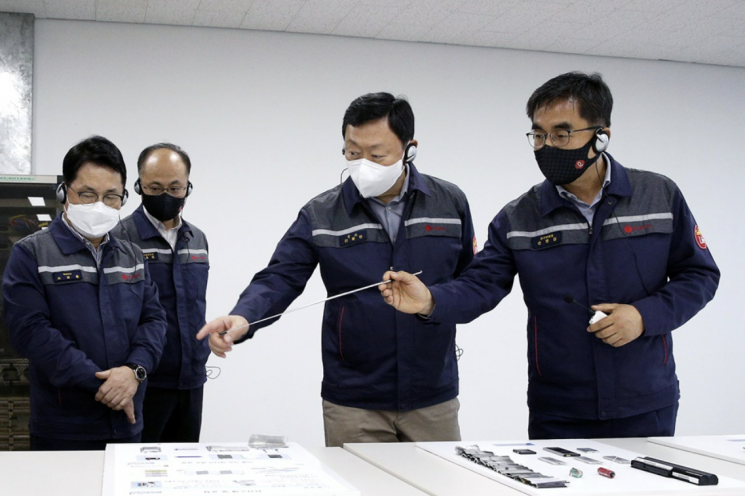 In May of last year, Shin Dong-bin, Chairman of Lotte Group (second from the right), visited Lotte Aluminum Ansan Plant 1, a subsidiary of Lotte Chemical, to receive an explanation about the secondary battery material process. Photo by Lotte Group
[Asia Economy Reporter Choi Seoyoon] Companies thirsty for new growth engines are aggressively expanding investments and mergers and acquisitions (M&A) surrounding secondary battery materials used in electric vehicles. As the electric vehicle market rapidly grows, they are moving beyond their existing core businesses to make secondary battery materials a key group business.
According to the industry on the 18th, Lotte Chemical, a chemical affiliate of Lotte Group, is reportedly the sole candidate negotiating to acquire Iljin Materials, the second-largest domestic producer of copper foil for secondary batteries, valued at 3 trillion won.
Lotte Chemical announced on the 22nd, "We have participated in the main bidding stage related to the acquisition of Iljin Materials," adding, "We will re-disclose specific details when they are decided or within one month."
Lotte is managing the secondary battery materials business at the group level. In June, Shin Dong-bin, Chairman of Lotte Group, personally visited the 'Lotte Cluster' established in the T?r?kb?lint industrial complex in Hungary and announced an additional investment of 110 billion won in the cathode foil business for secondary batteries. The Lotte Cluster is Lotte Group's first overseas battery materials business site.
Following that, last month, they announced plans to build their first cathode foil production base in the United States. To secure a leading position in the U.S. electric vehicle battery materials market, Lotte Chemical and Lotte Aluminum will invest 330 billion won to establish a joint venture, 'Lotte Aluminum Materials USA.' They plan to complete a cathode foil production plant in Kentucky with an annual production capacity of 36,000 tons by the first half of 2025.
POSCO Group is also focusing its group capabilities on secondary battery materials beyond steel after launching its holding company system for the first time in 54 years. In March, Choi Jeong-woo, Chairman of POSCO Group, designated secondary battery materials as one of the group's seven core businesses.
POSCO Group is the only company worldwide to secure the full value chain of secondary battery materials, from raw materials to core materials such as cathode and anode materials, and even recycling of used batteries. Park Jae-beom, Senior Researcher at POSCO Management Research Institute, stated, "The profit structure of the secondary battery value chain is an 'upstream (raw material mining and processing) high-profit' structure," adding, "Automakers are internalizing batteries, battery companies are internalizing cathode and anode materials, and companies across the value chain are focusing investments on securing key raw materials such as lithium and nickel."
Since batteries account for about 40% of the cost of electric vehicles, and cathode and anode materials make up about 55% of the battery cell cost, the upstream expansion of companies within each value chain is inevitable. In March, Chairman Choi visited Argentina and announced plans to invest 5 trillion won in expanding lithium plants, a key secondary battery material.
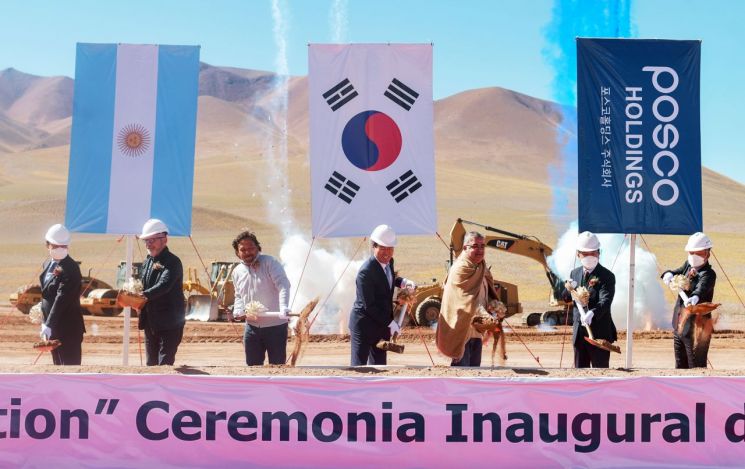 Choi Jung-woo, Chairman of POSCO Group (fourth from the left), is presiding over the groundbreaking ceremony for the first phase of the lithium brine project at Hombre Muerto Salt Lake in Argentina on March 23. Photo by POSCO Holdings
POSCO Chemical, responsible for secondary battery materials within the group, is aggressively expanding production capacity. In May this year, they agreed with General Motors (GM) to invest $327 million (about 450 billion won) to build a high-nickel cathode material joint plant with an annual capacity of 30,000 tons in Quebec, Canada, as the first phase. They also plan to invest 290 billion won to expand the cathode material production capacity at their Pohang plant to 60,000 tons annually. In March, they announced plans to invest 600 billion won to build a plant in Gwangyang capable of producing 100,000 tons annually of precursor, an intermediate raw material for cathode materials.
Kolon Group is also strengthening its secondary battery materials business. In July, Kolon Industries became the second-largest shareholder of Niva Corporation, which produces battery anode materials, by investing 10 billion won.
Earlier in May, they announced a five-year investment plan of 4 trillion won, pledging to pour 1.7 trillion won into advanced new materials businesses, including secondary battery materials. Earlier this year, they also established a CSO (Corporate Strategy Officer) organization to oversee future businesses such as next-generation secondary battery material development.
© The Asia Business Daily(www.asiae.co.kr). All rights reserved.
![Clutching a Stolen Dior Bag, Saying "I Hate Being Poor but Real"... The Grotesque Con of a "Human Knockoff" [Slate]](https://cwcontent.asiae.co.kr/asiaresize/183/2026021902243444107_1771435474.jpg)

















